Possessive Nouns Made Easy: 's and of

 Here we possessive nouns, focusing on using 's and of to show ownership and relationships. It covers common situations like people, things, and places, highlights frequent mistakes to avoid, and offers practice exercises for better understanding.
Mastering possessive forms might seem difficult at first, but the basic rules are quite simple. Using an apostrophe + s or the preposition of helps clearly show ownership. These forms make your writing more precise and easier to understand. With practice, using possessive nouns becomes natural, improving both clarity and style in your communication.
What Are Possessive Nouns?
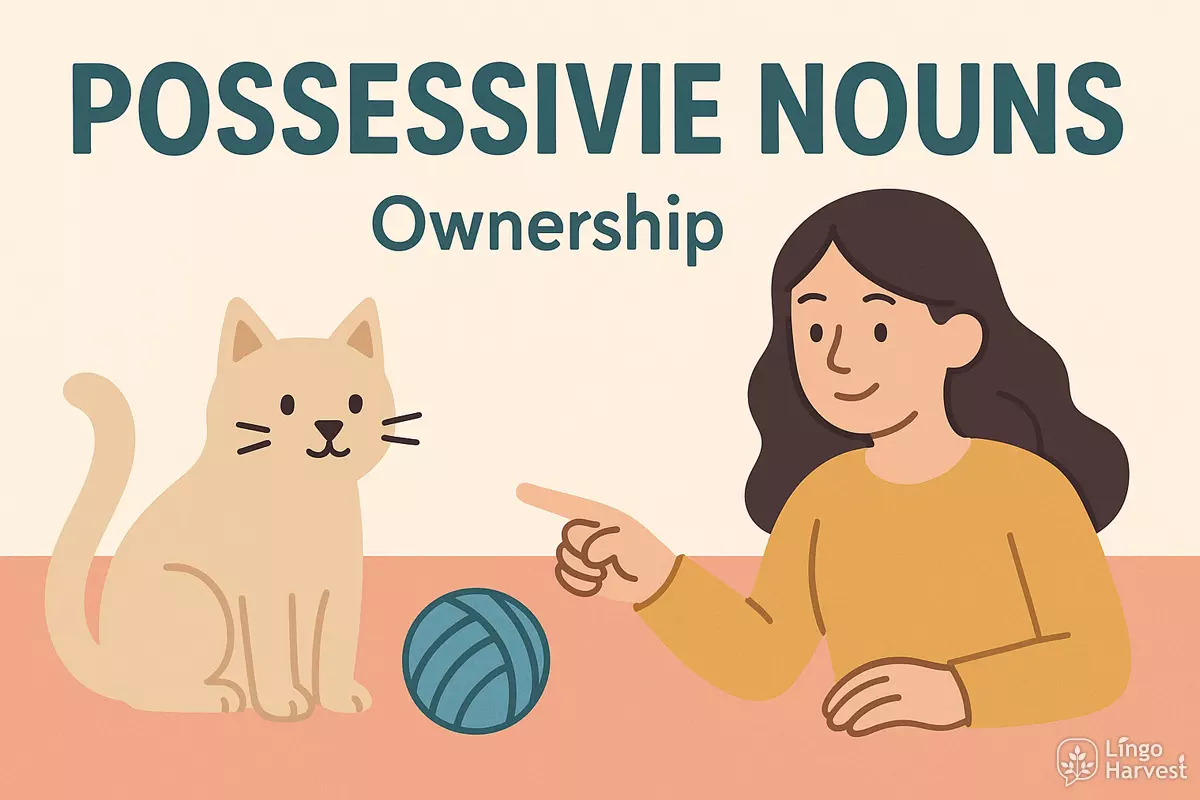
Possessive nouns show that something belongs to someone or something. They help clarify relationships between nouns. For example, in the cat’s toy, the word cat’s shows that the toy belongs to the cat. Learning to form possessive nouns correctly helps make your writing clearer and more effective.
Forms of Possessive Nouns
To show possession, we usually add an apostrophe and s. However, different forms apply depending on the noun:
- Singular nouns: add ’s (e.g., the dog’s bone).
- Plural nouns ending in -s: add only an apostrophe (e.g., the dogs’ park).
- Plural nouns not ending in -s: add ’s (e.g., the children’s books).
Using "of" for Possession
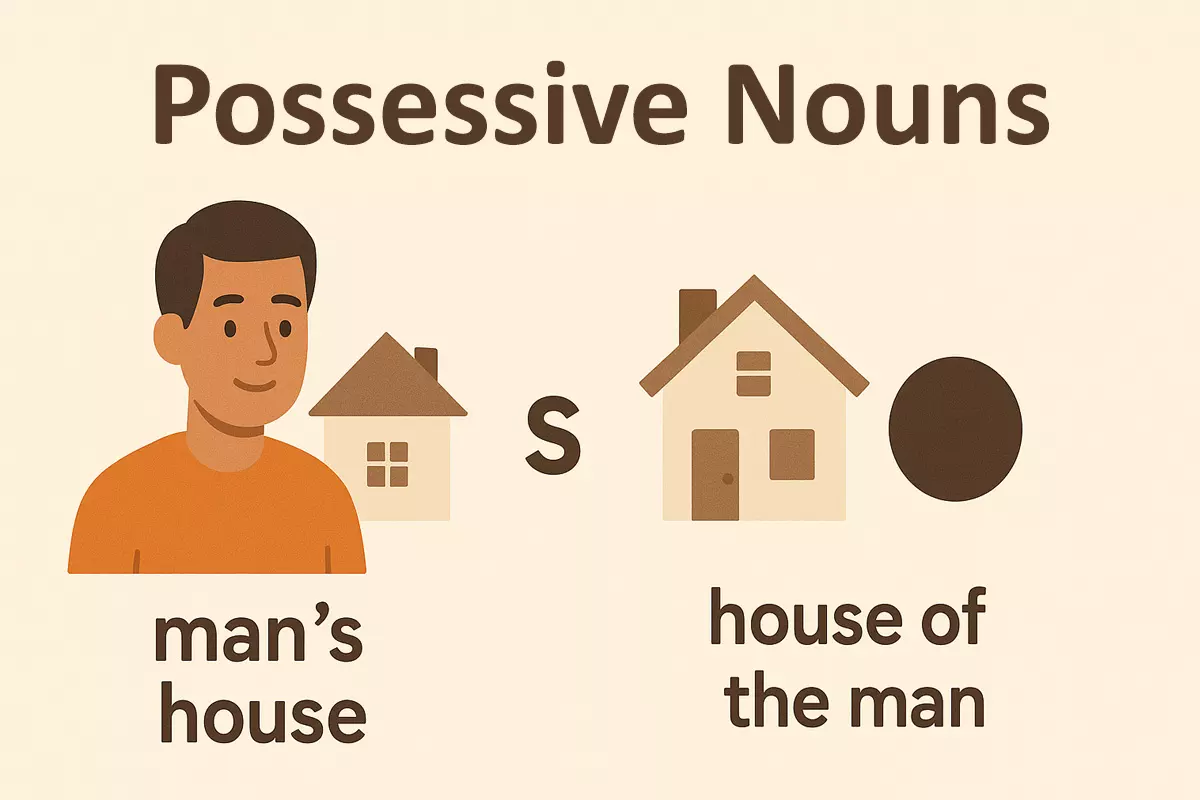
Sometimes possession is expressed using of, especially with inanimate objects or longer noun phrases. This avoids awkward wording. For example, instead of saying the book’s cover, you can say the cover of the book. This structure is especially common in more formal writing.
Examples and Usage
| Possessive Form | of-Structure |
|---|---|
| The teacher’s desk | The desk of the teacher |
| The city’s skyline | The skyline of the city |
| The manager’s decision | The decision of the manager |
| The dog’s collar | The collar of the dog |
Using ’s to Show Ownership
One of the most common ways to show ownership is by adding ’s to a noun. This indicates that something belongs to someone or something.
Basic Rules for Adding ’s
- Singular nouns: add ’s → Sarah’s book, the dog’s bone
- Plural nouns ending in -s: add only ’ → the teachers’ lounge
Special Cases
- For singular nouns ending in s, both forms are acceptable: James’s guitar or James’ guitar — be consistent.
- For compound nouns, add ’s to the last word: my mother-in-law’s recipe.
Examples
- children’s playground
- boss’s decision / boss’ decision
- women’s rights
Common Mistakes to Avoid
- Do not confuse plurals with possessives: cats (plural) vs. cat’s (possessive).
- Do not use apostrophes with possessive pronouns: its, yours, hers, ours, theirs.
Using "of" to Show Relationships
The word of is used to express possession, material, or part-whole relationships, especially when the phrase would sound awkward with ’s.
Examples
- The roof of the house (better than “the house’s roof”).
- A bottle of water.
- A chapter of the book.
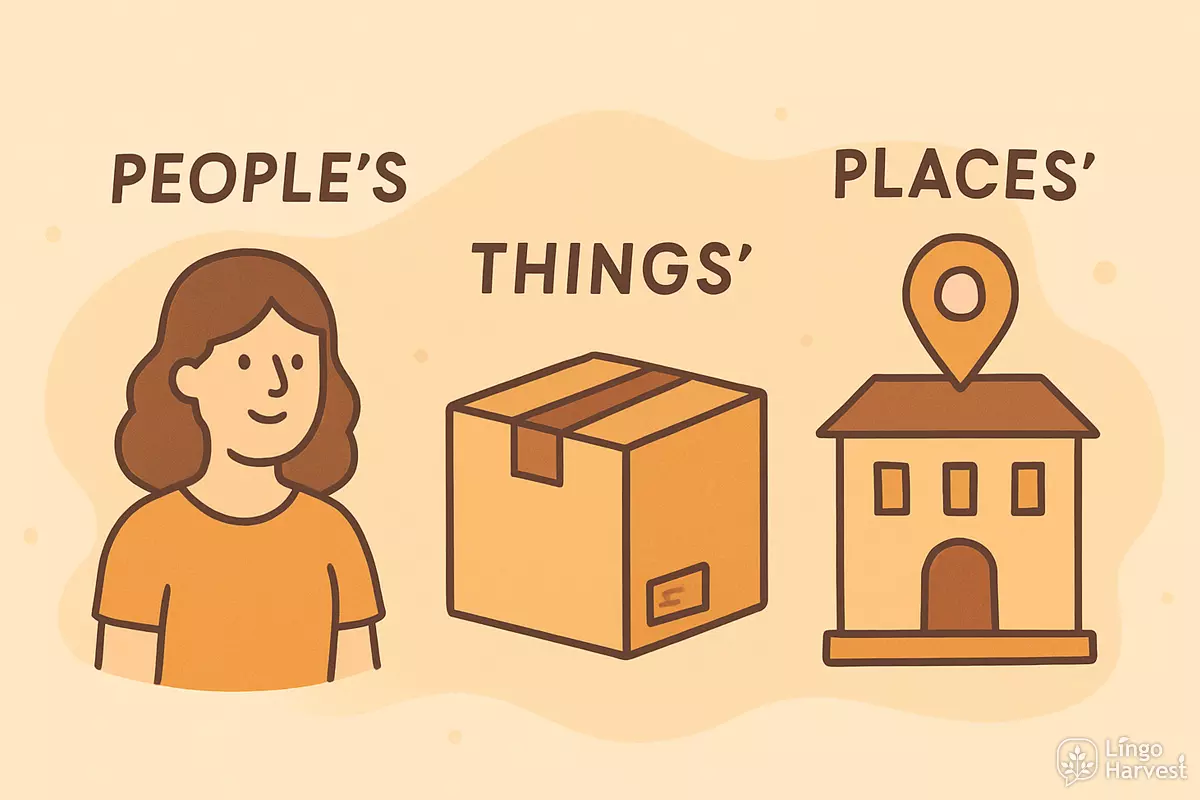
Common Situations: People, Things, Places
Possessive nouns appear constantly in everyday communication. We use them to show who something belongs to, what part something has, or how things relate to each other. Let’s look at how possessive forms work when we talk about people, things, and places.
People
When referring to people, possessives help show ownership or relationships. We often use ’s to show that something belongs to someone or is associated with them.
- Sarah’s book — the book belongs to Sarah.
- John’s car — the car is owned by John.
- The teacher’s desk — the desk used by the teacher.
- My brother’s friend — a friend who is connected to my brother.
- The children’s playground — a playground for the children.
Things
Possessives are also used with objects, especially when describing parts, features, or characteristics. This shows how one item relates to another.
- The car’s engine — the engine that belongs to the car.
- The clock’s hands — the hands that are part of the clock.
- The book’s cover — the cover of the book.
- The phone’s battery — the battery inside the phone.
- The computer’s memory — the memory used by the computer.
Places
We also use possessive forms to describe features or qualities of locations. This form is common in spoken and written English, especially when identifying characteristics of a place.
- The city’s skyline — the skyline associated with the city.
- The park’s entrance — the entrance belonging to the park.
- The country’s culture — the culture characteristic of the country.
- The school’s library — the library located in the school.
- The restaurant’s menu — the menu created for the restaurant.
| Category | Example |
|---|---|
| People | Mary’s laptop |
| People | The doctor’s office |
| Things | The phone’s screen |
| Things | The bicycle’s wheel |
| Places | The town’s festival |
| Places | The museum’s gallery |
Using possessive nouns in these everyday contexts makes your meaning clear and specific. Whether you are talking about people, objects, or locations, the possessive form helps you express ownership and relationships naturally and accurately.
Mini Practice: Possessives in Context
Choose the correct form in each sentence.
- (people) ________ book is on the table.
a) Mary book b) Mary’s book - (things) The ________ battery needs charging.
a) phone battery b) phone’s battery - (places) We admired the ________ skyline.
a) city skyline b) city’s skyline - (people) This is my ________ office.
a) doctor office b) doctor’s office - (things) I replaced the ________ wheel.
a) bicycle wheel b) bicycle’s wheel - (plural -s) The ________ lounge is on the second floor.
a) teachers lounge b) teachers’ lounge - (plural not -s) The ________ backpacks are in the corner.
a) children backpacks b) children’s backpacks - (singular ending in s) That is ________ guitar.
a) James guitar b) James’s guitar
Show answers
- 1 → b) Mary’s book
- 2 → b) phone’s battery
- 3 → b) city’s skyline
- 4 → b) doctor’s office
- 5 → b) bicycle’s wheel
- 6 → b) teachers’ lounge
- 7 → b) children’s backpacks
- 8 → b) James’s guitar (James’ is also accepted; be consistent.)
Common Mistakes to Avoid
Even learners who understand the basic rules of possessive nouns can make small mistakes that change meaning or cause confusion. Below are the most common issues and how to avoid them.
Mixing Up Singular and Plural Possessives
The form of the possessive depends on whether the noun is singular or plural.
- Singular: add ’s → the cat’s toy (one cat)
- Plural ending in -s: add only ’ → the cats’ toys (many cats)
Overusing the Word of
While of is correct in some cases, using possessive ’s is more natural and shorter when the possessor is a person.
- More natural: the teacher’s book
- Less natural: the book of the teacher
Confusion with Irregular Plurals
Irregular plural nouns do not take a simple s. Add ’s to the correct plural form—not to the singular root.
- children → children’s games (not childrens’)
- men → men’s clothing
- women → women’s restroom
Possessive Pronouns vs. Possessive Nouns
Possessive pronouns never use apostrophes. This is where many learners get confused.
- its = possessive (correct)
- it’s = it is (not possessive)
- yours, hers, ours, theirs → no apostrophes
Avoiding Overuse of Possessives
Using too many possessives in one sentence can sound unnatural. Try rephrasing when the sentence becomes long or complicated.
Example: Instead of the neighbor’s friend’s sister’s car, say the sister of my neighbor’s friend.
Examples of Common Mistakes (and Corrections)
- Incorrect: The dogs bone is missing. → Correct: The dog’s bone is missing.
- Incorrect: The teachers meeting was canceled. → Correct: The teachers’ meeting was canceled.
- Incorrect: Its a nice day. → Correct: It’s a nice day. (It’s = it is)
- Incorrect: The books cover is torn. → Correct: The book’s cover is torn.
- Incorrect: The childrens toys are scattered. → Correct: The children’s toys are scattered.
- Incorrect: This is hers book. → Correct: This is her book.
- Incorrect: The Smith's house is lovely. → Correct: The Smiths’ house is lovely. (referring to the family)
By watching for these common mistakes and practicing regularly, using possessive forms will become clear and automatic.
Practice Exercises
Understanding possessive nouns is easier with focused practice. Use the exercises below to reinforce when to use ’s and when to use of, including singular, plural, and irregular cases.
Exercise 1: Fill in the Blanks
Complete each sentence with the correct possessive form (’s / ’) or an of-phrase. Write just the missing part.
- That is the ________ car. (John)
- The ________ cover is torn. (book)
- We visited the ________ house. (Smiths)
- The color ________ the sky is beautiful at sunset. (—)
- The ________ toys are in the box. (children)
- I like the ________ design. (building)
- The ________ classroom is on the first floor. (teacher)
- We admired the ________ paintings. (museum)
- The ________ wheels need air. (bicycle)
- Please open the ________ door. (office)
- She wrote the ________ names on the list. (students)
- The ________ decision surprised everyone. (committee)
Show answers
- John’s
- book’s
- Smiths’
- of
- children’s
- building’s
- teacher’s
- museum’s
- bicycle’s
- office’s
- students’
- committee’s
Exercise 2: Sentence Transformation
Rewrite each sentence using a possessive with ’s (or ’ for regular plurals).
- The tail of the dog is wagging.
- The decision of the committee was unanimous.
- The flavor of the ice cream is chocolate.
- The design of the building is modern.
- The report of the manager is ready.
- The toys of the children are scattered.
- The cover of the magazine is glossy.
- The classroom of the teacher is bright.
- The wheels of the car are new.
- The songs of the band were amazing.
Show answers
- The dog’s tail is wagging.
- The committee’s decision was unanimous.
- The ice cream’s flavor is chocolate.
- The building’s design is modern.
- The manager’s report is ready.
- The children’s toys are scattered.
- The magazine’s cover is glossy.
- The teacher’s classroom is bright.
- The car’s wheels are new.
- The band’s songs were amazing.
Exercise 3: Identify the Correct Usage
Choose whether to use ’s or an of-phrase.
- The ________ (manager/office) is on the second floor.
- The ________ (roof/house) needs repairs.
- The ________ (pages/book) are torn.
- The ________ (importance/education) cannot be overstated.
- The ________ (edge/table) is sharp.
- The ________ (population/city) is growing fast.
- The ________ (goal/team) was clear.
- The ________ (keyboard/laptop) is broken.
- The ________ (walls/room) are white.
- The ________ (title/novel) is memorable.
Show answers
- manager’s office
- roof of the house
- book’s pages
- importance of education
- table’s edge
- city’s population
- team’s goal
- laptop’s keyboard
- walls of the room
- novel’s title
Exercise 4: Matching Possessives
Match each phrase to the best possessive form. (Fill the right column.)
Matching Possessives (List Version)
- the car of Mary — ________
- the bark of the dog — ________
- the decision of the board — ________
- the edge of the table — ________
- the offices of the managers — ________
- the backpacks of the children — ________
- the windows of the house — ________
- the gallery of the museum — ________
Show answers
- Mary’s car
- the dog’s bark
- the board’s decision
- the table’s edge
- the managers’ offices
- the children’s backpacks
- the house’s windows or the windows of the house
- the museum’s gallery
Practice regularly and watch for common trouble spots (irregular plurals, plural -s vs. ’s, and possessive pronouns). With repetition, choosing between ’s and of will become automatic.