Have Something Done: Causative Passive

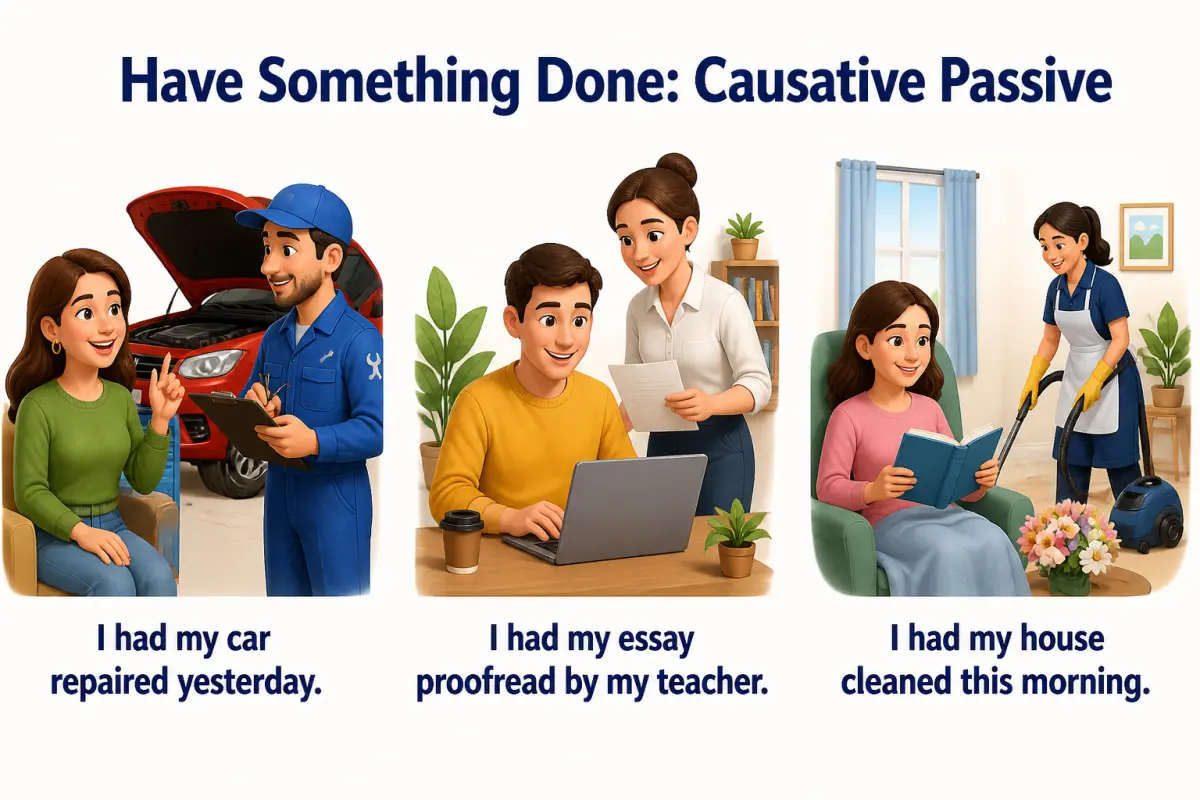 Here we the meaning of have something done and how the causative passive is used for services you arrange. It explains the structure, tenses, everyday examples, questions and negatives, common mistakes, practice, and an FAQ.
- What have something done means
- How causative passive shows arranged services
- Subject + have + object + past participle
- Have something done in present, past, and future
- Everyday examples: haircuts, repairs, and documents
- Have something done vs do something yourself
- Questions and negatives with have something done
- Common mistakes with have, do, and past participles
- Real-life practice: describe services you arrange
- FAQ: have something done
The causative passive is useful when you want to describe arranging for someone else to do something for you. In everyday English, it fits common situations such as getting your hair cut, having your phone repaired, or having your eyes checked. Instead of emphasizing the person who performs the service, this pattern keeps the focus on the result. Seen this way, it becomes a practical and natural part of communication.
What have something done means
This pattern is used when you arrange for another person to do a job for you. The focus is not on the worker, but on the service and the result. If you say, “I had my laptop repaired,” you mean that someone repaired it for you. You did not do the repair yourself.
Many learners first meet this structure in everyday situations: going to the hairdresser, taking a car to the garage, sending clothes to the cleaner, or asking a technician to fix something. It is called a causative passive because the subject causes an action to happen, and the object receives that action. In other words, you arrange it, but another person performs it.
Compare these meanings:
- “I cut my hair.” = I did it myself.
- “I had my hair cut.” = someone else cut it for me.
The difference is small in form but very important in meaning. This is why learners sometimes accidentally say they repaired their own phone, cleaned their own suit, or designed their own website when they really mean they paid someone to do it.
You will also hear this structure in both formal and informal English:
- We had the contract checked before signing it.
- She has her groceries delivered every Friday.
- They’re having the kitchen painted next month.
- I need to have my eyes tested.
Teacher note: students often understand the grammar quickly but still avoid using it in speech. A good habit is to connect it to your real life: hair, phone, car, passport, glasses, teeth, taxes. Once it feels personal, it becomes much easier to remember.
How causative passive shows arranged services
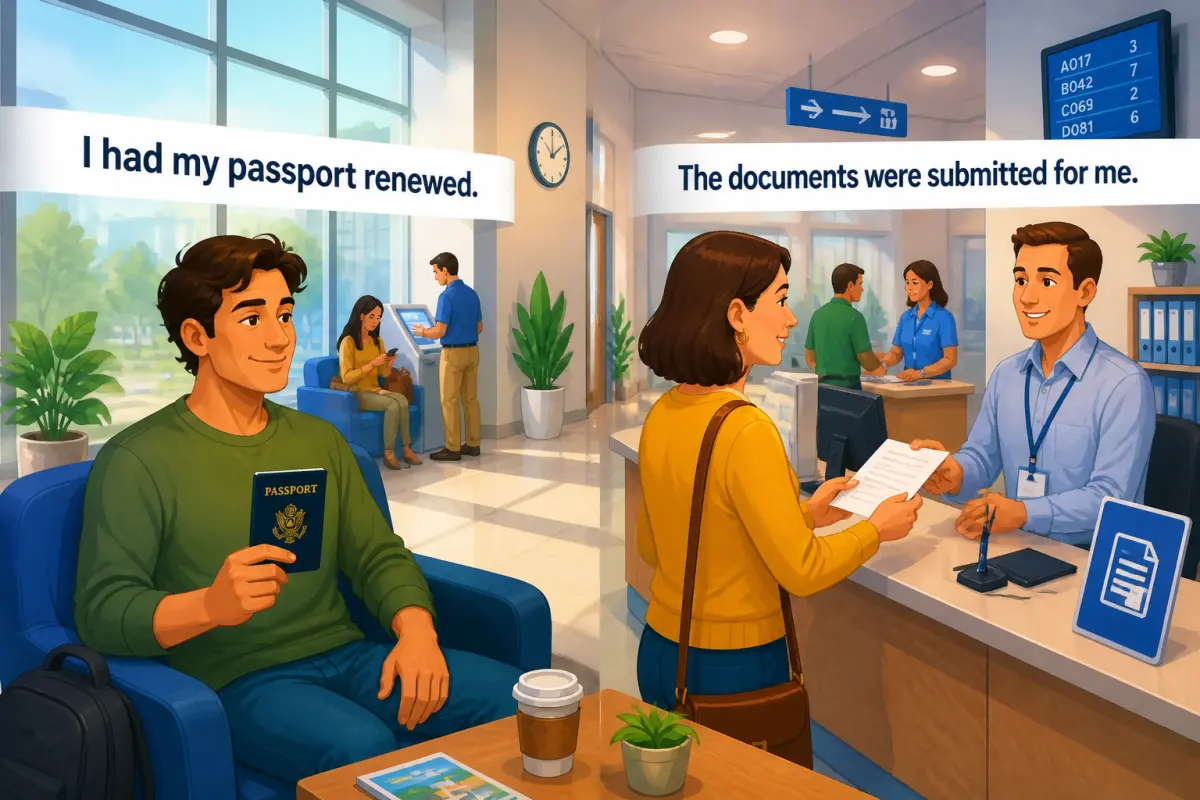
This structure is especially useful when the real point of the sentence is the arranged service, not the identity of the person who does it. In normal life, we often do not know the name of the mechanic, dentist, translator, electrician, or delivery driver. What matters is that we organized the service.
That is why English often prefers this pattern instead of a full active sentence with an unnamed person. “I had my passport renewed” sounds natural because it presents the experience from the customer’s point of view. “Someone renewed my passport” is possible, but it usually sounds less natural unless the person matters.
Look at these service situations:
- I had my watch fixed at the shop near the station.
- We had the office windows cleaned before the inspection.
- She’s having her wedding dress altered this week.
- He had his tax return prepared by an accountant.
- They are having solar panels installed on the roof.
The pattern can also suggest effort, planning, or expense:
- We had the whole house rewired.
- She had her portrait taken professionally.
- I’m having the report translated into Spanish.
These sentences do more than describe an action. They show that the speaker arranged something and often paid for it. This is one reason the pattern appears so often in travel, work, family life, and administrative tasks.
If you want the grammar background behind this type of sentence, it belongs to the wider area of causative verbs, where one person causes another action to happen in different ways.
Subject + have + object + past participle
The basic form is straightforward: subject + have + object + past participle. The object is the thing or person receiving the action, and the past participle describes the completed action done to that object.
This means the sentence has a special shape. After have, you do not use an infinitive here. You do not say “have my car repair” or “have my hair to cut.” You use the past participle: repaired, cut, cleaned, delivered, checked, updated.
| Part | Example | What it shows |
|---|---|---|
| Subject | I | the person arranging the service |
| Have | had | the causative verb in the chosen tense |
| Object | my bike | the thing receiving the action |
| Past participle | repaired | the action done by another person |
So “I had my bike repaired” means:
- I arranged it.
- my bike received the action.
- repaired is the past participle.
More examples:
- She had her nails painted before the party.
- We had the printer replaced yesterday.
- He has his meals delivered during the week.
- I’m having my suit dry-cleaned tomorrow.
Be careful with irregular forms. Learners often know the verb but choose the wrong participle:
- have my hair cut, not “cutted”
- have my photo taken, not “took”
- have my documents sent, not “sended”
If you want to review how these forms work more generally, a separate explanation of past participles can help.
From a sentence-structure point of view, this pattern is one of the useful English verb patterns learners should recognize as a complete unit, not as separate random words.
Have something done in present, past, and future
The structure changes tense through the verb have, while the past participle usually stays the same. This is the easiest way to control time in causative passive sentences. Once you know the pattern, you simply move have into the tense you need.
This allows you to talk about regular services, completed arrangements, and future plans with the same core structure.
| Time | Form | Example |
|---|---|---|
| Present simple | have / has + object + past participle | I have my shirts ironed at the cleaner’s. |
| Present continuous | am / is / are having + object + past participle | She is having her kitchen painted this week. |
| Past simple | had + object + past participle | We had the locks changed after the move. |
| Future | will have + object + past participle | They will have the report printed tomorrow. |
Some natural examples by time:
- Present routine: I have my hearing tested once a year.
- Present arrangement in progress: We’re having the carpets cleaned today.
- Past completed event: He had his visa extended last month.
- Future plan: I’ll have the invitations sent next week.
You can also use perfect forms:
- I’ve had my eyes checked already.
- She had had the copies made before the meeting started.
- By Friday, we’ll have the system updated.
These are perfectly correct, but in everyday conversation, present simple, past simple, and future with will are the most common starting points for learners.
Teacher note: when students struggle with tense, I ask them to build the sentence in two steps: first choose the time with have, then add the object and participle. For example: “tomorrow” → “will have” → “I’ll have my laptop cleaned.”
If you need extra support with how have and get behave as everyday verbs before using them in larger grammar patterns, that review can also be useful: have and get.
Everyday examples: haircuts, repairs, and documents
This grammar becomes much easier when you group it by real-life situations. Learners usually remember it better through common services than through abstract grammar labels.
Here are three of the most frequent areas where people naturally use the pattern.
Haircuts and personal care
- I had my hair cut before the interview.
- She has her nails done every two weeks.
- He’s having his beard trimmed this afternoon.
- We had our eyes tested at the new clinic.
Repairs and maintenance
- I had my phone screen replaced.
- They had the washing machine repaired last weekend.
- She’s having her bicycle serviced.
- We’ll have the air conditioner checked before summer.
Documents and official tasks
- I had my passport renewed.
- He had his signature verified at the bank.
- She had the contract translated into French.
- They’re having their wedding certificates copied.
Notice how useful this is in practical conversation. Instead of describing every person involved, you can simply explain what service you arranged:
- “Sorry I’m late. I had my car looked at.”
- “I need Friday off because I’m having my wisdom tooth removed.”
- “We had the internet fixed, so I can work from home again.”
This pattern also appears in work contexts:
- The manager had the presentation redesigned.
- Our team had the data checked by finance.
- I’m having the invoice corrected before I send it.
When you hear these sentences, do not focus only on grammar. Listen for the practical meaning: a service was arranged, often by appointment, request, or payment.
Have something done vs do something yourself

This is the contrast learners need most. If you use the causative passive, someone else does the work. If you use an ordinary active sentence, the subject usually does the work personally. Confusing these two can change the whole meaning.
Compare the following pairs carefully.
- ✅ I had my jacket cleaned. = a cleaner did it.
✅ I cleaned my jacket. = I did it myself. - ✅ She had her portrait painted. = an artist painted it.
✅ She painted her portrait. = she painted it herself. - ✅ We had the shelves installed. = a worker installed them.
✅ We installed the shelves. = we did the installation.
Here are three more pairs, because this difference is too important to skip:
- ✅ He had his suit altered. = a tailor did it.
✅ He altered his suit. = he changed it himself. - ✅ I had my laptop updated. = a technician updated it.
✅ I updated my laptop. = I did the update. - ✅ They had their garden designed. = someone designed it for them.
✅ They designed their garden. = they planned it themselves.
Now notice a subtle point: sometimes the active sentence is possible in real life, but less likely. For example, “I cut my hair” is grammatically correct, but many listeners will imagine that you literally cut it yourself. If you went to a salon, “I had my hair cut” is the natural choice.
There is another useful comparison with direct passive:
- My car was repaired yesterday.
- I had my car repaired yesterday.
Both are correct, but the second one highlights that I arranged the repair. The first one only states what happened to the car.
In grammar terms, the object after have works in a pattern related to object complements and result-focused structures, which is why the sentence behaves differently from a simple active clause.
Questions and negatives with have something done
To make negatives and questions, change the verb have in the normal way for the tense. In present simple and past simple, use do/does/did. In continuous forms, move the auxiliary verb. In future forms, use will.
The important thing is that the core pattern stays the same: object + past participle. Only the auxiliary structure changes.
Present simple
- Statement: I have my suits dry-cleaned.
- Negative: I don’t have my suits dry-cleaned locally.
- Question: Do you have your suits dry-cleaned locally?
Past simple
- Statement: She had her hearing checked.
- Negative: She didn’t have her hearing checked.
- Question: Did she have her hearing checked?
Present continuous
- Statement: We are having the office painted.
- Negative: We aren’t having the office painted this month.
- Question: Are you having the office painted this month?
Future
- Statement: I will have the package delivered.
- Negative: I won’t have the package delivered until Monday.
- Question: Will you have the package delivered today?
Common question types in real life:
- Did you have your wisdom tooth removed?
- Are they having the leak fixed today?
- Do you usually have your taxes done by an accountant?
- Will she have the report edited before sending it?
One very common learner mistake is to say “Did you had your car repaired?” That is wrong because after did, the verb goes back to the base form: “Did you have your car repaired?”
Teacher note: if questions feel difficult, first make a normal question with have, then add the object and participle. For example: “Did you have...?” + “your phone fixed” = “Did you have your phone fixed?”
Common mistakes with have, do, and past participles
Most errors with this structure come from three areas: choosing the wrong auxiliary, using the wrong verb form after have, and mixing up the meaning with “do it yourself.” These mistakes are very common, even at intermediate level, so it is worth checking them carefully.
1. Using the wrong form of have after do/does/did
- ❌ Did you had your watch fixed?
✅ Did you have your watch fixed? - ❌ She doesn’t has her hair colored.
✅ She doesn’t have her hair colored. - ❌ Do they had the forms printed here?
✅ Do they have the forms printed here?
After do/does/did, always use the base form have.
2. Using an infinitive or bare verb instead of a past participle
- ❌ I had my bathroom paint.
✅ I had my bathroom painted. - ❌ We’re having the problem solve tomorrow.
✅ We’re having the problem solved tomorrow. - ❌ He had his visa renew last week.
✅ He had his visa renewed last week.
The final word in this structure is a past participle, not a base verb.
3. Choosing the wrong participle form
- ❌ She had her photo took.
✅ She had her photo taken. - ❌ I had my package send yesterday.
✅ I had my package sent yesterday. - ❌ They had the damage wrote in the report.
✅ They had the damage written in the report.
Irregular verbs cause many of these errors, so learners should review common participles separately.
4. Saying the active form when the meaning is causative
- ❌ I cut my hair at the salon yesterday.
✅ I had my hair cut at the salon yesterday. - ❌ We repaired our car at the garage.
✅ We had our car repaired at the garage. - ❌ She translated her diploma at an agency.
✅ She had her diploma translated at an agency.
The wrong versions are not always ungrammatical, but they often give the wrong meaning.
5. Confusing have something done with get something done
Both are possible in many situations:
- I had my glasses adjusted.
- I got my glasses adjusted.
Get is often a little more informal, but both are common. If you are still building confidence, start with have, because it is the classic textbook pattern and very widely understood.
Real-life practice: describe services you arrange
Now it is time to use the pattern actively. The best practice is not random sentence drills alone, but realistic situations you could actually say in conversation, emails, or workplace English. Below are three short practice blocks. Each one checks a different skill.
Try to answer aloud first if possible. This grammar is much easier to remember when your mouth gets used to the pattern, not only your eyes.
Practice 1: Choose the correct form
- I had my laptop (repair / repaired / repairing) last Friday.
- Do you have your suits (clean / cleaned / cleaning) downtown?
- She is having her passport (renew / renewed / renewing) this week.
- We will have the invitations (print / printed / printing) tomorrow.
- He didn’t have his teeth (check / checked / checking) last year.
- Did they have the leak (fix / fixed / fixing) before winter?
- I have my groceries (deliver / delivered / delivering) on Saturdays.
- My sister had her wedding dress (alter / altered / altering).
- Are you having the contract (translate / translated / translating)?
- The company has its computers (update / updated / updating) regularly.
Show answers
- repaired
- cleaned
- renewed
- printed
- checked
- fixed
- delivered
- altered
- translated
- updated
Practice 2: Rewrite the sentence with have something done
- A mechanic serviced my car yesterday.
- A designer made our company logo.
- The dentist removed her wisdom tooth.
- A technician installed the new software for me.
- A photographer took their family portraits.
- The bank verified his signature.
- A cleaner washed the office windows.
- An electrician checked the wiring.
- A tailor shortened my trousers.
- A translator translated the certificate into English.
Show answers
- I had my car serviced yesterday.
- We had our company logo made.
- She had her wisdom tooth removed.
- I had the new software installed.
- They had their family portraits taken.
- He had his signature verified.
- We had the office windows washed.
- We had the wiring checked.
- I had my trousers shortened.
- I had the certificate translated into English.
Practice 3: Spot and correct the error
- Did you had your bike repaired?
- I’m having my kitchen paint next month.
- She has her passport renew every ten years.
- We didn’t had the printer fixed.
- He had his photo took for the application.
- Do she have her nails done there?
- They are having the problem solve now.
- I will had the documents sent this afternoon.
- My brother cut his hair at the barber’s. (Use causative passive.)
- Did the company had the website redesigned?
Show answers
- Did you have your bike repaired?
- I’m having my kitchen painted next month.
- She has her passport renewed every ten years.
- We didn’t have the printer fixed.
- He had his photo taken for the application.
- Does she have her nails done there?
- They are having the problem solved now.
- I will have the documents sent this afternoon.
- My brother had his hair cut at the barber’s.
- Did the company have the website redesigned?
For homework, write five true sentences about services you arranged in the last year, five about things you arrange regularly, and five about things you plan to arrange soon. Use different objects if possible: your phone, glasses, car, documents, clothes, room, or work files.
Teacher note: the strongest practice is “true but small.” Students remember “I had my laptop battery replaced” far better than an invented sentence about a palace or a spaceship.
FAQ: have something done
1. Is “have something done” always about paying for a service?
No. It often involves a paid service, but not always. The main idea is that you arrange for another person to do something. For example, “I had my brother check my CV” does not necessarily involve payment. It still fits the pattern because you caused the action to happen.
2. Can I use “get something done” instead of “have something done”?
Yes, very often you can. “I had my phone repaired” and “I got my phone repaired” are both natural. Get is usually a bit more conversational. In careful grammar study, learners often start with have because the structure is easier to identify clearly.
3. Can the object be a person?
Yes, but be careful with meaning. “She had her son vaccinated” means she arranged for someone to vaccinate her son. The son is the object receiving the action. This is common with medical care, education, and administration.
4. Do I need to mention who did the action?
No, and usually you do not. The pattern is useful exactly because the worker is often unknown, obvious, or unimportant. If you really want to mention the person, you can add it: “We had the roof repaired by a local contractor.” But many sentences sound more natural without that extra detail.
5. Can I use this structure for bad experiences too?
Yes, English sometimes uses it for unwanted events, especially when the subject is affected by something. For example, “She had her bag stolen” means the theft happened to her. She did not arrange it, of course. This is a related use, and the meaning comes from context. In service English, the arranged meaning is the main one learners should master first.
6. What is the difference between “I had my car repaired” and “My car was repaired”?
The second sentence is an ordinary passive and focuses only on the event. The first one adds the idea that you arranged the repair. If you want to show involvement as the customer or organizer, the causative version is usually better.
7. Can I use adverbs and time expressions in this pattern?
Yes. They fit naturally before or after the object-participle phrase, depending on the sentence. For example: “I had my laptop professionally cleaned,” “We had the locks changed yesterday,” and “She’s having the report carefully edited.” Keep the core structure together so the sentence stays clear.
8. Why do learners say “I cut my hair” when they mean a salon visit?
Because many languages do not make this contrast in the same way. Learners translate directly from their first language and produce an active sentence. In English, that often sounds as if you personally used the scissors. When another person provides the service, English strongly prefers “I had my hair cut.”