Stative Passive or Adjective? Key Differences

 This article explains why some passive-looking forms are actually adjectives. It covers how to tell action passives from state descriptions using context, by-phrases, modifiers, and time clues, with examples like closed, interested, married, and broken, plus common mistakes, practice, and an FAQ.
- Why passive forms can look like adjectives
- Action passive vs state description
- Past participles used as adjectives
- How context shows whether an action happened
- By-phrases, modifiers, and time expressions as clues
- Common examples: closed, interested, married, broken
- Stative passive with be, become, seem, and remain
- Mistakes with -ed adjectives and passive meaning
- Practice: identify passive forms or adjectives
- FAQ: stative passive and adjective forms
Some sentences seem simple, but deciding whether a form expresses a condition or acts like a describing word can greatly affect the meaning. In everyday English, this difference shapes how we talk about feelings, situations, and results. It helps to notice what the speaker wants to emphasize: an action that took place or the state that exists now. Once you recognize that contrast in real examples, these patterns become much easier to use with confidence.
Why passive forms can look like adjectives
One of the most confusing things for learners is that the same past participle form can behave in two different ways. It can be part of a passive verb, as in “The window was broken by the boys,” or it can describe a condition, as in “The window was broken when I arrived.” On the page, these look almost identical. That is why students often ask, “Is this grammar passive, or is it just an adjective?”
The reason is simple: English regularly uses past participles both in verb phrases and in descriptions. A form like closed, finished, damaged, or interested can connect to a true action, or it can describe a state. In other words, English does not always clearly separate “verb form” and “adjective form” by spelling. You have to read the whole sentence and ask what job the word is doing.
Compare these pairs:
- “The shop was closed at 6 p.m.” = someone closed it; focus on the event.
- “The shop was closed when we got there.” = it was not open; focus on the condition.
- “The guests were invited by email yesterday.” = an action happened.
- “Only invited guests may enter.” = invited describes which guests.
- “The floor was cleaned by the staff.” = passive action.
- “The floor looks cleaned” sounds odd because English usually prefers clean here, which shows that not every participle works naturally as an adjective.
This is also why learners need to pay attention not only to form but also to meaning. A sentence may look passive because it has be + past participle, but the real question is: does it describe an action done to something, or a resulting condition?
Teacher note: In class, I often tell students not to “diagnose” the grammar too early. First ask, “What is the speaker trying to say here: what happened, or what something is like now?” That usually leads to the correct answer faster than memorizing labels.
Action passive vs state description
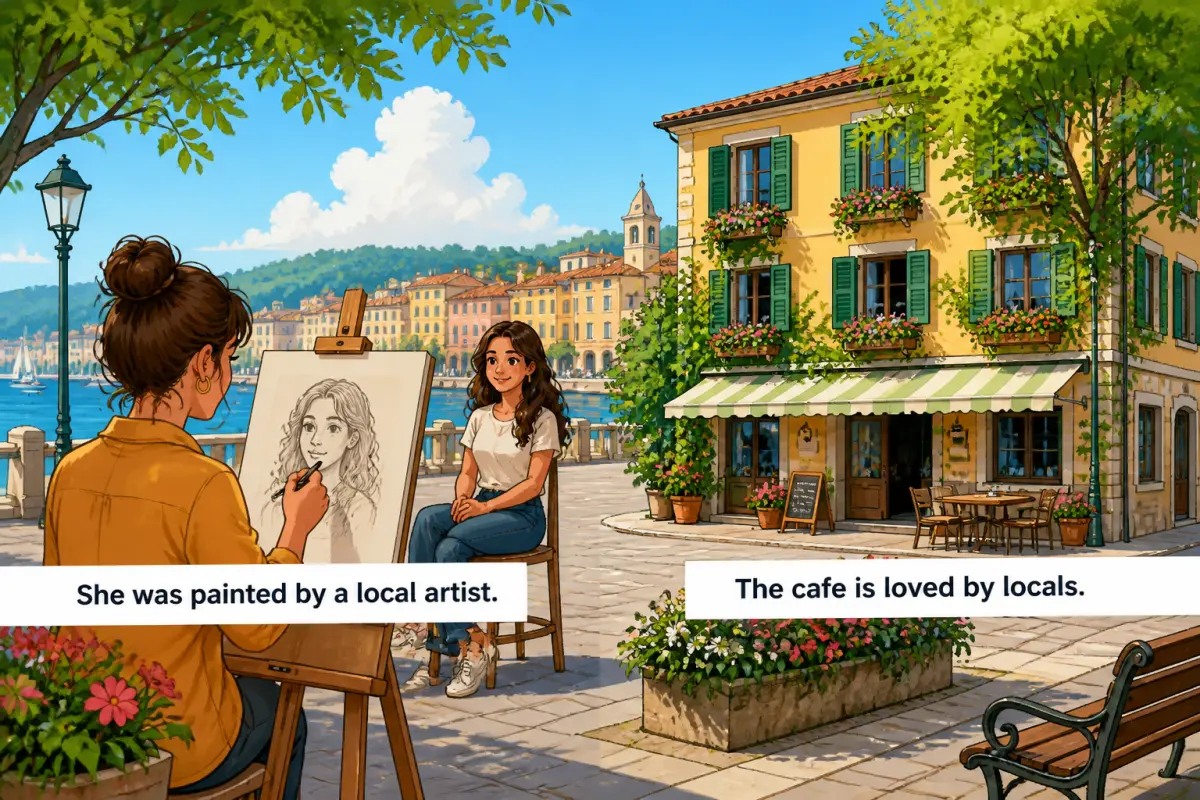
The clearest distinction is this: an action passive tells us that an action happened to someone or something, while a state description tells us what condition that person or thing is in. This difference matters because the grammar may be similar, but the meaning is not.
When you read or hear a sentence, test it with a simple question. If you can naturally ask “Who did it?” or “When did it happen?” you are probably dealing with an action passive. If the sentence mainly answers “What is it like now?” or “What condition is it in?” then it is probably a stative use or adjective-like use.
Look at these comparison pairs:
- “The lights were turned off by security at midnight.” = action passive.
- “The lights were off when I entered.” = state, but now with a normal adjective phrase.
- “The door was locked by the manager after the meeting.” = action passive.
- “The door was locked, so we used the back entrance.” = state description.
- “His bag was stolen on the train.” = action passive.
- “My bag is still stolen” is not natural English; we would say “My bag is still missing.” This shows that some participles are passive forms but do not become everyday adjectives.
| Type | Main focus | Typical question | Example |
|---|---|---|---|
| Action passive | An event or process | Who did it? When did it happen? | The report was sent this morning. |
| State description | A condition or result | What is it like now? | The report is already sent sounds unnatural; we usually say it is ready or finished. |
| Stative passive | A resulting state expressed with a participle | What state has resulted from the action? | The room is filled with smoke. |
| Regular adjective | Quality or description | What kind? What condition? | The room is quiet. |
Notice that “stative passive” sits between a normal passive and a normal adjective. It still connects to a verb idea in the background, but the sentence is focused on the result, not on the action itself. This is one reason the border between grammar categories can be blurry.
Past participles used as adjectives
Many past participles function naturally as adjectives. They can come before a noun, after a linking verb, or with degree words such as very, quite, and too. When that happens, they are behaving more like adjectives than like passive verbs.
For example, in “an excited child,” “a broken chair,” and “We felt relaxed,” the participles describe people or things. They are not really telling us about a completed event in the sentence. This is where the topic connects closely to participial adjectives and also to how predicate adjectives work after verbs like be, seem, and feel.
Here are common adjective signals:
- The participle appears before a noun: “a crowded train,” “a worried parent.”
- It follows a linking verb: “She seems confused.”
- It works with degree modifiers: “very tired,” “deeply concerned,” “quite pleased.”
- It can coordinate with another adjective: “The office was clean and organized.”
Compare these pairs:
- “The audience was bored during the lecture.” = adjective-like description of their feeling.
- “The audience was bored by the speaker’s endless slides.” = still often understood as a state, but the by-phrase makes the cause visible.
- “The package was damaged in transit.” = passive event or result, depending on context.
- “We cannot sell the damaged package.” = adjective before a noun.
- “She looks exhausted.” = adjective after a linking verb.
- “She was exhausted by the climb.” = caused state, very close to passive meaning.
A good learner habit is to notice which participles are common as everyday adjectives and which are not. For example, interested, tired, worried, and excited are very common adjective forms. In contrast, forms like arrested or delivered much more often keep a stronger passive sense.
How context shows whether an action happened
You usually cannot decide from one isolated phrase alone. Context does the real work. The same words may point to an action in one sentence and to a state in another. That is why advanced learners who only look at form often get stuck.
Take “The window was open” and “The window was opened.” The first is clearly a state with a normal adjective. The second usually points to an action. But now compare “The window was closed.” This could mean someone closed it, or it could simply describe its condition. To understand it, you need the surrounding sentence, the situation, or both.
Look at these pairs carefully:
- “When the alarm sounded, the main gate was closed immediately.” = action happened at that moment.
- “When we reached the stadium, the main gate was closed.” = describes what we found.
- “After the argument, his account was blocked by the administrator.” = action passive.
- “I tried to log in, but my account was blocked.” = likely a state from the user’s point of view.
- “The patient was moved to another room at 3 p.m.” = event with time reference.
- “By the time I arrived, the patient was already moved” is less natural; many speakers prefer “had already been moved,” because the sentence focuses on the earlier action rather than the resulting state.
Context also comes from the type of verb. Some verbs naturally produce a visible result. If you say “The vase is broken,” most people imagine a current state. If you say “The vase was broken during the move,” people focus more on the event. With result verbs, state readings are very common.
Teacher note: If students are unsure, I ask them to continue the sentence in two ways: one with a time/event detail and one with a condition/result detail. The continuation often reveals which reading fits better.
This is one place where understanding linking verbs helps. After a true linking verb, the word after it often functions as a description rather than part of an action.
By-phrases, modifiers, and time expressions as clues
Certain clues strongly suggest an action passive. The most famous is the by-phrase: “by the chef,” “by our team,” “by a stranger.” If the sentence names the agent, we are usually dealing with an action or at least a very clear connection to an action. Adjectives do not normally take agent by-phrases in the same way.
Other clues point in the opposite direction. Degree modifiers such as very, quite, so, and extremely usually go with adjectives, not with ordinary passives. Compare “The teacher was very pleased” with “The teacher was praised.” You can say “praised by the principal,” but “very praised” is not normal.
| Clue | Usually suggests | Example |
|---|---|---|
| by + agent | Action passive | The mural was painted by local artists. |
| Specific time expression | Action passive | The files were uploaded at 9:15. |
| Degree modifier like very | Adjective use | She was very surprised. |
| Coordination with an adjective | Adjective use | The hallway was crowded and noisy. |
| Result phrase like with or full of | Often stative/result meaning | The sink was blocked with hair. |
Time expressions are especially useful. Compare these:
- “The contract was signed on Monday.” = event.
- “The contract is already signed.” = result state, though many speakers may still feel the passive background.
- “The classrooms were cleaned after lunch.” = action.
- “The classrooms were perfectly clean after lunch.” = state, but now expressed with a normal adjective phrase.
Be careful, though: clues help, but they do not act like absolute rules. “He was very hurt by the remark” contains both a degree modifier and a by-phrase. English allows overlap because language is flexible. In real use, categories are often mixed rather than perfectly separate.
Common examples: closed, interested, married, broken
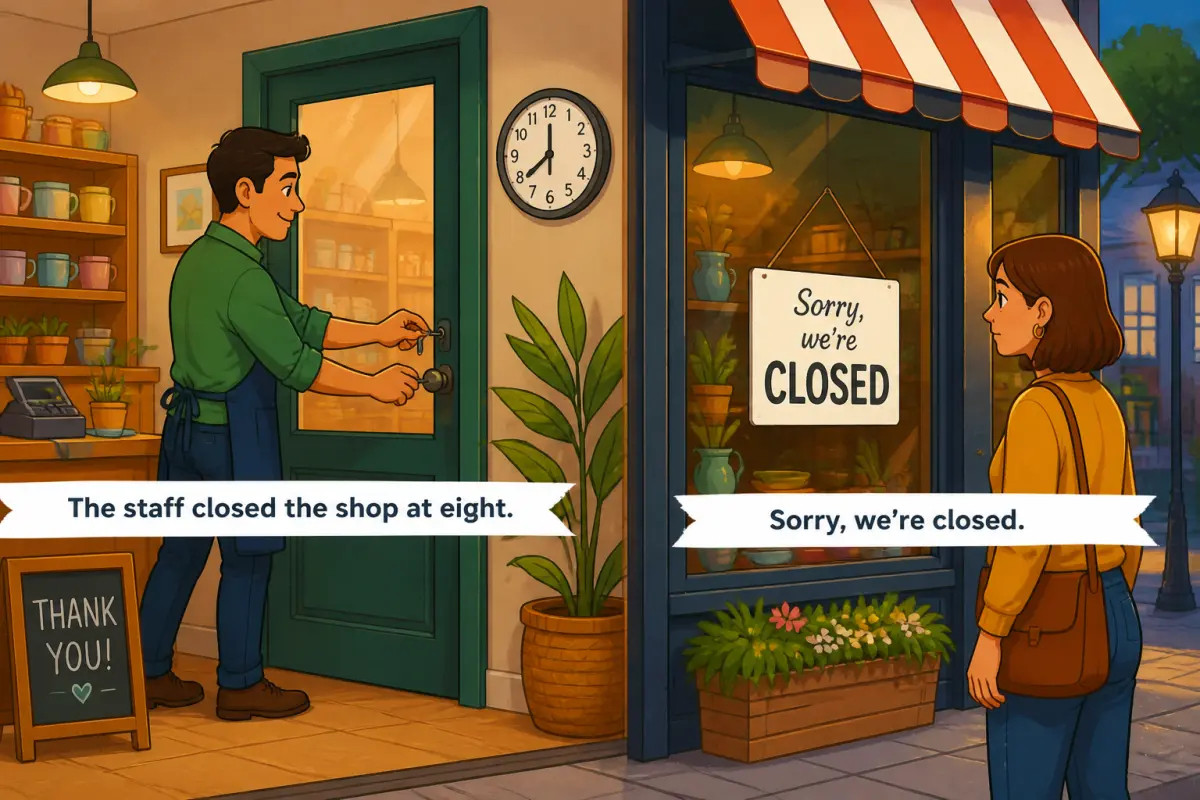
These four words cause a lot of trouble because each one behaves slightly differently. Learners often assume they all follow one single rule, but they do not. The best approach is to study how each word is commonly used in everyday English.
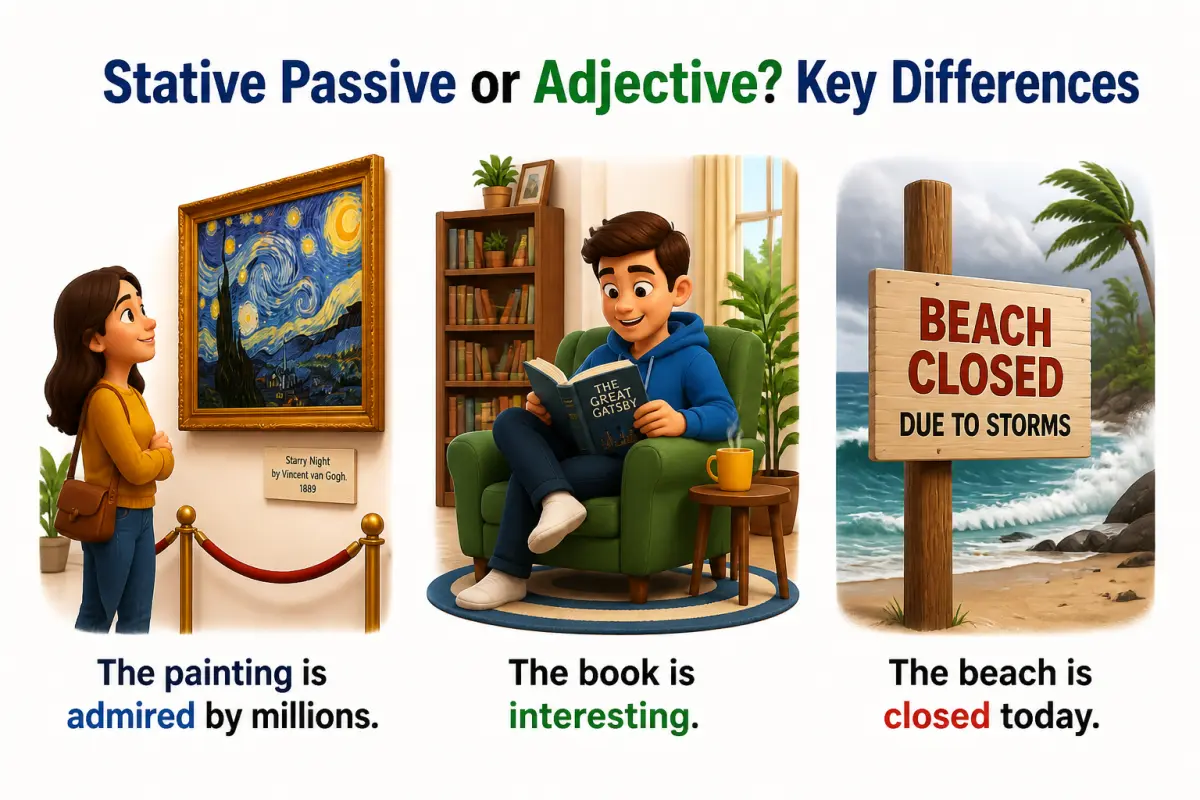
Closed can be passive or adjectival very easily. “The staff closed the shop at eight” gives us the active source. So “The shop was closed at eight” can describe the action. But “Sorry, we’re closed” is clearly an adjective-like state meaning “not open.” You also hear “The road is temporarily closed.” That is not really about the action of closing; it is about present condition.
Interested is mostly adjective-like in modern English. We normally use it to describe feelings: “I’m interested in photography,” “She seems interested,” “They were genuinely interested.” It comes from the verb interest, but in everyday grammar it behaves very much like an adjective. This area overlaps with ed adjectives, especially the contrast between “interested” and “interesting.”
Married usually describes status, not a fresh event. “They got married in June” refers to the event. “They are married” describes their state. You can technically say “They were married by a judge,” and that is a passive event. But in ordinary conversation, “married” often works like an adjective of social status: “a married couple,” “She is married to a doctor.”
Broken often describes result state. “My phone screen is broken” usually means its current condition. “My phone screen was broken by my little brother” clearly points to the action. The stronger the sentence focuses on present damage, the more adjective-like broken becomes.
- Closed: “The museum is closed on Mondays.” / “The museum was closed by the city last year.”
- Interested: “We’re interested in your proposal.” / “The proposal interested us” is active, but “We were interested by the proposal” is possible and less common than the adjective-style pattern.
- Married: “He is married now.” / “They were married in a small church.”
- Broken: “That lamp is broken.” / “The lamp was broken during delivery.”
Teacher note: I encourage learners to build small word families instead of memorizing one rule. For example: marry → get married → be married → a married couple. That helps you hear which patterns are natural.
Stative passive with be, become, seem, and remain
Stative passive often appears after verbs that present a condition rather than an action. The most common are be, become, seem, and remain. These verbs do not usually tell us that something happened at that moment. Instead, they introduce a state, appearance, or continuing situation.
That is why sentences like “The room is decorated beautifully,” “He seems confused,” and “The issue remains unresolved” feel descriptive. The participle may still come from a verb, but the grammar of the whole sentence is working like a state description. This relates indirectly to the difference between dynamic actions and stative verbs: some structures naturally present situations as states rather than events.
Notice how these verbs shape the meaning:
- With be: “The office is packed today.” = current condition.
- With become: “The neighborhood has become crowded.” = a change into a state.
- With seem: “Your instructions seem confusing” uses an -ing adjective, but “She seemed surprised” uses an -ed one; both describe appearance.
- With remain: “Several questions remain unanswered.” = the state continues.
Here are some pairs that show the difference more clearly:
- “The hall was decorated by volunteers on Friday.” = event.
- “The hall was decorated with paper lanterns.” = strong result-state reading.
- “The child became frightened during the storm.” = change of state.
- “The child was frightened by the thunder.” = cause expressed; still often state-focused.
- “Two seats remain reserved for guests.” = continuing status.
- “Two seats were reserved yesterday.” = action in the past.
One useful test is whether the sentence sounds natural with another adjective in the same position. If “The issue remains serious” and “The issue remains unresolved” work in the same grammar slot, then unresolved is functioning very adjective-like there.
Mistakes with -ed adjectives and passive meaning
Learners often mix up three things: true passive meaning, result state, and ordinary adjective use. The mistakes usually happen because the form looks familiar, but the pattern around it is wrong. Some errors are small; others completely change the meaning.
One major problem is using a passive form where English prefers a normal adjective. Another is using an adjective where a real passive event is needed. A third common problem is confusion between -ed and -ing forms.
Mistake 1: using a passive-looking form where English wants a regular adjective
- ❌ “My keys are losted.”
- ✅ “My keys are lost.”
- ❌ “The child is frighten.”
- ✅ “The child is frightened.”
- ❌ “This soup is salted too much.”
- ✅ “This soup is too salty.”
Mistake 2: using an adjective reading when the sentence needs an action passive
- ❌ “The documents are signed yesterday.”
- ✅ “The documents were signed yesterday.”
- ❌ “The room is cleaned at 10 a.m. every day.”
- ✅ “The room is cleaned at 10 a.m. every day.”
- ✅ “The room is clean now.”
- ❌ “My bike is stolen last week.”
- ✅ “My bike was stolen last week.”
Mistake 3: confusing -ed and -ing adjectives
- ❌ “I am interesting in jazz.”
- ✅ “I am interested in jazz.”
- ❌ “The movie was very bored.”
- ✅ “The movie was very boring.”
- ❌ “She felt relaxing after the exam.”
- ✅ “She felt relaxed after the exam.”
Mistake 4: forcing a by-phrase after words usually used as adjectives
- ❌ “I am interested by history.”
- ✅ “I am interested in history.”
- ❌ “She is married with a pilot.”
- ✅ “She is married to a pilot.”
- ❌ “We were delighted from the news.”
- ✅ “We were delighted by the news.” / “We were delighted with the news.”
The safest strategy is to learn common combinations as chunks: interested in, married to, known for, crowded with, pleased with. Once a participle becomes adjective-like, it often starts behaving with adjective-style prepositions rather than passive-style grammar.
Practice: identify passive forms or adjectives
Use these exercises to test whether you can recognize the difference between an action passive and an adjective or stative use. Do not look only at be + past participle. Pay attention to time, agent, result, and natural collocations.
The three sets below test different skills: identification, sentence transformation, and error correction. Try to explain your answer briefly, even if the task only asks for one word or one correction. That is how you build real control.
Practice block 1: Choose the best label
Write A for action passive, S for state/adjective use, or B for both possible depending on context.
- The office was locked when we arrived.
- The office was locked by the last employee at 9:30.
- I’m interested in applying for the job.
- The road is closed until Friday.
- The road was closed by police after the accident.
- Her ankle is swollen.
- The forms were printed this morning.
- The kids seemed disappointed.
- The cup was broken during the move.
- Those seats remain reserved for guests.
Show answers
- B
- A
- S
- S
- A
- S
- A
- S
- A
- S
Practice block 2: Rewrite to show the meaning asked for
Keep the general idea, but change the sentence so it clearly shows either an action or a state.
- State meaning: “Someone closed the café.”
- Action meaning: “The warehouse is empty now because workers moved the boxes.”
- State meaning: “Someone has already solved the problem.”
- Action meaning: “The picture is damaged now.”
- State meaning: “They married in 2018.”
- Action meaning: “The guests are seated.”
- State meaning: “A mechanic repaired my car.”
- Action meaning: “The hallway is decorated with lights.”
- State meaning: “The committee has finished the report.”
- Action meaning: “The shop is closed now.”
Show answers
- The café is closed.
- The boxes were moved out of the warehouse.
- The problem is solved.
- The picture was damaged in transit. / The picture was damaged by the movers.
- They are married.
- The guests were seated by the host.
- My car is repaired. / My car is fixed. (In everyday English, “fixed” is often more natural.)
- The hallway was decorated with lights for the party.
- The report is finished.
- The shop was closed at six.
Practice block 3: Find and correct the mistake
- I was very interesting in her presentation.
- The package is delivered yesterday.
- She is married with an engineer.
- The classroom was very clean by the janitor.
- My laptop is broke.
- The invitations were already sented.
- We felt relaxing after the holiday.
- The doors remain lock after 10 p.m.
- The files are deleted by mistake last night.
- He seems confuse about the instructions.
Show answers
- I was very interested in her presentation.
- The package was delivered yesterday.
- She is married to an engineer.
- The classroom was cleaned by the janitor. / The classroom was very clean.
- My laptop is broken.
- The invitations were already sent.
- We felt relaxed after the holiday.
- The doors remain locked after 10 p.m.
- The files were deleted by mistake last night.
- He seems confused about the instructions.
FAQ: stative passive and adjective forms
These are questions learners often ask after they understand the basic difference but still feel unsure in real sentences.
1. Can one sentence be both passive and adjective-like at the same time?
Yes. English does not always draw a hard line. “The window is broken” describes a state, but the state clearly comes from an action. That is why many grammars call some forms stative passives. In practical terms, do not worry if the category seems mixed. Focus on what the speaker means.
2. Is a by-phrase always proof of a real passive?
Usually it is a very strong clue, but not always absolute proof of a purely event-focused meaning. In “She was deeply moved by the letter,” the sentence still describes her emotional state. The by-phrase identifies the cause. So yes, it points strongly toward passive meaning, but the sentence can still feel descriptive.
3. Why can I say “very interested” but not usually “very invited”?
Because interested has become a common adjective in modern English, while invited usually keeps a narrower participle meaning. English usage develops word by word. That is why vocabulary knowledge matters as much as grammar rules here.
4. Are all past participles able to become adjectives?
No. Some are common as adjectives, some are limited, and some sound unnatural in most contexts. “Tired,” “excited,” and “broken” are very common. “Delivered” and “arrested” are much less flexible. If a form sounds strange, native speakers often prefer a different adjective such as ready, available, missing, or damaged.
5. How can I check quickly in an exam?
Use three questions: Who did it? When did it happen? What is the condition now? If the sentence clearly answers the first two, it is probably an action passive. If it mainly answers the third, it is probably adjectival or stative. Then look for clues like a by-phrase, a time expression, or degree words such as very.
6. Why does “married” behave differently from many other participles?
Because it is strongly established as a status word in English. “She is married” works much like “She is single.” The event form still exists, as in “They were married in June,” but everyday use often treats it as a description of relationship status.
7. Is “get” used with stative passive too?
Often get points more clearly to change or event than to a stable state. “The window got broken” suggests something happened. “He got married” focuses on the event of entering that state. After that, “He is married” describes the continuing condition. So get often helps you feel the difference between change and state.
8. What is the best long-term way to master this topic?
Notice real collocations, not just rules. Keep examples in pairs: “The gate was closed at ten” and “The gate was closed when we arrived”; “She was interested in the class” and “The class interested her.” If you record both the grammar and the natural context, the distinction becomes much easier to feel.