Prepositions in, on, at: Time and Place Guide for Beginners

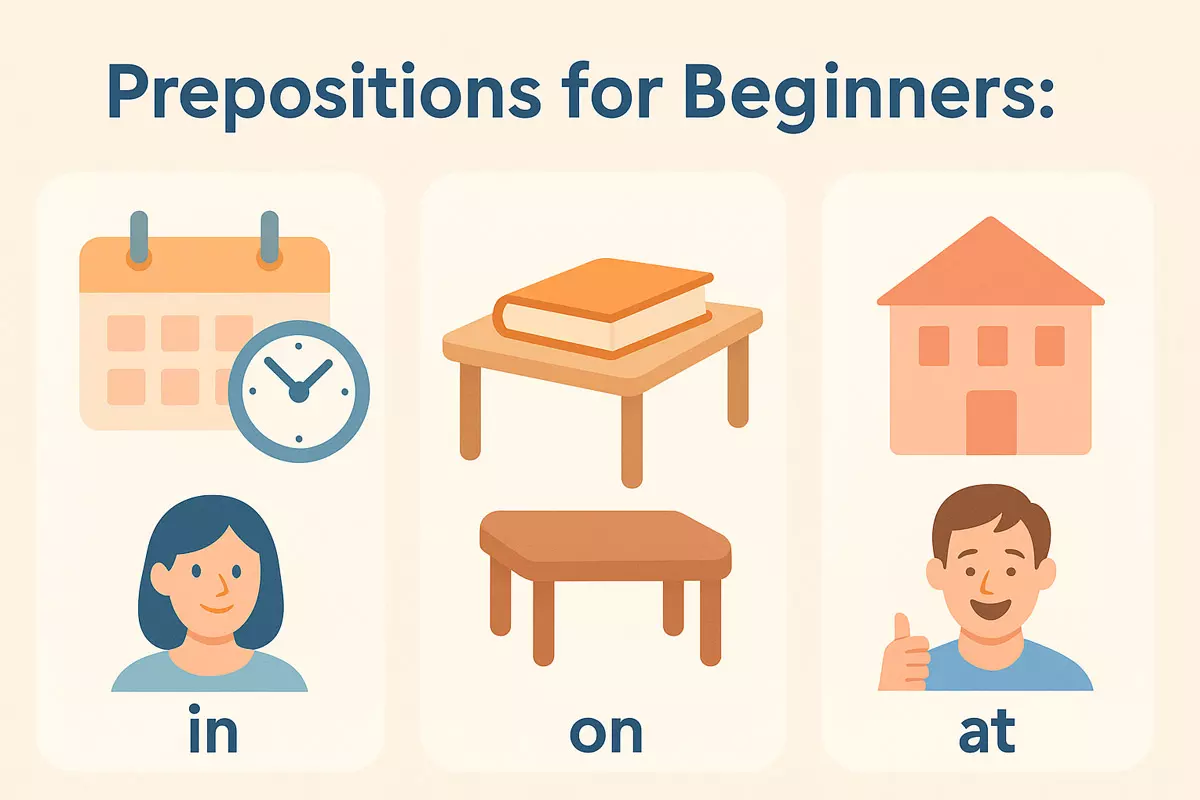 Use in for wider periods and enclosed spaces, on for days, dates, and surfaces, and at for exact times and points. This guide gives you a simple decision system, real examples, common mistakes, and practice tasks so you can choose the right preposition faster.
Choosing between in, on, and at becomes easier when you stop memorizing random phrases and start seeing the basic pattern. Takeaway: use in for a wider space or period, on for a surface, day, or date, and at for an exact point in time or place. This article explains the pattern with clear examples, common wrong choices, classroom and travel phrases, practice tasks, and answers.
Core meaning of in / on / at
The prepositions in, on, and at often show how specific something is. For beginners, the best starting point is this simple scale: in = inside a space or period, on = touching a surface or attached to a day/date, and at = a precise point.
General to specific: the basic idea
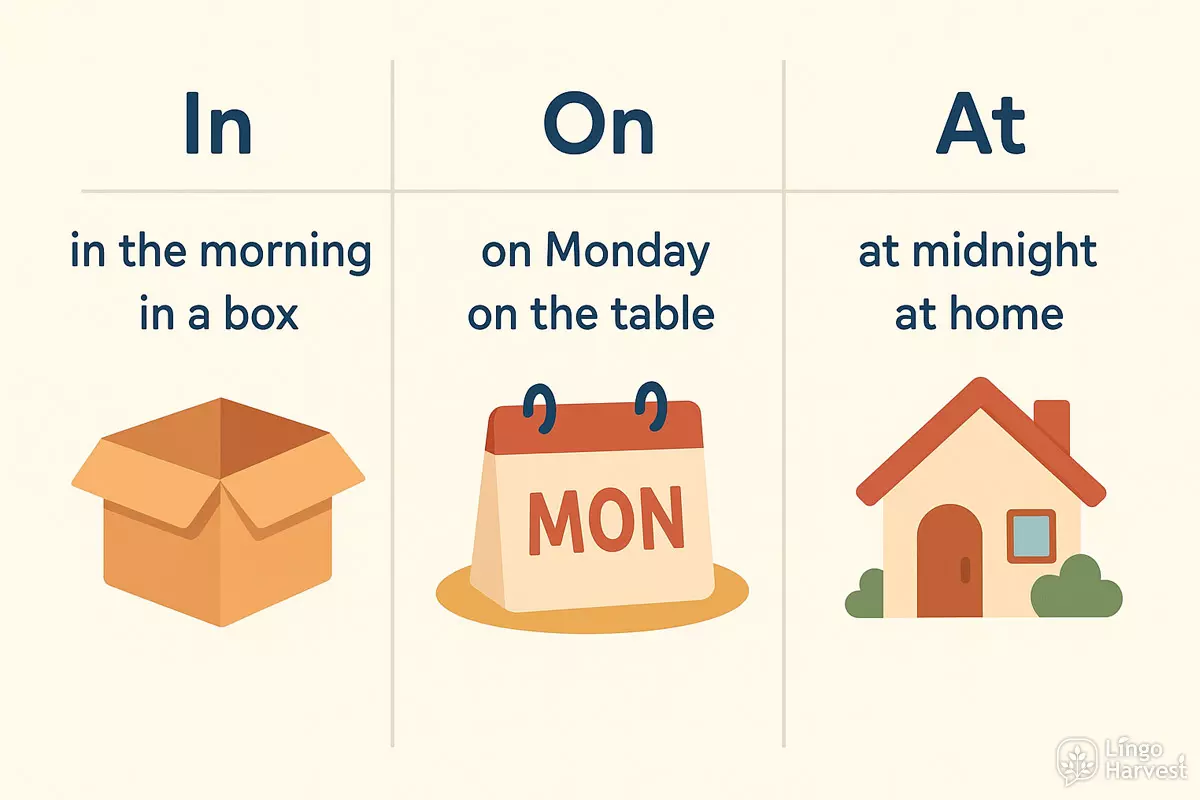
| Preposition | Core idea | Time example | Place example |
|---|---|---|---|
| in | Inside a period, area, room, city, or container | in April, in 2026, in the evening | in a room, in London, in a bag |
| on | On a surface, line, day, date, page, screen, or route | on Monday, on May 5th, on my birthday | on the table, on Main Street, on the screen |
| at | At a precise point, exact time, address, event, or meeting place | at 7:30, at noon, at midnight | at the door, at the station, at 25 King Street |
A quick memory rule
- In often answers “inside what period or area?” — in a box, in winter, in Canada.
- On often answers “on what surface, day, date, or line?” — on the wall, on Tuesday, on the road.
- At often answers “at what exact point?” — at 8:00, at the entrance, at the corner.
This core idea is helpful, but English also has fixed phrases. That is why you need both a visual rule and real examples. If you want a broader overview later, you can also study the complete guide to prepositions of time.
Time uses with examples
For time, think about size and precision. A year is a wide period, so we usually say in 2026. A date is more specific, so we say on June 10th. A clock time is exact, so we say at 6:45.
Use in for longer or wider time periods
Use in with months, years, seasons, centuries, decades, long periods, and parts of the day.
- We moved here in March.
- My brother was born in 1998.
- Many people travel in summer.
- The building was designed in the 19th century.
- Fashion changed quickly in the 1990s.
- I usually study in the morning.
- She prefers running in the evening.
- The project will finish in two weeks.
- Call me in a few minutes.
- People may work differently in the future.
Use on for days and dates
Use on when the time expression names a day, date, special day, or a day plus part of the day.
- The lesson is on Monday.
- Our exam is on Friday.
- She arrived on April 12th.
- The shop opens on May 1st.
- We met on my birthday.
- They travel on New Year’s Eve.
- The office is closed on Christmas Day.
- I have a meeting on Tuesday morning.
- We usually go hiking on weekends.
- The report was published on the last day of the month.
Use at for exact times and specific moments
Use at with clock times, exact moments, and several fixed time phrases.
- The train leaves at 6:20.
- Class starts at nine o’clock.
- Let’s meet at noon.
- The streets are quiet at midnight.
- He called me at lunchtime.
- The sky looked beautiful at sunset.
- She is busy at the moment.
- I often read at night.
- We usually visit family at Christmas.
- Prices often rise at the beginning of the year.
Time comparison table
| Use | Correct examples | Common mistake |
|---|---|---|
| in + wide period | in July, in 2025, in winter | on 2025 ❌ → in 2025 |
| on + day/date | on Wednesday, on July 4th, on Sunday evening | in Monday ❌ → on Monday |
| at + exact time | at 5:15, at noon, at midnight | in 5:15 ❌ → at 5:15 |
One useful detail: say in the morning, but on Monday morning. When you add a specific day, the phrase becomes more exact, so on is the better choice.
Place uses with examples
For place, imagine the shape of the location. Is something inside an area or container? Use in. Is it touching a surface or connected to a line? Use on. Is it a point, address, building, event, or meeting place? Use at.
Use in for enclosed spaces, areas, cities, and countries
Use in when something is inside a physical space, within an area, or inside the limits of a city, region, or country.
- The plates are in the cupboard.
- My phone is in my backpack.
- There is a sofa in the living room.
- She works in a small office.
- They live in Madrid.
- He studied in Germany.
- The children are playing in the garden.
- There are ducks in the lake.
- I left my notebook in the car.
- The answer is in the first paragraph.
Use on for surfaces, streets, floors, screens, and public transport
Use on when something touches a surface, appears on a screen or page, is located on a street, or is connected with many forms of public transport.
- The cup is on the shelf.
- There is a map on the wall.
- Your name is on the list.
- The photo is on page 12.
- She lives on Oak Street.
- Our classroom is on the third floor.
- I saw the message on my phone.
- He is on the train.
- They talked on the bus.
- The café is on the left side of the road.
Use at for exact places, addresses, events, and meeting points
Use at when the place is a point on a map, a building used for an activity, an address, or a specific meeting point.
- I’ll wait for you at the entrance.
- She is at the reception desk.
- We met at the bus stop.
- The package arrived at the office.
- He lives at 44 Park Avenue.
- They are at a conference today.
- My sister is at school now.
- We had dinner at a small restaurant.
- The taxi stopped at the corner.
- I’ll see you at the airport.
Place comparison table
| Preposition | Typical place use | Natural examples |
|---|---|---|
| in | Inside spaces, containers, cities, countries, areas | in a room, in a box, in Rome, in the park |
| on | Surfaces, streets, floors, pages, screens, transport | on the table, on Main Street, on the second floor, on the train |
| at | Points, addresses, buildings, events, meeting places | at the door, at home, at the station, at a concert |
For a fuller place lesson, continue with this guide to prepositions of place.
Useful classroom and travel phrases
These prepositions appear constantly in classroom instructions, travel questions, hotel conversations, and daily schedules. Learning them as short phrases helps you speak faster and sound more natural.
Common classroom questions and answers
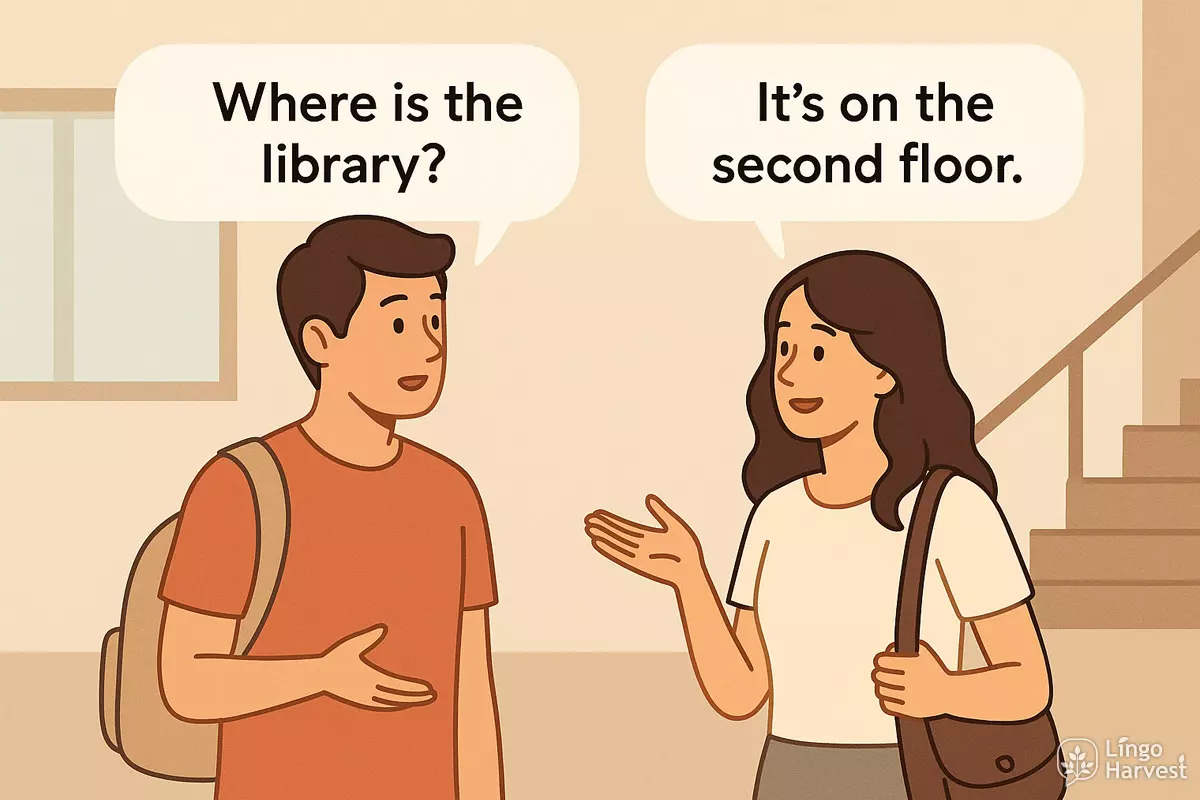
- Where is the library? — It’s on the second floor.
- What time is the lesson? — It starts at 9:30.
- Where is your notebook? — It’s in my bag.
- Is the homework on the board? — Yes, it’s on the board.
- Are you in Group A? — No, I’m in Group B.
- When is the test? — It’s on Thursday.
- Where should I write my name? — Write it at the top of the page.
- Where is the answer? — It’s in the last sentence.
- When do we have English? — We have English in the afternoon.
- Where do students wait? — They wait at the classroom door.
Useful travel phrases
- I’ll meet you at the airport.
- The hotel is on River Street.
- We are staying in a small town near the coast.
- The gate number is on your boarding pass.
- The train arrives at platform 4.
- We travel in July every year.
- The museum is on the left.
- The taxi is waiting at the main entrance.
- There is a guidebook in the suitcase.
- Our seats are on the bus, near the front.
Travel English has several special transport patterns: in a car, but usually on a bus, on a train, on a plane. You can review more examples in the guide to transport prepositions.
Common confusion patterns
Most mistakes with in, on, and at come from direct translation or from applying one rule too widely. The table below shows frequent wrong forms, the correct version, and the reason.
Common mistakes and corrections
| Incorrect | Correct | Why |
|---|---|---|
| I was born on 2001. | I was born in 2001. | Use in with years. |
| The meeting is in Monday. | The meeting is on Monday. | Use on with days. |
| Class starts on 8:00. | Class starts at 8:00. | Use at with exact clock times. |
| She studies at the morning. | She studies in the morning. | Use in with parts of the day. |
| I saw him in Friday morning. | I saw him on Friday morning. | A day plus morning/afternoon/evening usually takes on. |
| They live at New York. | They live in New York. | Use in with cities. |
| The keys are on my bag. | The keys are in my bag. | If the keys are inside the bag, use in. |
| The picture is in the wall. | The picture is on the wall. | A picture is attached to a surface, so use on. |
| I’m waiting in the bus stop. | I’m waiting at the bus stop. | A bus stop is a point/location, so use at. |
| We arrived in the airport. | We arrived at the airport. | For a building or travel point, at is usually natural. |
| We arrived at London. | We arrived in London. | Use in with cities and countries. |
| She got in the bus. | She got on the bus. | Use on with many public transport forms. |
In time vs on time
On time means punctual, not late. In time means early enough for something.
- The train left on time. (It left at the scheduled time.)
- We arrived in time to hear the first song. (We arrived early enough.)
- Incorrect: The train left in time if you mean it was punctual.
- Correct: The train left on time.
In vs into
In usually describes location. Into often describes movement from outside to inside.
- The phone is in my pocket. (location)
- She put the phone into her pocket. (movement)
- Incorrect: She walked in the room if you mean she entered.
- Correct: She walked into the room.
For more detail on this movement difference, read in vs into.
Fixed expressions and exceptions
Some uses of in, on, and at are fixed expressions. They still often follow the basic idea, but they are best learned as short chunks.
Common fixed time expressions
| Expression | Example | Note |
|---|---|---|
| at night | I don’t like driving at night. | Use this for night in general. |
| in the night | The baby woke up in the night. | Use this for a specific time during the night. |
| at the weekend | We often visit friends at the weekend. | Common in British English. |
| on the weekend / on weekends | She works on weekends. | Common in American English. |
| at Christmas | We see our relatives at Christmas. | Holiday period. |
| on Christmas Day | The shop is closed on Christmas Day. | Specific day. |
Common fixed place expressions
| Expression | Example | How to understand it |
|---|---|---|
| at home | I’ll be at home tonight. | Home is treated as a point or personal location. |
| at work | He is at work now. | Work means the activity/place. |
| at school | The children are at school. | School as an institution or activity place. |
| in class | Sorry, I’m in class. | Inside a lesson or classroom situation. |
| on the internet | I found the article on the internet. | Online content is often treated as being on a platform. |
| on a website | The form is on the website. | A website works like a digital surface or page. |
When a phrase feels like an exception, write it down as a full phrase, not as a single preposition. For example, remember at home, in class, on the website, and at the moment.
Practice: choose the correct preposition
Now practice choosing in, on, or at. Read the whole sentence before you answer because the noun after the preposition often gives you the clue.
Exercise 1: Fill in the blanks
Choose in, on, or at.
- The meeting starts ___ 10:15.
- My cousin lives ___ Toronto.
- There is a small café ___ the corner.
- The notes are ___ page 18.
- We usually travel ___ August.
- The picture is ___ the wall above the sofa.
- She was born ___ 2003.
- The concert is ___ Saturday night.
- I left my wallet ___ the taxi.
- They are waiting ___ the station.
- The office is ___ the fifth floor.
- I prefer studying ___ the evening.
- The exam is ___ June 3rd.
- He is standing ___ the entrance.
- The answer is ___ the next paragraph.
- We arrived ___ Rome late at night.
- There is a lot of traffic ___ Main Street.
- The plane leaves ___ midnight.
- She keeps her glasses ___ a small case.
- I saw your message ___ my screen.
Show answers
- The meeting starts at 10:15.
- My cousin lives in Toronto.
- There is a small café at the corner.
- The notes are on page 18.
- We usually travel in August.
- The picture is on the wall above the sofa.
- She was born in 2003.
- The concert is on Saturday night.
- I left my wallet in the taxi.
- They are waiting at the station.
- The office is on the fifth floor.
- I prefer studying in the evening.
- The exam is on June 3rd.
- He is standing at the entrance.
- The answer is in the next paragraph.
- We arrived in Rome late at night.
- There is a lot of traffic on Main Street.
- The plane leaves at midnight.
- She keeps her glasses in a small case.
- I saw your message on my screen.
Exercise 2: Correct the mistakes
Each sentence has one preposition mistake. Rewrite it with the correct preposition.
- We have a test in Monday.
- The class begins on 8:30.
- I live at Brazil.
- The keys are on my pocket.
- She arrived at Paris yesterday.
- There is a poster in the wall.
- He works in the weekend.
- The hotel is in 12 Green Road.
- My birthday is at September.
- We sat in the train for two hours.
Show answers
- We have a test on Monday. Use on with days.
- The class begins at 8:30. Use at with exact times.
- I live in Brazil. Use in with countries.
- The keys are in my pocket. The keys are inside the pocket.
- She arrived in Paris yesterday. Use in with cities.
- There is a poster on the wall. A poster is on a surface.
- He works at the weekend or on weekends. The choice depends on variety of English.
- The hotel is at 12 Green Road. Use at with exact addresses.
- My birthday is in September. Use in with months.
- We sat on the train for two hours. Use on with trains.
Exercise 3: Choose the best option
Choose the better sentence.
- A. I’ll call you in noon. / B. I’ll call you at noon.
- A. The files are on my laptop. / B. The files are at my laptop.
- A. She is in the kitchen. / B. She is on the kitchen.
- A. We met in the bus stop. / B. We met at the bus stop.
- A. The event is on Friday evening. / B. The event is in Friday evening.
- A. He was born in winter. / B. He was born at winter.
- A. The office is on the second floor. / B. The office is in the second floor.
- A. I saw the notice on the door. / B. I saw the notice at the door.
- A. We stayed at a hotel near the river. / B. We stayed on a hotel near the river.
- A. She put the letter in the envelope. / B. She put the letter on the envelope.
Show answers
- B. I’ll call you at noon.
- A. The files are on my laptop.
- A. She is in the kitchen.
- B. We met at the bus stop.
- A. The event is on Friday evening.
- A. He was born in winter.
- A. The office is on the second floor.
- A. I saw the notice on the door.
- A. We stayed at a hotel near the river.
- A. She put the letter in the envelope.
For extra mixed practice, use this preposition practice quiz.
Homework: write your own sentences
Write one sentence for each prompt. Then compare your sentence with the sample answer. Your wording can be different, but the preposition should follow the same pattern.
- Write a sentence with in + month.
- Write a sentence with on + day.
- Write a sentence with at + exact time.
- Write a sentence with in + city.
- Write a sentence with on + surface.
- Write a sentence with at + meeting point.
- Write a sentence with on + street.
- Write a sentence with in + container.
- Write a sentence with at + event.
- Write a sentence that contrasts in time and on time.
Show sample answers
- We usually take a holiday in July.
- The interview is on Tuesday.
- The film starts at 7:45.
- My uncle lives in Dublin.
- The glasses are on the kitchen table.
- I’ll wait at the main entrance.
- The bakery is on King Street.
- There are three pens in the drawer.
- We met several new people at the conference.
- The bus left on time, but we arrived in time to catch it.
FAQ
1. What is the easiest rule for in, on, and at?
The easiest rule is: in for inside a space or wider time period, on for surfaces, days, and dates, and at for exact points in time or place. This rule covers many beginner situations.
2. Do we say in Monday or on Monday?
Say on Monday. English uses on with days: on Monday, on Friday, on Sunday evening. Do not say in Monday.
3. Do we say at 5 o’clock or in 5 o’clock?
Say at 5 o’clock. Use at with exact clock times: at 6:30, at noon, at midnight.
4. Do we say in the morning or on the morning?
Say in the morning when you mean the part of the day in general. But use on when you add a specific day: on Monday morning, on Friday evening.
5. What is the difference between in the car and on the bus?
Use in with smaller private vehicles where you sit inside a limited space: in a car, in a taxi. Use on with many forms of public transport: on a bus, on a train, on a plane.
6. Do we say at the airport or in the airport?
Both can be possible in different contexts, but at the airport is usually the natural beginner choice when you mean the airport as a travel point or meeting place. Use in the airport only when you specifically mean inside the building.
7. What is the difference between in time and on time?
On time means punctual: The meeting started on time. In time means early enough: We arrived in time to get good seats.
8. Why are in, on, and at so difficult for learners?
They are difficult because English uses both logic and fixed phrases. The visual ideas help: inside, surface, point. But learners also need to memorize common chunks such as at home, in class, on Monday, and at night.