Subject vs Object Pronouns: Easy Rules and Examples

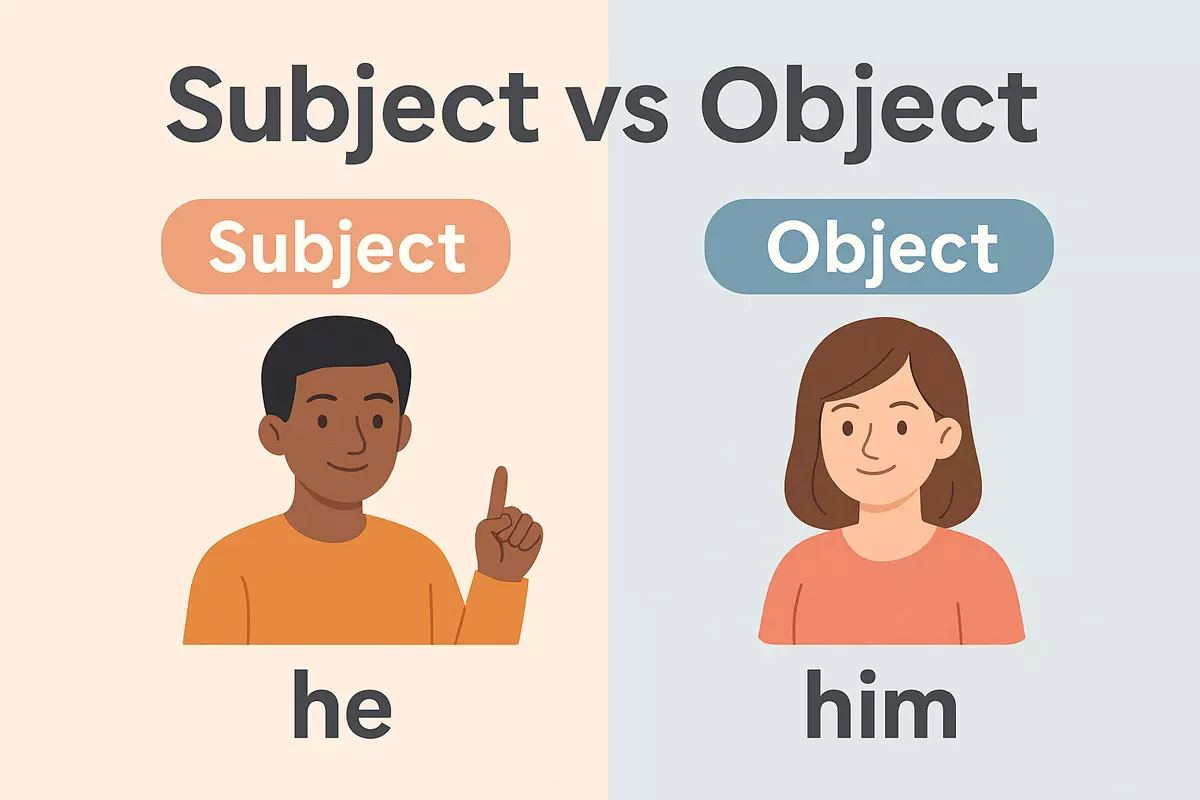 This article explains subject pronouns like I, you, he, she, it, we, and they, and object pronouns like me, you, him, her, it, us, and them. Takeaway: use subject pronouns when they do the action, and object pronouns after verbs and prepositions.
Subject and object pronouns are small words, but they control who does the action and who receives it. Takeaway: use I, you, he, she, it, we, they when the pronoun is the subject of the sentence, and use me, you, him, her, it, us, them when the pronoun is after a verb or preposition. If you can find the pronoun’s position and job in the sentence, the choice becomes much easier.
What Are Subject and Object Pronouns?
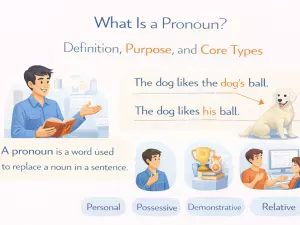
Pronouns replace nouns so English sentences do not sound repetitive. Instead of saying Anna called Anna’s brother because Anna needed help, we can say Anna called her brother because she needed help. This is the basic purpose of pronouns: they keep sentences shorter, clearer, and more natural. If you need a wider introduction first, start with pronouns for beginners.
Subject pronouns are used when the pronoun does the action or is the subject of the sentence. Object pronouns are used when the pronoun receives the action or comes after a preposition.
The basic difference
| Pronoun type | Job in the sentence | Examples |
|---|---|---|
| Subject pronoun | Does the action or comes before the main verb as the subject | She called me. They arrived early. |
| Object pronoun | Receives the action or comes after a preposition | I called her. I sat next to them. |
Subject and object pronoun chart
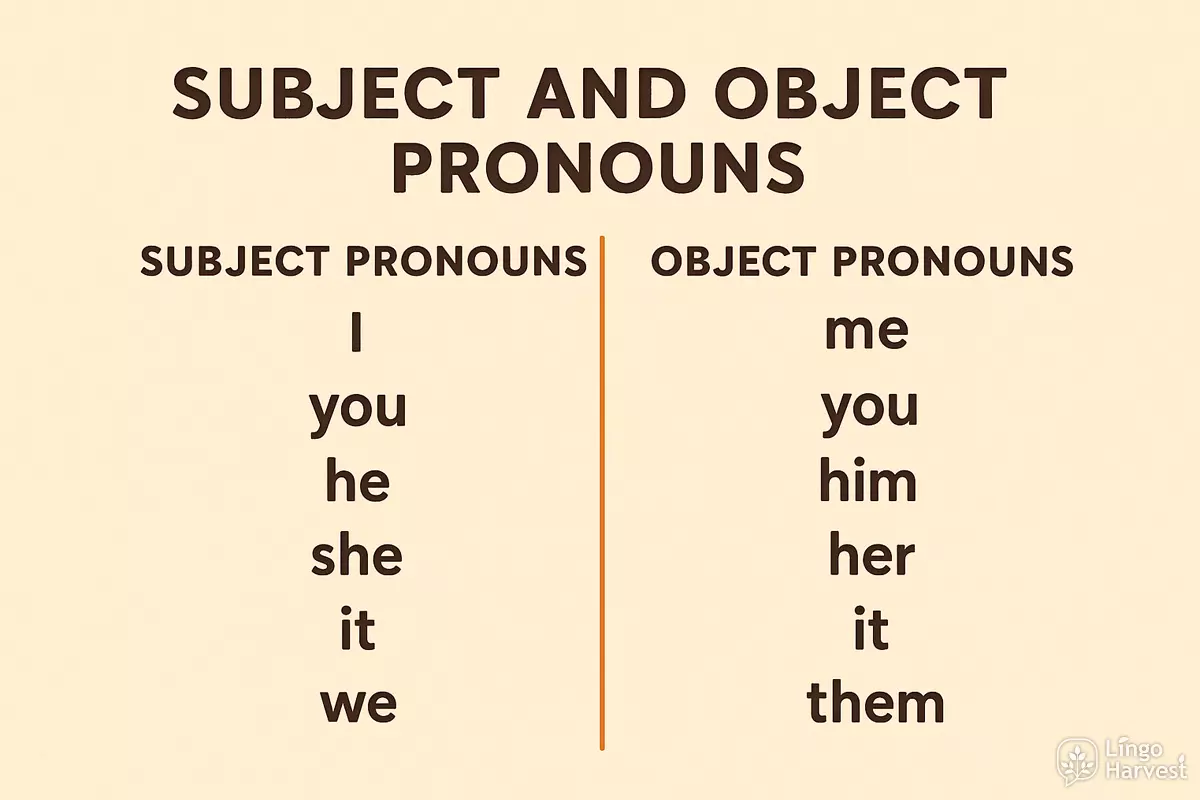
| Subject Pronoun | Object Pronoun | Simple Example |
|---|---|---|
| I | me | I helped Tom. Tom helped me. |
| you | you | You called Anna. Anna called you. |
| he | him | He saw Sarah. Sarah saw him. |
| she | her | She invited Mark. Mark invited her. |
| it | it | It works. I fixed it. |
| we | us | We met Lisa. Lisa met us. |
| they | them | They helped me. I helped them. |
Quick way to test the pronoun
- Ask: Who is doing the action? Use a subject pronoun: She called.
- Ask: Who receives the action? Use an object pronoun: I called her.
- Ask: Is the pronoun after a preposition? Use an object pronoun: with her, for them, to us.
Subject Pronouns (I, you, he, she, it, we, they)
Subject pronouns tell us who or what performs the action. They usually come before the main verb in a normal sentence. For example, in She runs every morning, the pronoun she is the subject because she performs the action.
List of subject pronouns
- I — the speaker: I need a pen.
- You — the person or people being spoken to: You look tired.
- He — one male person: He works here.
- She — one female person: She is my sister.
- It — a thing, animal, situation, weather, time, or idea: It is raining.
- We — the speaker plus one or more people: We are ready.
- They — people or things; also one person when gender is unknown, irrelevant, or intentionally not specified: They are waiting outside.
Subject pronouns in natural sentences
- I enjoy hiking in the mountains.
- You should try the new restaurant downtown.
- He is an excellent guitarist.
- She won the science fair.
- It is raining outside.
- We are planning a trip to the beach.
- They are arriving tomorrow.
- They said they would send the file later. (one person, gender not specified)
- It looks expensive.
- We need more time.
Important notes about subject pronouns
- I is always capitalized: I am ready, not i am ready.
- You can be singular or plural: You are my friend / You are all invited.
- It can refer to a thing, animal, weather, time, or situation: It is cold, It is late, It broke.
- They can refer to plural people or things, and it can also be used for one person when the gender is not specified. See more on gender-neutral pronouns.
Subject pronouns vs repeated nouns
| Repetitive sentence | Better with subject pronoun |
|---|---|
| Maria is tired. Maria wants to go home. | Maria is tired. She wants to go home. |
| Tom and Anna are late. Tom and Anna missed the bus. | Tom and Anna are late. They missed the bus. |
| The phone is new. The phone works well. | The phone is new. It works well. |
Object Pronouns (me, you, him, her, it, us, them)
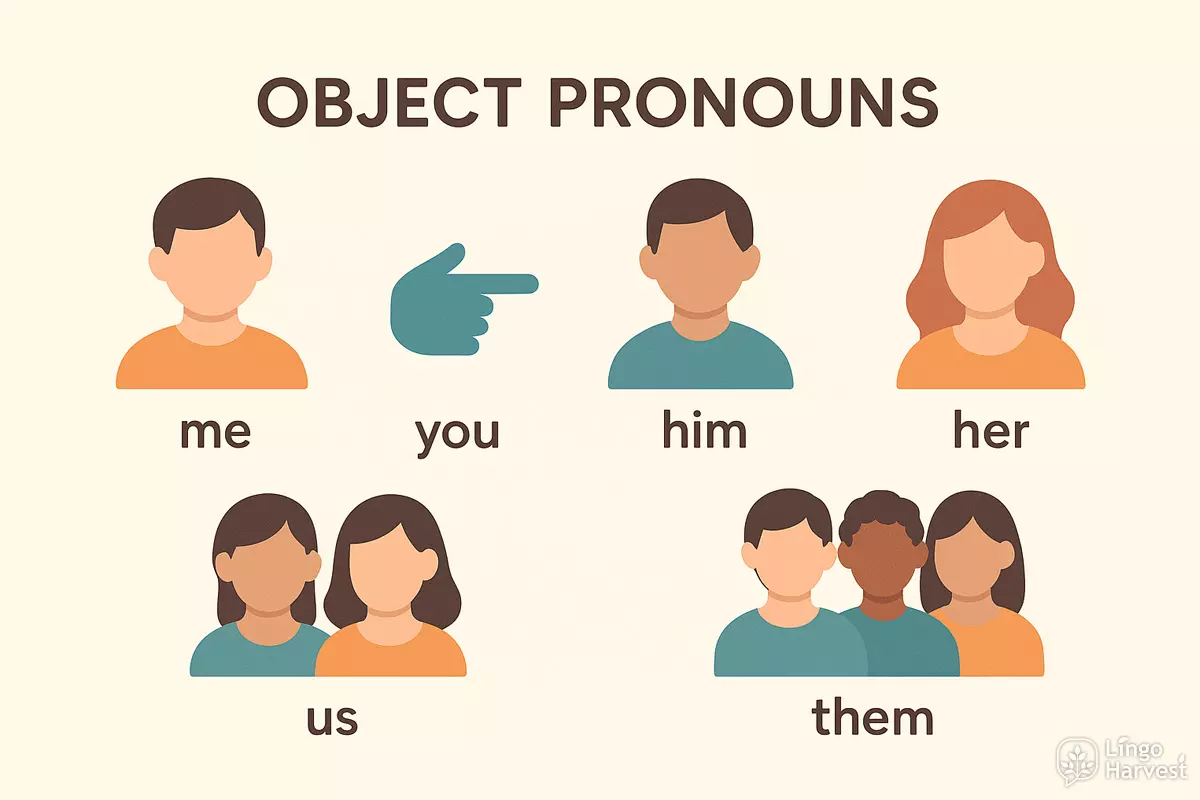
Object pronouns receive the action of a verb or come after a preposition. In the sentence The teacher called him, the pronoun him is the object because he receives the action of the verb called. You can study this area in more detail in the lesson on pronouns as objects.
List of object pronouns
- me — object form of I: Call me later.
- you — same form as subject and object: I saw you yesterday.
- him — object form of he: We invited him.
- her — object form of she: I thanked her.
- it — same form as subject and object: Can you fix it?
- us — object form of we: They helped us.
- them — object form of they: She called them.
Examples of object pronouns after verbs
- Maria called me yesterday.
- Can you help us with the project?
- The teacher explained the lesson to them.
- He found it under the table.
- I saw her at the station.
- We invited him to dinner.
- They thanked us for the help.
- Please send me the address.
Subject form and object form together
| Subject Form | Object Form | Example Pair |
|---|---|---|
| I | me | I called Dan. Dan called me. |
| he | him | He helped Lisa. Lisa helped him. |
| she | her | She met Paul. Paul met her. |
| we | us | We know them. They know us. |
| they | them | They invited us. We invited them. |
Everyday note: “It’s me”
After the verb be, everyday English normally uses the object form in short answers and identifications.
- Natural: It’s me.
- Natural: That was her on the phone.
- Very formal or old-fashioned: It is I.
In normal conversation, It’s me is the safe and natural choice.
How to Choose: Position in the Sentence
The easiest way to choose between subject and object pronouns is to look at the pronoun’s position and job in the sentence. Do not choose only by sound. Choose by function.
The three-position rule
| Position | Use | Examples |
|---|---|---|
| Before the main verb as the doer | Subject pronoun | She called. They arrived. I agree. |
| After a verb as the receiver | Object pronoun | Call her. Help them. Invite me. |
| After a preposition | Object pronoun | with us, for him, between you and me |
Remove the other name test
This test is very useful when two people are joined by and. Remove the other name and check which pronoun sounds correct.
| Full sentence | Test | Correct form |
|---|---|---|
| Sarah and ___ are going. | ___ am going. | Sarah and I are going. |
| The teacher helped Sarah and ___. | The teacher helped ___. | The teacher helped Sarah and me. |
| Tom and ___ finished early. | ___ finished early. | Tom and he finished early. (Formal/grammatical, but often rewritten as Tom finished early, and so did he.) |
| She spoke to Tom and ___. | She spoke to ___. | She spoke to Tom and him. |
Subject or object: quick examples
- She loves reading books. (Subject: she does the action.)
- The teacher called him to the front. (Object: him receives the action.)
- We waited outside. (Subject: we do the action.)
- The manager spoke to us. (Object after preposition: to us.)
- They helped me. (They = subject; me = object.)
After Verbs and Prepositions
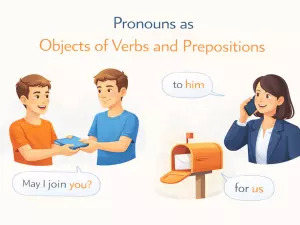
Object pronouns often appear in two important places: after verbs and after prepositions. These are the most common positions for me, him, her, us, and them.
After verbs
Many verbs take an object. The object receives the action of the verb.
- She called him yesterday.
- The teacher praised us for our work.
- Can you help me with this?
- I saw them outside the building.
- We invited her to the meeting.
- He asked me a question.
- They thanked us after the event.
After prepositions
Prepositions such as to, for, with, between, about, after, and before are followed by object pronouns.
- This gift is for her.
- They went to the movies with them.
- Please give this to me.
- The message is from him.
- She sat next to us.
- This is between you and me.
- We talked about them after class.
Verb and preposition examples
| Verb or preposition | Correct object pronoun | Full example |
|---|---|---|
| call | call him | I will call him tonight. |
| help | help me | Can you help me with this form? |
| invite | invite them | We should invite them to dinner. |
| for | for her | This seat is for her. |
| with | with us | Do you want to come with us? |
| between | between you and me | This stays between you and me. |
Special verbs: let, make, and help
Some verbs are especially common with object pronouns. For example, English says let me go, make him wait, and help us understand. You can review more examples in the lesson on pronouns after help.
- Let me explain.
- She made him wait.
- Can you help us move this table?
- The news made them nervous.
Common Mistakes (than me/I, between you and I)
Subject and object pronoun mistakes often happen when two names are joined by and, after prepositions, or in comparisons with than. This section fixes the most common problems. For a broader review, see pronoun mistakes.
Than me vs than I
The choice between than me and than I depends on the meaning and the style. In everyday English, than me is very common when the pronoun functions like an object. In formal English, than I may appear when a verb is understood after it.
- Everyday: She is taller than me.
- Formal: She is taller than I am.
- Different meaning: She likes him more than me. (She likes him more than she likes me.)
- Different meaning: She likes him more than I do. (She likes him more than I like him.)
This comparison can change meaning, so it is worth studying the focused lesson on than me vs than I.
Between you and I vs between you and me
Between is a preposition, so it takes an object pronoun. The correct phrase is between you and me.
- Incorrect: Between you and I, this is difficult.
- Correct: Between you and me, this is difficult.
- Correct: This stays between you and me.
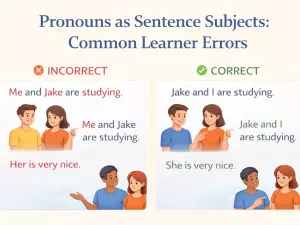
Me and Sarah vs Sarah and I
When the pronoun is part of the subject, use the subject form.
- Informal/incorrect in standard writing: Me and Sarah are late.
- Correct: Sarah and I are late.
- Test: I am late, not me am late.
John and I vs John and me
Use I when the phrase is the subject. Use me when the phrase is the object.
| Sentence | Correct? | Reason |
|---|---|---|
| John and I went to the store. | Correct | The phrase is the subject. |
| She gave the tickets to John and me. | Correct | The phrase follows the preposition to. |
| John and me went to the store. | Incorrect in standard grammar | The subject needs I. |
| She gave the tickets to John and I. | Incorrect | After to, use me. |
Common mistake table
| Incorrect | Correct | Why |
|---|---|---|
| Him and I went to the store. | He and I went to the store. | The first pronoun is part of the subject. |
| She gave the tickets to John and I. | She gave the tickets to John and me. | After to, use an object pronoun. |
| Between you and I, this is difficult. | Between you and me, this is difficult. | Between is a preposition. |
| Me and Sarah are late. | Sarah and I are late. | The phrase is the subject. |
| Can you help I? | Can you help me? | After the verb help, use an object pronoun. |
| Her is my friend. | She is my friend. | The pronoun is the subject. |
| I spoke with they. | I spoke with them. | After with, use an object pronoun. |
Practice
Practice helps you see the pronoun’s job faster. Work through the tasks below, then open the answer blocks to check your choices.
Exercise 1: Identify the pronoun type
Decide whether the highlighted pronoun is a subject pronoun or an object pronoun.
- He went to the store.
- Maria gave him a gift.
- They are playing soccer.
- Can you see her in the crowd?
- We will meet you at the park.
- The manager called us yesterday.
- She works in a hospital.
- I sent them an email.
- It looks interesting.
- Tom sat next to me.
Show answers
- He — subject pronoun
- him — object pronoun
- They — subject pronoun
- her — object pronoun
- We — subject pronoun
- us — object pronoun
- She — subject pronoun
- them — object pronoun
- It — subject pronoun
- me — object pronoun
Exercise 2: Choose the correct pronoun
Complete each sentence using the correct pronoun.
- Jessica and ___ went to the movies. (I/me)
- Please give the book to ___. (they/them)
- ___ is the best player on the team. (She/Her)
- My friends and ___ are going on a trip. (I/me)
- Could you pass ___ the salt? (he/him)
- ___ called me after lunch. (He/Him)
- The teacher spoke to Anna and ___. (I/me)
- ___ are waiting outside. (They/Them)
- This gift is for ___. (she/her)
- Can ___ help us tomorrow? (they/them)
Show answers
- Jessica and I went to the movies.
- Please give the book to them.
- She is the best player on the team.
- My friends and I are going on a trip.
- Could you pass him the salt?
- He called me after lunch.
- The teacher spoke to Anna and me.
- They are waiting outside.
- This gift is for her.
- Can they help us tomorrow?
Exercise 3: Correct the mistakes
Each sentence has one pronoun mistake. Rewrite it correctly.
- Me and Jack are ready.
- The email is for I.
- Her works at the bank.
- Between you and I, this plan is risky.
- They invited Sarah and I.
- Him and Tom play tennis every Sunday.
- Please tell she the truth.
- Us are going home now.
- Can you sit beside we?
- The teacher helped he with the exercise.
Show answers
- Jack and I are ready.
- The email is for me.
- She works at the bank.
- Between you and me, this plan is risky.
- They invited Sarah and me.
- He and Tom play tennis every Sunday.
- Please tell her the truth.
- We are going home now.
- Can you sit beside us?
- The teacher helped him with the exercise.
Exercise 4: Homework — write your own examples
Write one sentence for each prompt. Then compare your work with the sample answers.
- Write one sentence with I as the subject.
- Write one sentence with me after a verb.
- Write one sentence with she as the subject.
- Write one sentence with her after a preposition.
- Write one sentence with they as the subject.
- Write one sentence with them after a verb.
- Write one sentence with we as the subject.
- Write one sentence with us after a preposition.
- Write one sentence with between you and me.
- Write one sentence with two people joined by and.
Show sample answers
- I study English every morning.
- My friend called me after dinner.
- She knows the answer.
- The message is from her.
- They live near the station.
- We invited them to lunch.
- We need more practice.
- The teacher spoke with us.
- This secret stays between you and me.
- Anna and I finished the project.
FAQ
1. What is the difference between subject and object pronouns?
Subject pronouns do the action or act as the subject of the sentence. Object pronouns receive the action or come after prepositions. For example, She called me: she is the subject pronoun, and me is the object pronoun.
2. What are the subject pronouns in English?
The subject pronouns are I, you, he, she, it, we, and they. They usually come before the main verb when they show who or what performs the action.
3. What are the object pronouns in English?
The object pronouns are me, you, him, her, it, us, and them. They are used after verbs and prepositions, as in call me, help him, with us, and for them.
4. Why is “between you and I” wrong?
Between is a preposition, and prepositions take object pronouns. The correct phrase is between you and me, not between you and I.
5. Should I say Sarah and I or Sarah and me?
Use Sarah and I when the phrase is the subject: Sarah and I are ready. Use Sarah and me when the phrase is the object: The teacher helped Sarah and me.
6. Is “It’s me” correct?
Yes. It’s me is natural and correct in everyday English. Very formal grammar sometimes prefers It is I, but that sounds stiff or old-fashioned in normal conversation.
7. Can they be singular?
Yes. They can refer to more than one person or thing, and it can also refer to one person when gender is unknown, not important, or intentionally not specified. For example: Someone left their phone here. I hope they come back.
8. What is the easiest way to choose I or me?
Use I when the pronoun is doing the action: I called Anna. Use me when the pronoun receives the action or follows a preposition: Anna called me, for me, with me.
9. How can I check pronouns in sentences with and?
Remove the other person and test the sentence. Sarah and I are late works because I am late works. The teacher helped Sarah and me works because The teacher helped me works.