English Word Order Overview: Subject, Verb, Object, Details

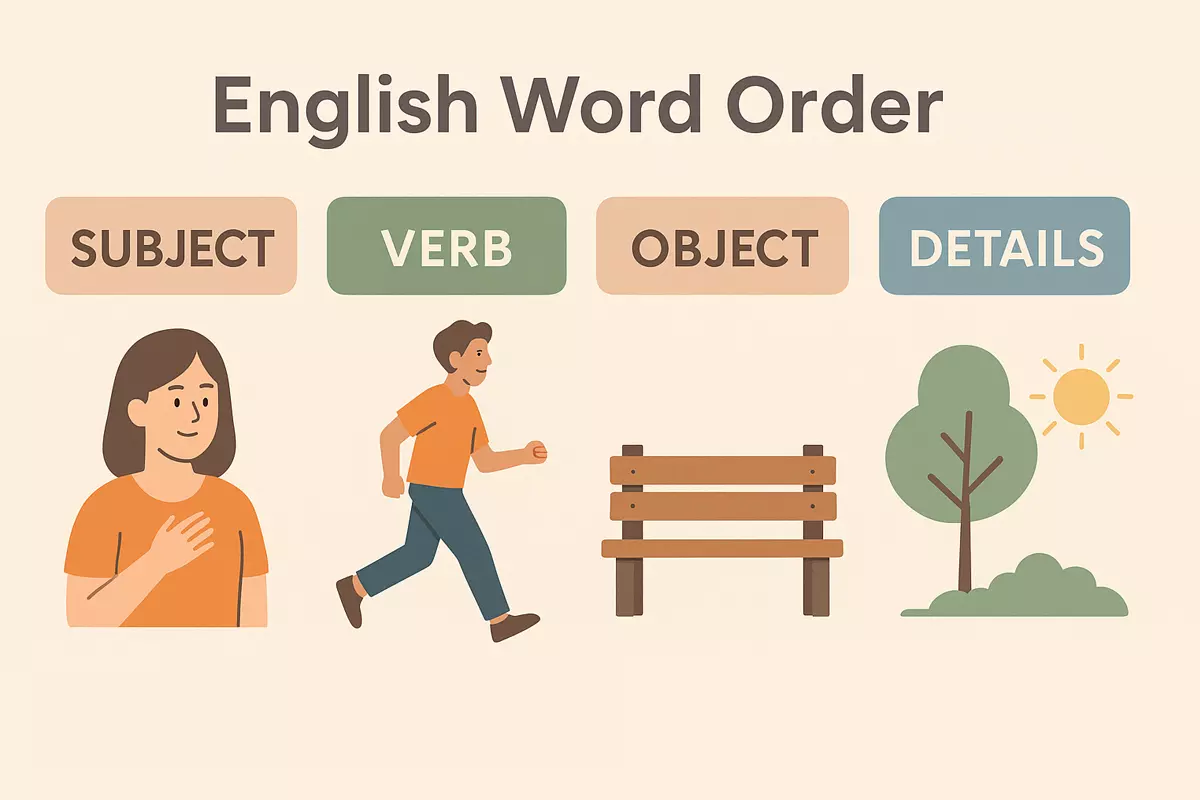 Here we basic English sentence patterns, shows where to add time and place details, and explains the correct positions for adjectives and adverbs. It also discusses word order in questions and provides practice with arranging sentences.
Mastering the arrangement of words in English sentences is essential for effective communication. By understanding the usual order—identifying who is performing an action, what the action is, and who or what receives it—you can significantly improve your ability to express ideas clearly and ensure that others easily understand your message. This awareness not only helps you construct sentences more confidently but also allows you to engage more naturally in conversations, both in writing and speaking.
Basic Sentence Pattern
Most English statements follow a clear structure: the subject comes first, followed by the verb, and then the object. This arrangement helps listeners and readers quickly understand who is doing what to whom. After these core parts, extra information like time, place, or manner can be added to give more context.
Core Elements in Order
- Subject (S): The person or thing performing the action.
- Verb (V): The action or state.
- Object (O): The receiver of the action (if there is one).
- Details: Extra information, such as when, where, why, or how.
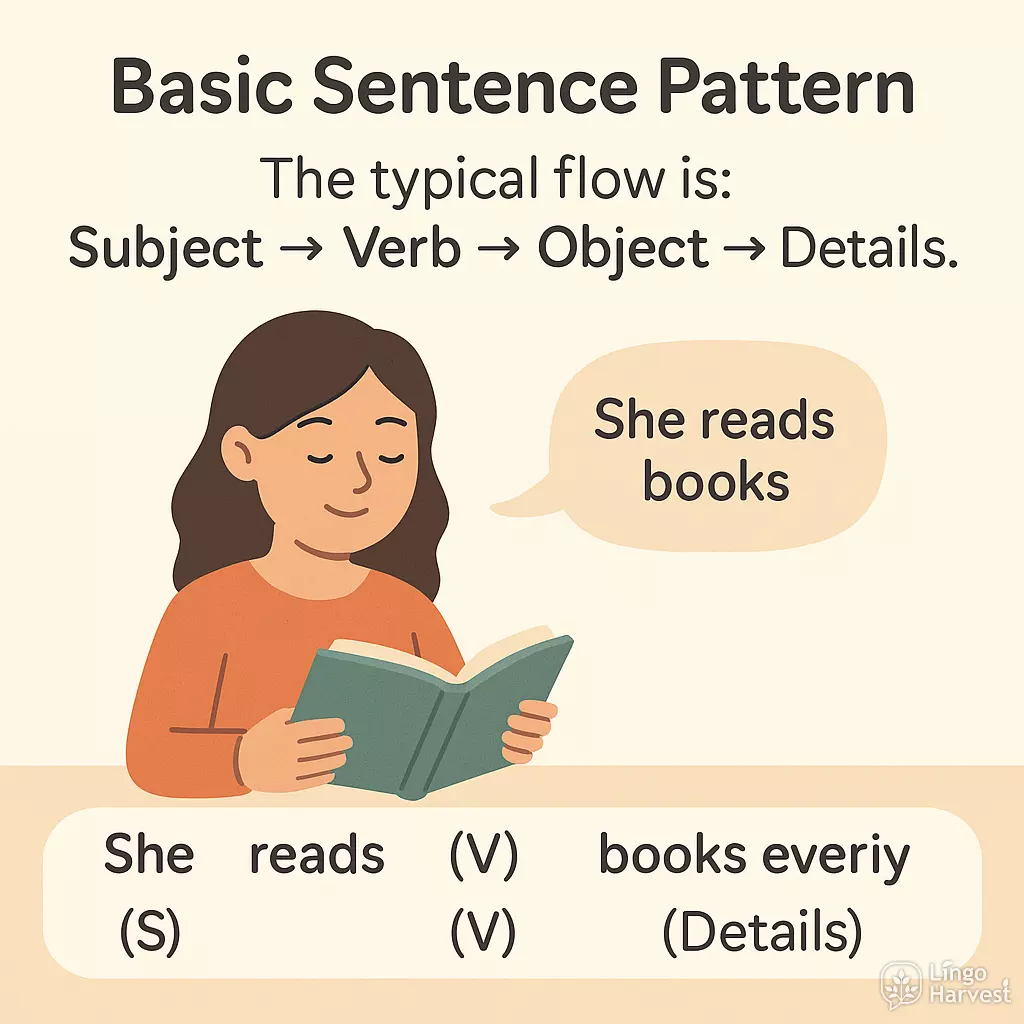
The typical flow is: Subject → Verb → Object → Details. For example: She (S) reads (V) books (O) every evening (Details).
Common Patterns and Examples
English sentences can sometimes omit the object or add more details. Here are several patterns with sample sentences:
- S + V: Birds sing.
- S + V + O: He likes pizza.
- S + V + O + Detail: They watch movies on weekends.
- S + V + O + Place: I left my bag at home.
- S + V + O + Time: She drinks coffee in the morning.
- S + V + O + Manner: We solved the problem easily.
- S + V + O + Reason: He called me because he was late.
- S + V + O + Two Details: She met her friend at the park yesterday.
- S + V + Adjective: The soup smells delicious.
- S + V + Prepositional Phrase: The cat sleeps on the sofa.
- S + V + O + Question Tag: You finished your homework, didn’t you?
- S + V + O + Frequency: They play tennis every Friday.
- S + V + O + Purpose: I went to the store to buy milk.
- S + V + O + Instrument: She cut the paper with scissors.
- S + V + Two Objects: He gave his friend a gift.
Comparing Sentence Structures
| Structure | Example Sentence |
|---|---|
| S + V | The sun rises. |
| S + V + O | Lisa reads books. |
| S + V + O + Detail | We eat dinner at 7 p.m. |
| S + V + O + Place + Time | Tom studies English at home every night. |
| S + V + O + Manner | They solved the puzzle quickly. |
Understanding this order makes it easier to create clear, natural sentences in English. As you practice, try rearranging different parts to see how meaning changes or if the sentence still sounds natural.
Where to Add Time and Place Details
In English sentences, extra information about time and place generally comes after the main parts: subject, verb, and object. These details help answer questions like "when?" and "where?" something happens. Placing them correctly makes your statements clear and natural.
Standard Position in Sentences
Usually, time and place elements appear at the end of the sentence, following any objects. For example:
- She reads books in the library every afternoon.
- We met at the café yesterday.
When both are present, place typically comes before time. However, it is possible to rearrange them for emphasis or style, but the default order feels most natural in everyday speech.
Examples of Time and Place Phrases
Here are common phrases that indicate location and time:
- at home → I stayed at home to finish my work.
- in the morning → She usually goes for a run in the morning.
- on Main Street → The café is located on Main Street.
- last week → We met last week to discuss the project.
- in the park → The children were playing in the park.
- next year → He plans to move abroad next year.
- at the bus stop → They were waiting at the bus stop.
- on Friday → The meeting is scheduled on Friday.
- at 9 o’clock → The class starts at 9 o’clock.
- in London → She studied in London for two years.
- during the holidays → We traveled a lot during the holidays.
- every night → He reads for thirty minutes every night.
- on the weekend → We usually relax on the weekend.
- before dinner → Let’s talk before dinner.
- after work → She goes to the gym after work.
- in July → They’re getting married in July.
Comparing Word Order Options
Sometimes, you may want to put time or place at the beginning for emphasis. This is common in writing, storytelling, or when setting the scene. The table below shows how these details can move in a sentence:
| Sentence Structure | Example |
|---|---|
| Standard: Subject + Verb + Object + Place + Time | She played tennis in the park yesterday. |
| Time First: Time + Subject + Verb + Object + Place | Yesterday, she played tennis in the park. |
| Place First: Place + Subject + Verb + Object + Time | In the park, she played tennis yesterday. |
| Object in Focus: Subject + Verb + Object + Time + Place | She played tennis yesterday in the park. |
Tips for Natural Word Order
- Keep location before time when both are at the end: at school today.
- Move time or place to the front only for emphasis or variety.
- Don’t split the verb from its object with time or place information.
- Use commas when time or place starts the sentence: After lunch, we went shopping.
Mastering the position of these details will help your sentences flow more naturally and make your meaning clearer.
Adjective and Adverb Positions
Knowing where to place descriptive words and modifiers is essential for clear English sentences. Both adjectives and adverbs have “typical” locations, but there are exceptions and special patterns to be aware of.
Where Adjectives Go
Adjectives usually come directly before the noun they describe. For example, in “a red apple,” the word “red” sits before “apple.” Multiple adjectives follow a particular order, such as “a big old brown dog.” Sometimes, adjectives appear after linking verbs (like “be,” “seem,” “become”): “The sky is blue.”
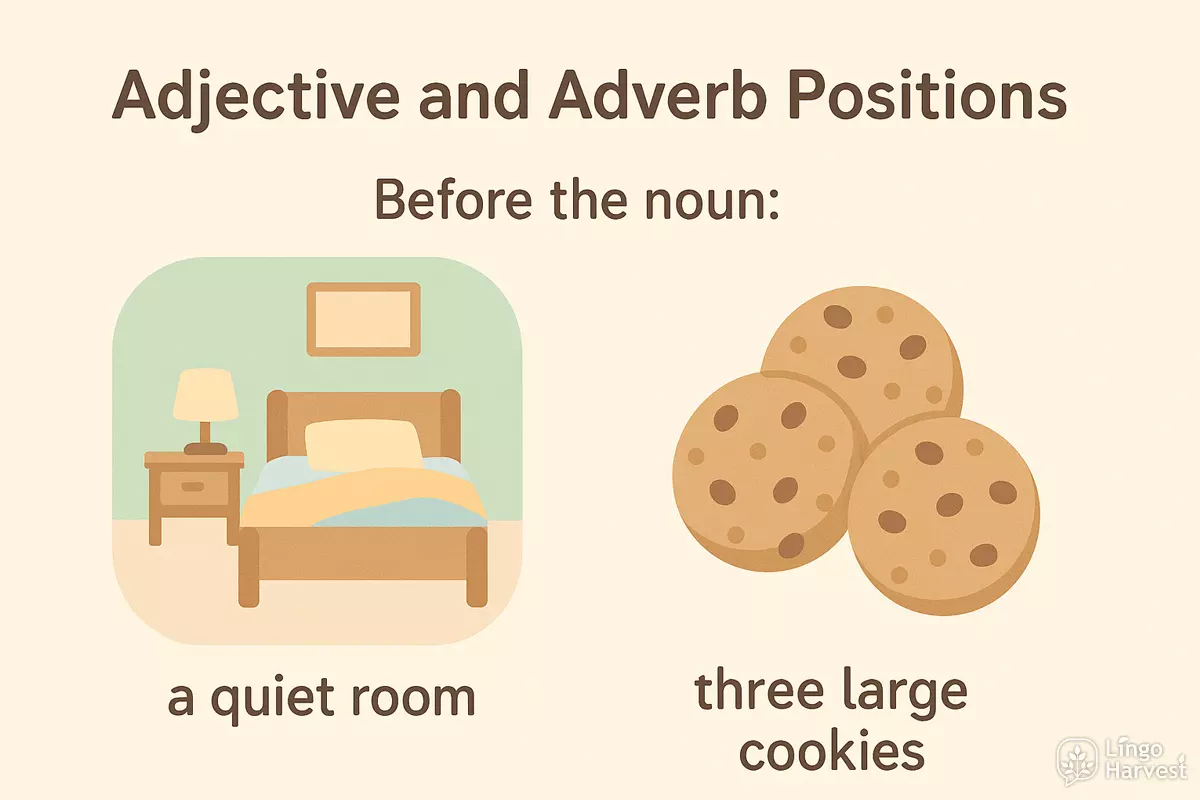
- Before the noun: a quiet room, three large cookies
- After a linking verb: The cake smells delicious.
- After certain pronouns: something interesting, nothing new
- Fixed expressions: Attorney General, Secretary General
Placing Adverbs
Adverbs can modify verbs, adjectives, or entire sentences. Their position depends on what they describe. Most commonly, adverbs of manner (how?) come after the main verb or at the end of the sentence: “She sings beautifully.” Adverbs of frequency (how often?) often go before the main verb but after “be”: “He always arrives early,” “She is often late.”
| Modifier Type | Typical Placement & Example |
|---|---|
| Adjective (single) | Before the noun: a cold drink |
| Adjective (after ‘be’) | After the verb: The answer is correct. |
| Adverb of frequency | Before main verb: She usually walks. After “be”: He is always calm. |
| Adverb of manner/place/time | Usually after the verb/object: He spoke quietly. / She waited outside. / They left yesterday. |
| Sentence adverbs | At the start or between subject and verb: Unfortunately, we were late. |
Common Patterns and Examples
Here’s a selection of common placements for modifiers in English sentences:
- He quickly finished his homework.
- They are extremely happy.
- We often visit our grandparents.
- That is absolutely right.
- She walked silently into the room.
- This is something useful.
- The cat is very old.
- He rarely eats breakfast.
- I have a small red notebook.
- Honestly, I didn’t know.
- It’s surprisingly easy.
- We met yesterday evening.
- The food smells delicious.
- She became nervous.
- This solution is completely new.
- You answered correctly.
- He always forgets his keys.
- The tall, friendly man waved.
Paying attention to where you place adjectives and adverbs helps your sentences sound natural and clear. If in doubt, check if the modifier describes a noun (use it close to the noun) or a verb/action (put it near the verb or at the end). Some exceptions exist, but these guidelines cover most everyday usage.
Inversions in Questions
When forming questions in English, the typical word order changes from the standard Subject-Verb-Object pattern. Instead, the verb or auxiliary often comes before the subject. This rearrangement is called inversion and is a core feature of English interrogative sentences.
Basic Patterns
Most yes/no questions use auxiliary verbs (like do, is, have) or modal verbs (such as can, will). In these cases, the auxiliary or modal verb appears before the subject, followed by the main verb or complement:
- Are you ready?
- Do they play chess?
- Can she swim?
- Will we meet tomorrow?
- Has he arrived?
Wh- Questions
For questions starting with wh-words (who, what, where, when, why, how), the question word comes first, followed by the auxiliary or modal, then the subject and main verb:
- Where are they going?
- What did you eat?
- How can we help?
- Why was she late?
Question Word Order: Comparison Table
| Statement | Question (Inversion) |
|---|---|
| You are happy. | Are you happy? |
| She can sing. | Can she sing? |
| They will leave. | Will they leave? |
| He has finished. | Has he finished? |
| We eat lunch. | Do we eat lunch? |
Common Cases Where Inversion Occurs
- With auxiliary verbs in simple present/past (Do/Does/Did): Did she call?
- In present/past continuous: Are you coming?
- With modal verbs: Could he help?
- For questions with have as an auxiliary: Have you seen it?
- Using be as the main verb: Is he a doctor?
- With negative adverbials (advanced): Never have I seen this.
- After so and neither: So do I.
- Conditional inversions (formal): Had I known, I would have acted.
- Tag questions: You’re coming, aren’t you?
- After here/there (for emphasis): Here comes the bus.
Notes on Usage
In spoken English, inversion is essential for forming questions clearly. Without this structure, statements and questions could sound identical, leading to confusion. While some question forms in informal speech may drop inversion (especially in very casual contexts), standard usage requires it for clarity.
Remember, the main verb never directly inverts with the subject except with be as the main verb (Is she your teacher?). Otherwise, an auxiliary is needed for the switch. Mastering this pattern is key for both asking and answering questions naturally in English.
Practice: Arrange the Words Correctly
Understanding the basic sequence of subject, verb, object, and details is key to forming clear English sentences. Below, you'll find a variety of exercises designed to help you put words in the correct order. Try to figure out the logical structure before peeking at the solutions.
Task 1: Reorder the Jumbled Sentences
Each group of words below forms a simple sentence, but the order is mixed up. Rearrange the words to create a correct English sentence.
- book / reads / she / every morning
- the / at / dog / barks / strangers
- quickly / the / runs / child / playground / in the
- to the store / I / yesterday / went
- plays / music / beautifully / he
- after work / meets / she / friends / her
- at 7 o’clock / starts / the / class
- carefully / the / opened / box / he
- in the evening / watches / TV / they
- to school / every day / walks / the boy
Show answers
- She reads a book every morning.
- The dog barks at strangers.
- The child runs quickly in the playground.
- I went to the store yesterday.
- He plays music beautifully.
- She meets her friends after work.
- The class starts at 7 o’clock.
- He carefully opened the box.
- They watch TV in the evening.
- The boy walks to school every day.
Task 2: Identify the Sentence Parts
Look at each sentence and label the parts: subject (S), verb (V), object (O), and details (D). Example: I (S) eat (V) apples (O) every day (D).
- The teacher explains the lesson clearly.
- My friends play football in the park.
- We visited the museum last weekend.
- She always drinks coffee in the morning.
- The students completed the task on time.
- He reads the news every evening.
- They watched the movie at home.
- I finished the report yesterday.
- The child opened the door carefully.
- She practices piano after school.
Show answers
- The teacher (S) explains (V) the lesson (O) clearly (D).
- My friends (S) play (V) football (O) in the park (D).
- We (S) visited (V) the museum (O) last weekend (D).
- She (S) always drinks (V) coffee (O) in the morning (D).
- The students (S) completed (V) the task (O) on time (D).
- He (S) reads (V) the news (O) every evening (D).
- They (S) watched (V) the movie (O) at home (D).
- I (S) finished (V) the report (O) yesterday (D).
- The child (S) opened (V) the door (O) carefully (D).
- She (S) practices (V) piano (O) after school (D).
Task 3: Build Sentences Using the Correct Order
Use the prompts to create sentences with the right sequence. Add any missing words as needed.
- Anna / homework / do / after school
- rain / heavily / last night
- they / new restaurant / try / tomorrow
- bird / sing / tree / morning
- we / movie / watch / evening
- he / email / send / yesterday
- children / park / play / afternoon
- she / coffee / drink / morning
- teacher / lesson / explain / clearly
- I / report / finish / on time
Show answers
- Anna does her homework after school.
- It rained heavily last night.
- They will try the new restaurant tomorrow.
- The bird sings in the tree every morning.
- We watch a movie in the evening.
- He sent the email yesterday.
- The children play in the park in the afternoon.
- She drinks coffee in the morning.
- The teacher explains the lesson clearly.
- I finished the report on time.
Common Sentence Patterns
Here are several examples of correct sentence order. Notice how the subject, verb, object, and extra details fit together:
- John eats breakfast at 7 a.m.
- The children watch cartoons on weekends.
- We are studying English now.
- She sent an email yesterday.
- They built a sandcastle on the beach.
- My brother drives to work every day.
- Lisa bought a new dress last week.
- The bus leaves at 8 o’clock.
- He cleaned the kitchen this morning.
- The cat sleeps under the table.
- Our team won the match easily.
- I saw a movie last night.
Summary Table: Sentence Structure Examples
| Example Sentence | Order Breakdown |
|---|---|
| Mary opens the window quietly. | Subject + Verb + Object + Detail |
| They play chess every Friday. | Subject + Verb + Object + Detail |
| The children are reading books in the library. | Subject + Verb + Object + Detail |
| I will call you tomorrow. | Subject + Verb + Object + Detail |
| He quickly finished his homework. | Subject + Adverb + Verb + Object |
| We went to the cinema last weekend. | Subject + Verb + Detail + Detail |
Practicing the correct word sequence helps you write and speak more accurately. Use these activities to reinforce your understanding of English sentence construction.