Search the site
Search
Grammar ▾
▸ Articles
▸ Advanced Grammar
▸ Adjectives & Adverbs
▸ Conjunctions
▸ Conditionals
▸ Determiners
▸ Gerunds & Infinitives
▸ Grammar Practice
▸ Modal Verbs
▸ Nouns
▸ Parts of Speech
▸ Passive Voice
▸ Prepositions
▸ Pronouns
▸ Quantifiers
▸ Question Formation
▸ Reported Speech
▸ Verbs
Writing ▾
▸ Punctuation
▸ Sentence Structure
▸ Writing Mistakes
Vocabulary ▾
▸ Visual Vocabulary
▸ Food Vocabulary
▸ People Vocabulary
▸ Places Vocabulary
▸ Hobbies Vocabulary
▸ Home Vocabulary
▸ School Vocabulary
▸ Weather Vocabulary
▸ Basic Vocabulary
▸ General Vocabulary
Speaking ▾
▸ Conversational English
Calculators
Contacts
Home
» A1–A2 Beginner
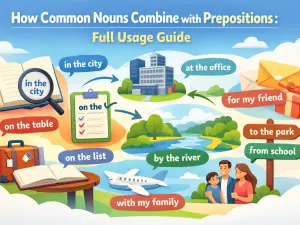
How Common Nouns Combine with Prepositions: Full Usage Guide
The article explains why many nouns require fixed prepositions, highlights everyday collocations like problem with and interest in, compares abstract and concrete patterns, shows how to spot these chunks in texts, addresses common mistakes, and offers practice tasks.
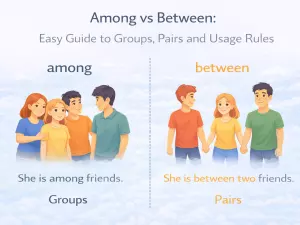
Among vs Between: Easy Guide to Groups, Pairs and Usage Rules
Here we when to use among or between, explaining both traditional and modern grammar rules. It discusses their use with people and things, gives real-life and academic examples, highlights common errors, and offers practice correcting misuse.
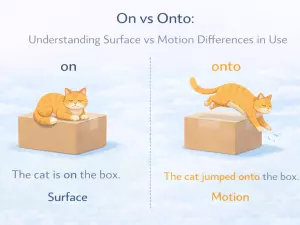
On vs Onto: Understanding Surface vs Motion Differences in Use
This article explains how on means contact with a surface, while onto shows movement or direction. It covers verbs that prefer onto, when on replaces onto in casual speech, formal versus informal use, and includes practice exercises.
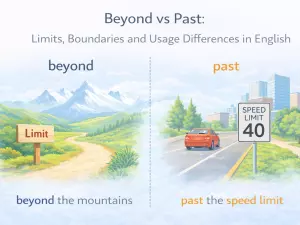
Beyond vs Past: Limits, Boundaries and Usage Differences in English
This article explains how beyond and past are used to express limits, movement, and abstract ideas like ability or belief. It covers typical collocations, context-based usage, and offers practice rewriting sentences using these words.
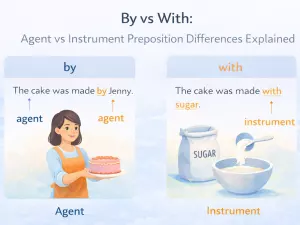
By vs With: Agent vs Instrument Preposition Differences Explained
This article explains how by shows the agent in passive voice and with signals tools or instruments. It covers their roles in action and transport phrases, common learner mistakes, and offers practice changing active to passive sentences.
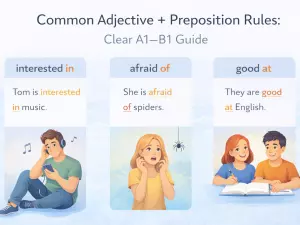
Common Adjective + Preposition Rules: Clear A1–B1 Guide
Here we what adjective plus preposition patterns are, common pairs for A1–B1 learners, how prepositions change adjective meanings, differences between similar patterns like good at and good for, typical mistakes, and short practice ideas.
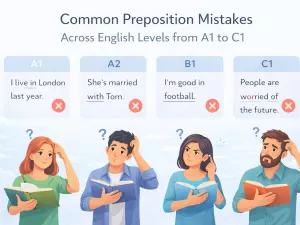
Common Preposition Mistakes Across English Levels from A1 to C1
Here we why prepositions are challenging from A1 to C1, details typical mistakes at each level, and provides strategies, practice tasks, and a checklist to help you recognize, diagnose, and improve your preposition use over time.
Around vs About: Movement, Approximation and Meaning Differences
Here we how around expresses movement in space, about indicates approximate numbers or time, and discusses regional and style differences. It also reviews fixed expressions, common learner mistakes, and provides practice correcting around and about.
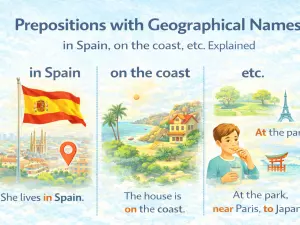
Prepositions with Geographical Names: in Spain, on the coast, etc.
This article explains when to use in, on, and at with countries, cities, borders, coasts, and addresses. It covers common travel phrases, tricky place names, and offers practice for describing locations on a simple map.
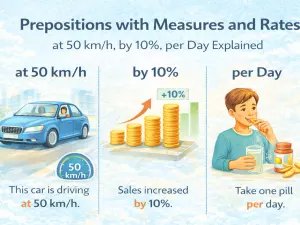
Prepositions with Measures and Rates: at 50 km/h, by 10%, per Day
The article explains how to use at for speeds and rates, by for expressing percentage changes, and per for frequency and distribution. It covers combining these with time or quantity, gives km/h and mph examples, and includes sentence practice.
Previous
1
...
11
12
13
14
15
16
17
18
19
...
34
Next