Search the site
Search
Grammar ▾
▸ Articles
▸ Advanced Grammar
▸ Adjectives & Adverbs
▸ Conjunctions
▸ Conditionals
▸ Determiners
▸ Gerunds & Infinitives
▸ Grammar Practice
▸ Modal Verbs
▸ Nouns
▸ Parts of Speech
▸ Passive Voice
▸ Prepositions
▸ Pronouns
▸ Quantifiers
▸ Question Formation
▸ Reported Speech
▸ Verbs
Writing ▾
▸ Punctuation
▸ Sentence Structure
▸ Writing Mistakes
Vocabulary ▾
▸ Visual Vocabulary
▸ Food Vocabulary
▸ People Vocabulary
▸ Places Vocabulary
▸ Hobbies Vocabulary
▸ Home Vocabulary
▸ School Vocabulary
▸ Weather Vocabulary
▸ Basic Vocabulary
▸ General Vocabulary
Speaking ▾
▸ Conversational English
Calculators
Contacts
Home
» A1–A2 Beginner
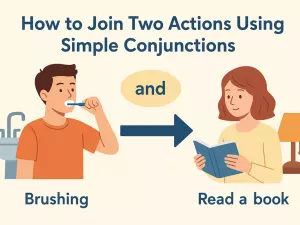
How to Join Two Actions Using Simple Conjunctions
Here we how to use basic conjunctions to join actions, including connecting verbs with and, but, or, showing sequence, making choices, and avoiding sentence fragments. It also offers practice combining short action sentences.
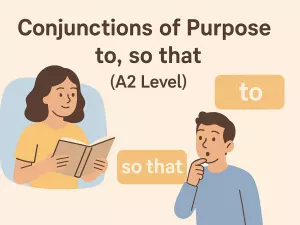
Conjunctions of Purpose: to, so that (A2 Level)
Here we what a purpose clause is, how to express purpose with to plus a verb or so that, and the differences in meaning and style between them. It also lists common verbs and includes practice rewriting sentences to show purpose.
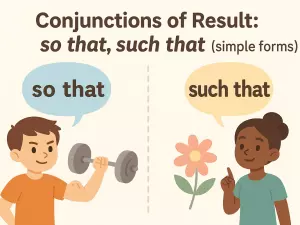
Conjunctions of Result: so that, such that (simple forms)
This article explains what a result clause is, why we use it, and shows how to use so that and such that for expressing results. It covers key patterns, common phrases, and provides practice for making clear result sentences.
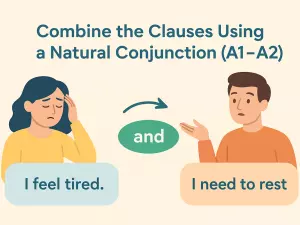
Combine the Clauses Using a Natural Conjunction (A1–A2)
Here we why joining short sentences makes English sound natural, how to pick the right conjunction for meaning, examples for each, patterns for combining ideas, and includes both guided and free exercises for practice.
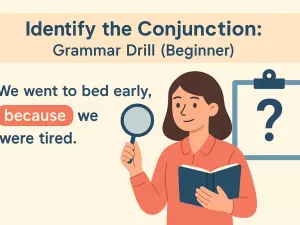
Identify the Conjunction: Grammar Drill (Beginner)
This article reviews what conjunctions look like, gives step-by-step sentence examples, and offers exercises to identify conjunctions, including mixed and challenge tasks. An answer key is included so you can check your work and improve your grammar.
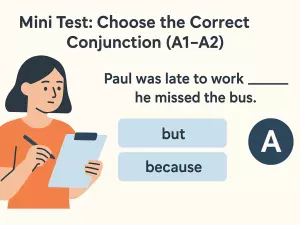
Mini Test: Choose the Correct Conjunction (A1–A2)
The article provides instructions for a mini test on basic English connectors. It features multiple-choice questions, tasks to choose the right conjunction, mixed practice with common connectors, an answer key with explanations, and a review guide.
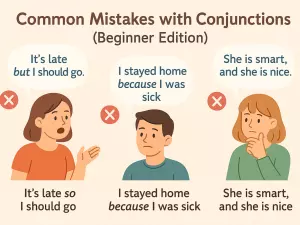
Common Mistakes with Conjunctions (Beginner Edition)
This article explains common mistakes with conjunctions like and, but, or, because, and so, such as run-on sentences, missing subjects, and starting sentences incorrectly. It gives step-by-step fixes and practice sentences to help you improve.
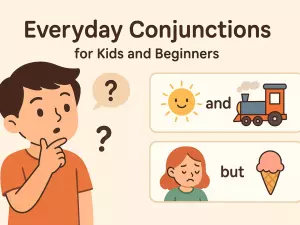
Everyday Conjunctions for Kids and Beginners
The article lists the most common everyday conjunctions, explains their meanings with simple examples, provides fun daily and story examples, shows short dialogues, gives memory tips, and includes fill-in-the-gap practice activities.
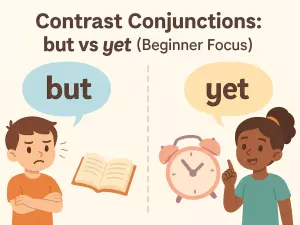
Contrast Conjunctions: but vs yet (Beginner Focus)
This article explains how contrast works in English sentences, focusing on using but for simple contrast and yet for surprising contrast. It compares their meanings, highlights common mistakes, and includes practice choosing the right word.
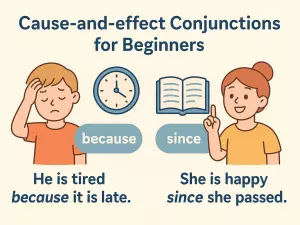
Cause-and-effect Conjunctions for Beginners: because, since
This article explains how to express cause and effect in everyday English sentences using because and since. It covers when to use each word, where to place reason clauses, punctuation rules, and includes practice matching reasons to results.
Previous
1
...
18
19
20
21
22
23
24
25
26
...
34
Next