Conjunctions of Result: so that, such that (simple forms)

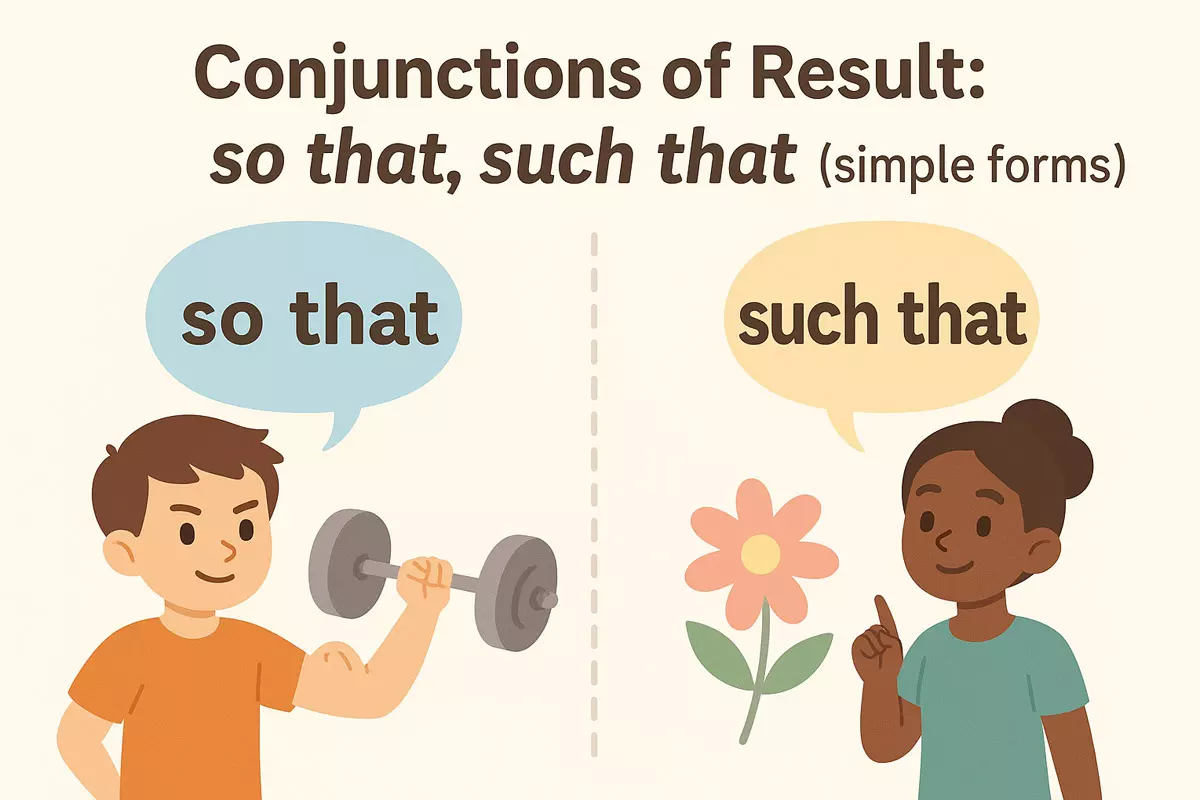 This article explains what a result clause is, why we use it, and shows how to use so that and such that for expressing results. It covers key patterns, common phrases, and provides practice for making clear result sentences.
- What a result clause is and why we use it
- Basic pattern with so that to show result
- Basic pattern with such that to show strong result
- Difference between cause-and-effect and simple result
- Common adjectives and expressions used with so that and such that
- Practice: complete sentences to show clear results
Expressing outcomes clearly in English often involves using connectors such as "so that" and "such that," which help link actions to their results or intentions. By incorporating these phrases into your sentences, you can clarify the purpose or expected effect of an action, making your communication more precise and understandable. For example, saying "I studied hard so that I could pass the exam" highlights the reason behind the action. Mastering these connectors enhances both written and spoken English by ensuring your explanations are smooth and your intentions are transparent.
What a result clause is and why we use it
A result clause explains the outcome or consequence of an action described in the main part of a sentence. In English, these clauses are used to show that one event is the direct result of another. This helps us connect two ideas clearly, showing cause and effect in a single sentence. Using result clauses makes our communication more precise and helps listeners or readers understand not just what happened, but why it happened.
Purpose of result clauses
We use result clauses to answer questions like "What happened because of this?" or "What was the effect?" They allow us to join two ideas: the cause (main clause) and the effect (result clause), often with conjunctions such as so that and such that. This structure is common in both spoken and written English, especially when explaining reasons or consequences.
- Clarifies consequences: Helps the listener understand what followed from the first action.
- Avoids repetition: Combines two ideas smoothly without repeating information.
- Improves flow: Makes sentences more fluid and logical.
- Shows cause and effect: Clearly links actions to their outcomes.
Common result conjunctions and their functions
The most frequent connectors for result clauses are so that and such that. Each has its own usage patterns:
- so that → Used before a subject and verb to express purpose or result. Example: "She spoke quietly so that she wouldn't wake the baby."
- such that → Used with nouns or adjectives to emphasize the degree or extent of something. Example: "It was such a cold day that we stayed inside."
Examples of result clauses in context
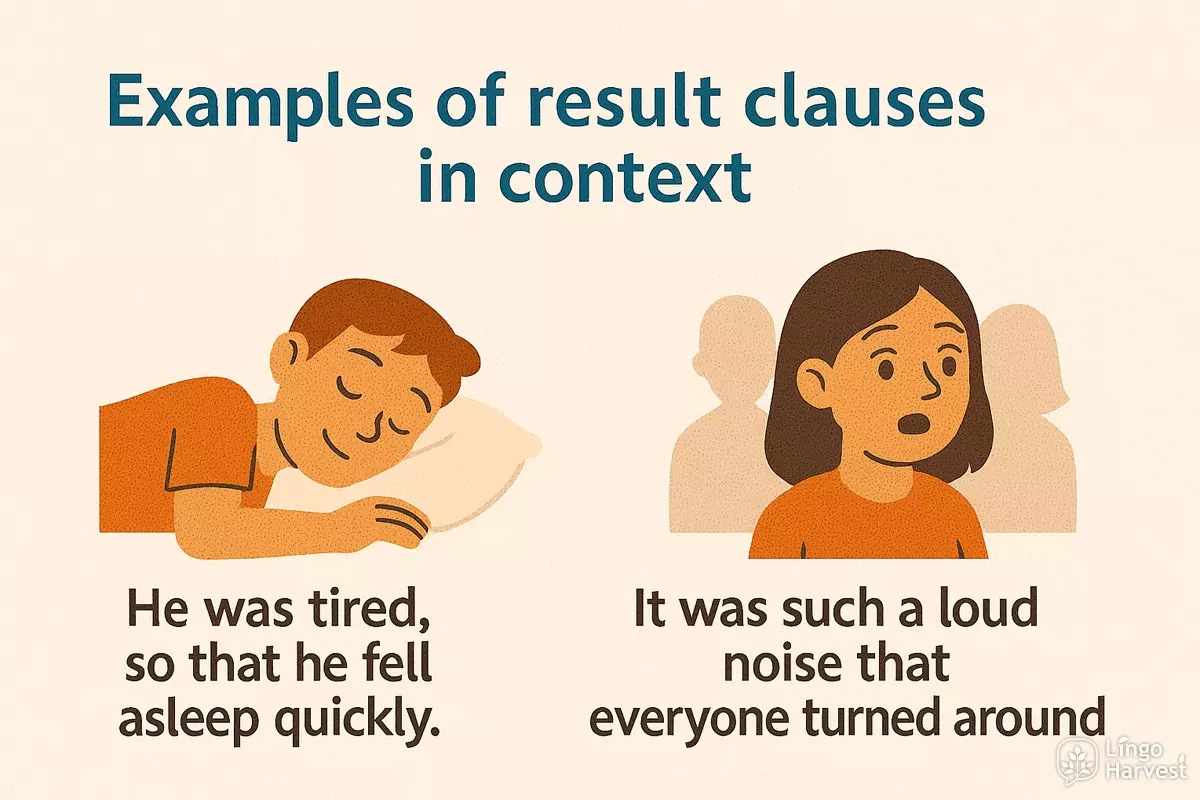
- He was tired, so that he fell asleep quickly.
- It was such a loud noise that everyone turned around.
- The weather was hot, so that we went swimming.
- She had such a busy schedule that she forgot her appointment.
- The movie was boring, so that we left early.
- He made such a delicious meal that everyone asked for seconds.
- The test was difficult, so that many students struggled.
- There was such heavy rain that the streets flooded.
- She ran fast, so that she caught the bus.
- It was such an interesting book that I read it in one day.
Why using result clauses matters
Including result clauses in your sentences can make your communication more natural and sophisticated. They help you express relationships between actions and outcomes without needing multiple sentences. Mastering these structures is important for clear, effective English, whether you're explaining a process, telling a story, or giving reasons for your opinions.
Basic pattern with so that to show result
"So that" is commonly used to connect two clauses, where the first clause presents an action or situation, and the second clause explains the purpose or result. In this structure, "so that" acts as a conjunction introducing the result or intended outcome of an action. Understanding this pattern helps clarify cause and effect in sentences.
Structure of sentences with "so that"
The typical construction involves an independent clause (main action) followed by "so that" and a dependent clause (result or purpose). Modals like "can," "could," "will," or "would" are often included in the result clause, indicating possibility or intention.
- He left early so that he could catch the first train.
- She lowered her voice so that nobody would hear.
- I’ll write it down so that I don’t forget.
- They saved money so that they could buy a house.
- We studied hard so that we would pass the exam.
- Close the window so that the room stays warm.
- He explained it again so that everyone understood.
- I set an alarm so that I wake up on time.
- She brought an umbrella so that she wouldn’t get wet.
- He spoke slowly so that we could follow him.
- We left early so that we wouldn’t be late.
- I wear glasses so that I can see better.
- He practiced every day so that he would improve.
- They took notes so that they could review later.
- She cooked extra so that there would be leftovers.
- I called ahead so that they knew we were coming.
Key points to remember
- "So that" is used for both present and past intentions or results.
- The verb in the result clause often uses a modal (can, could, will, would) to show possibility or purpose.
- Sometimes, "so that" clauses express unintended consequences, but more often, they show intended results.
Pattern breakdown
A simple model for this pattern is:
- Action/Reason + so that + Result/Purpose (with modal verb)
For example: "She left the light on so that she could find her way in the dark."
Basic pattern with such that to show strong result
The phrase "such that" is commonly used in English to emphasize a particularly strong or notable result or consequence, especially when you want to highlight the intensity or extremity of a situation. This structure helps make your sentences more precise and vivid, indicating not just any result, but one that is significant or remarkable.
How the structure works
Generally, "such that" connects a cause (or quality) to its powerful effect. The typical construction is:
- such + [noun/quality] + that + [result]
This pattern is different from just using "so...that," because "such that" often points out an exceptional or surprising outcome.
Examples of usage
Here are several examples to illustrate how this pattern is used to express strong or striking results:
- The noise was such that nobody could concentrate.
- Her dedication was such that she worked through the night.
- His explanation was such that everyone immediately understood.
- The storm was such that flights were canceled for days.
- The challenge was such that few dared to attempt it.
- The pressure was such that even experienced players made mistakes.
- The view was such that tourists stopped to take photos.
- The excitement was such that the crowd cheered for hours.
- The offer was such that he couldn’t refuse.
- Their friendship was such that they supported each other in any situation.
- The evidence was such that the jury reached a quick verdict.
- The need was such that volunteers arrived from other cities.
- The instructions were such that even a beginner could follow them.
- The confusion was such that nobody knew what to do next.
- The performance was such that the audience gave a standing ovation.
- The risk was such that most people avoided the area.
- The heat was such that the pavement melted.
- The demand was such that tickets sold out in minutes.
- The arrangement was such that everyone felt comfortable.
Key points to remember
- This pattern is useful for formal or written contexts.
- It often appears in academic, technical, or descriptive writing.
- It emphasizes the extent or intensity of a cause and its impact.
- Unlike "so that," which simply links cause and effect, "such that" signals a noteworthy or exceptional result.
Using "such that" in your sentences can help you express outcomes that are not just ordinary, but so significant that they deserve special attention. This construction is a powerful tool for making your language more expressive and precise.
Difference between cause-and-effect and simple result
Understanding when to use "so that" or "such that" depends on whether you want to express a direct cause with a purpose, or simply state a result that follows naturally. These two concepts are related but not identical, and each has its own typical language patterns.
Cause-and-effect: Explaining reasons and purposes
When you highlight a cause and its intended outcome, you often use conjunctions to show intention. For example, "so that" is used to explain why something is done:
- She left early so that she could catch the bus. → Purpose: catching the bus is the reason for leaving early.
- He whispered so that he wouldn't wake the baby. → The whispering is motivated by not wanting to disturb the baby.
In these sentences, the action is taken with a specific purpose in mind. The phrase following "so that" usually includes a subject and a modal verb (could, would, can, etc.).
Simple result: Stating what happened next
On the other hand, sometimes you only want to state a result, not a purpose. Here, "so" and "such that" are commonly used, but the meaning is more about the outcome than the intention behind the action. For example:
- It was raining, so we stayed inside. → The rain caused us to stay inside, but there’s no purpose implied.
- The soup was so hot that I couldn’t eat it. → The result of the soup’s temperature is that eating it was impossible.
- She spoke so quickly that I couldn't understand her.
- He made such a mess that we had to clean for hours.
These forms focus on what happened as a consequence, not on a goal or intention.
Comparison: Purpose vs. Result
| Purpose (Cause-and-effect) | Simple Result |
|---|---|
| She saved money so that she could travel. | She saved so much money that she traveled for a year. |
| He turned off his phone so that he wasn’t disturbed. | The noise was so loud that he turned off his phone. |
| They left early so that they would avoid traffic. | Traffic was so bad that they left early. |
| She took notes so that she could remember the lecture. | The lecture was so interesting that she took notes. |
Quick Reference List: Typical Patterns
- so that + subject + modal verb (can, could, will, would, etc.)
- so + adjective/adverb + that + result
- such + (a/an) + adjective + noun + that + result
- so + result (no purpose implied)
- such that + result (less common, usually formal or technical)
- so...that (degree of an adjective/adverb leads to a result)
- such...that (degree of a noun phrase leads to a result)
- so + clause (simple consequence)
- so as to (expresses purpose, more formal)
- in order that (purpose, formal/rare)
In summary, deciding between these structures depends on whether you wish to express an intended goal (the reason for the action) or simply report what happened as a consequence. Recognizing this distinction helps you choose the right conjunction and sentence pattern for clear, natural English.
Common adjectives and expressions used with so that and such that
When using result conjunctions like so that and such that, certain adjectives and descriptive phrases naturally fit to express degree, consequence, or effect. These combinations help to make statements about cause and effect clearer and more precise. Learners often encounter these patterns in both written and spoken English, especially when describing situations where one thing leads to another.
Typical adjectives for expressing degree
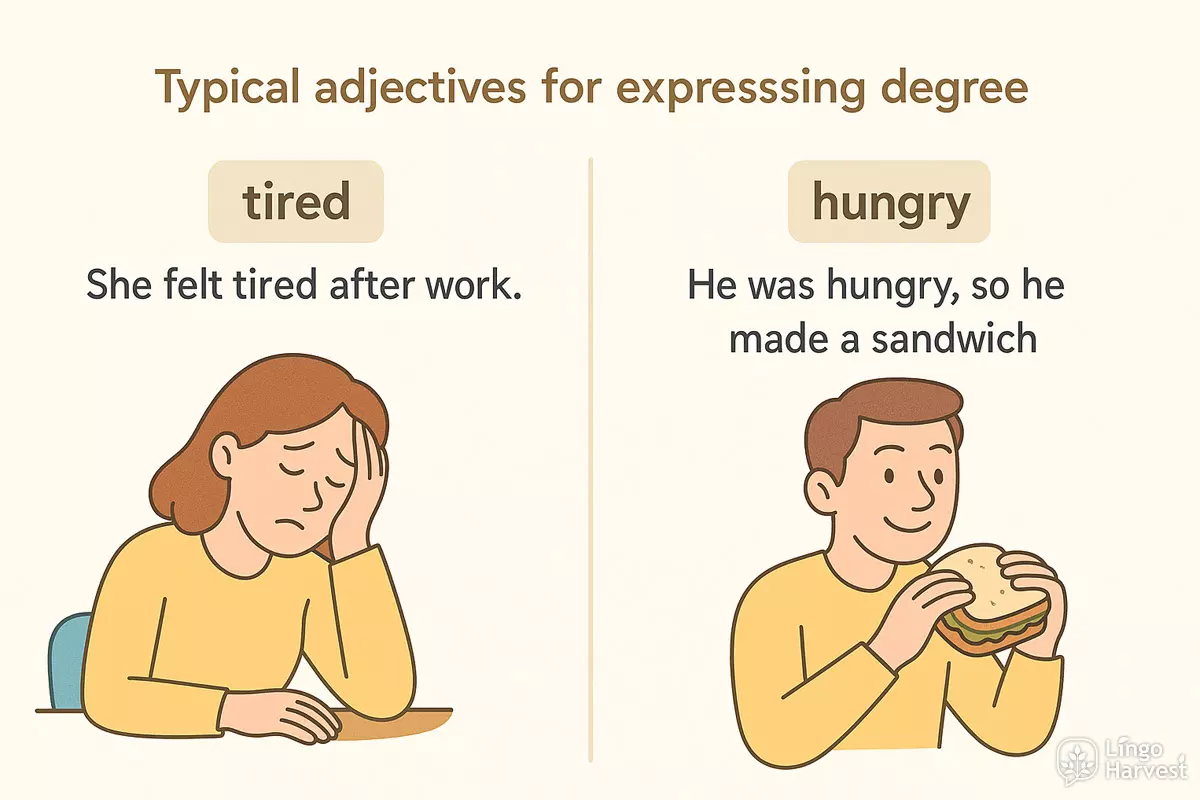
Some adjectives pair well with so that or such that to emphasize how strong, extreme, or notable a quality is. Here are some of the most frequently used ones:
- tired → She felt tired after work.
- hungry → He was hungry, so he made a sandwich.
- cold → It’s cold outside today.
- hot → The soup is too hot to eat.
- busy → I’m busy right now, call me later.
- excited → The kids are excited about the trip.
- happy → She looked happy with the results.
- angry → He was angry because the bus was late.
- loud → The music is too loud.
- quiet → The library is very quiet.
- quick → She gave a quick answer.
- slow → The internet is too slow today.
- late → He arrived late to the meeting.
- early → She woke up early this morning.
- expensive → That phone is very expensive.
- cheap → These shoes were really cheap.
- interesting → The book was interesting.
- boring → The lesson was boring.
- strong → He is strong enough to lift it.
- weak → After the flu, she felt weak.
Common expressions and intensifiers
Beyond single adjectives, certain expressions and adverbs intensify the result or set up the situation for so that and such that structures. These include:
- so much (noise, effort, rain, etc.)
- so many (people, problems, ideas, etc.)
- such a(n) (difficult task, beautiful place, wonderful day, etc.)
- such (good weather, bad luck, strong feelings, etc.)
- so little (time, money, space, etc.)
- so few (options, friends, opportunities, etc.)
- so well (prepared, organized, designed, etc.)
- so poorly (written, managed, executed, etc.)
Examples of usage patterns
To see how these adjectives and phrases fit with so that and such that, compare the following structures:
| Adjective/Expression | Example Sentence |
|---|---|
| so + adjective | She was so tired that she fell asleep instantly. |
| so + much/many + noun | There was so much noise that we couldn’t hear each other. |
| such + a/an + adjective + noun | It was such a difficult question that nobody could answer it. |
| such + adjective + uncountable noun | They had such bad luck that they missed the train again. |
| so + adverb | He spoke so quickly that I couldn’t follow. |
Choosing the right adjective or expression helps your sentence sound natural and clear. Notice how intensifiers like so and such set up the result, making it easy to express cause and effect with these conjunctions.
Practice: complete sentences to show clear results
To clearly express the outcome or consequence of an action, English often uses conjunctions like so that and such that. These patterns help listeners understand the purpose or result of what is being described. Below, you’ll find practical exercises and examples to reinforce how these conjunctions signal results.
Complete the Sentences
Fill in the blanks using so that or such that to show the result or purpose. Make sure the sentences are logical and complete.
- I left early ________ I could catch the first train.
- The soup was ________ hot ________ I couldn't eat it right away.
- She spoke softly ________ the baby would not wake up.
- It was ________ a boring movie ________ many people left the theater.
- They studied hard ________ they would pass the exam.
- He ran ________ fast ________ he broke the school record.
- We closed the windows ________ the rain wouldn't come in.
- The cake was ________ delicious ________ everyone wanted a second piece.
- She worked late ________ she could finish the project on time.
- The mountain was ________ tall ________ we couldn't see the top.
Show answers
- so that
- so / that
- so that
- such / that
- so that
- so / that
- so that
- so / that
- so that
- so / that
Recognizing Patterns: "so that" vs. "such that"
Understanding the structure of these conjunctions can clarify when to use each one. Here’s a quick comparison:
| Conjunction | Pattern & Example | Usage Note |
|---|---|---|
| so that | Verb/Action + so that + result He whispered so that nobody would hear him. |
Shows purpose or intended result |
| so...that | so + adjective/adverb + that + result The test was so difficult that I couldn’t finish it. |
Highlights the degree or extent |
| such...that | such + (adjective) + noun + that + result It was such a cold day that schools closed. |
Emphasizes quality or type |
Write Your Own Sentences
- Create a sentence with so that to express a purpose.
- Make a sentence using so...that to show a strong result.
- Try one with such...that to emphasize the quality or intensity.
- Write a sentence with so that showing intention.
- Create one with so...that showing an extreme outcome.
- Make a sentence using such...that to highlight a strong characteristic.
- Use so that in a sentence about studying or work.
- Use so...that to describe something surprising.
- Use such...that to describe something emotional.
- Create a sentence with so that related to daily routine.
Show answers
- I set an alarm so that I wouldn't oversleep.
- The story was so interesting that I read it twice.
- She gave such a moving speech that everyone applauded.
- He saved money so that he could travel abroad.
- The exam was so difficult that many students failed.
- It was such a beautiful day that we stayed outside for hours.
- She works overtime so that she can finish the project.
- The movie was so funny that I couldn’t stop laughing.
- He told such a sad story that everyone went quiet.
- I wake up early so that I can exercise before work.
Practicing these structures helps you give clear, logical reasons and outcomes in your writing and speaking. Notice how the choice between so that and such that changes the focus of the sentence, either on the purpose, the extent, or the quality involved.