Search the site
Search
Grammar ▾
▸ Articles
▸ Advanced Grammar
▸ Adjectives & Adverbs
▸ Conjunctions
▸ Conditionals
▸ Determiners
▸ Gerunds & Infinitives
▸ Grammar Practice
▸ Modal Verbs
▸ Nouns
▸ Parts of Speech
▸ Passive Voice
▸ Prepositions
▸ Pronouns
▸ Quantifiers
▸ Question Formation
▸ Reported Speech
▸ Verbs
Writing ▾
▸ Punctuation
▸ Sentence Structure
▸ Writing Mistakes
Vocabulary ▾
▸ Visual Vocabulary
▸ Food Vocabulary
▸ People Vocabulary
▸ Places Vocabulary
▸ Hobbies Vocabulary
▸ Home Vocabulary
▸ School Vocabulary
▸ Weather Vocabulary
▸ Basic Vocabulary
▸ General Vocabulary
Speaking ▾
▸ Conversational English
Calculators
Contacts
Home
» B1–B2 Intermediate
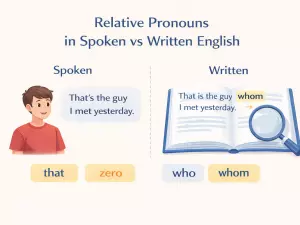
Relative Pronouns in Spoken vs Written English
The article compares how spoken and written English use relative pronouns, including patterns in pronoun frequency, omission in speech, punctuation and clause length, register-driven choices, typical learner mistakes, and includes practice rewriting sentences.
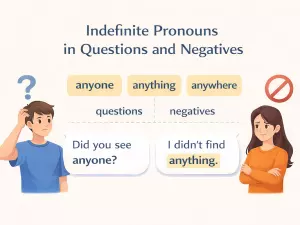
Indefinite Pronouns in Questions and Negatives
Here we how indefinite pronouns are used in questions and negatives, including any-, some-, and no- forms. It also covers meaning changes, common mistakes, spoken versus written usage, and offers practice rewriting questions and negatives.
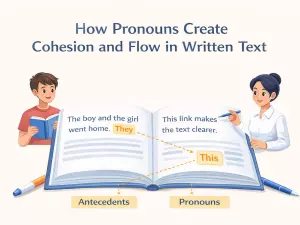
How Pronouns Create Cohesion and Flow in Written Text
This article explains text cohesion in writing, focusing on how pronouns link sentences and ideas. It covers managing references, balancing repetition, fixing cohesion problems, and editing techniques, with a practice section on revising paragraphs.
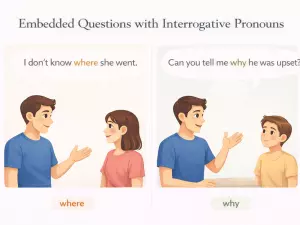
Embedded Questions with Interrogative Pronouns
Here we what embedded questions are, how their word order differs from direct questions, and how to use interrogative pronouns and common introducing verbs.
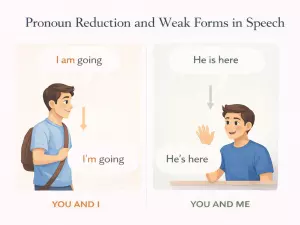
Pronoun Reduction and Weak Forms in Speech
Here we what weak forms are, why they matter, and how pronouns are reduced in fast speech. It discusses stress patterns, common reduced combinations, listening challenges, pronunciation versus spelling, examples, and practice activities.
Pronouns in Coordinated Phrases: You and I vs You and Me
Here we the use of coordinated phrases with pronouns in subject and object positions, discusses pronoun order and politeness, explains how to check correctness, highlights common mistakes, and provides practice for fixing pronouns.
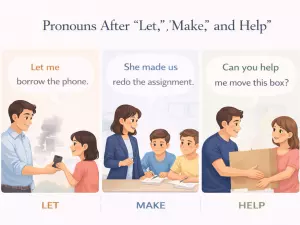
Pronouns After “Let”, “Make”, and “Help”
Here we how to use let, make, and help with correct verb patterns and object pronouns, including the difference between bare and to-infinitive after help, correct word order, passive forms, common mistakes, and provides practice with examples.
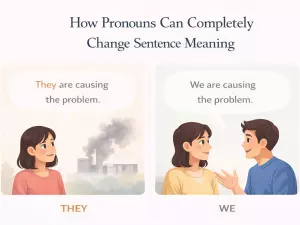
How Pronouns Can Completely Change Sentence Meaning
This article explains how changing pronouns can shift meaning, responsibility, or agency, and cause ambiguity. It provides examples, highlights common learner errors, and offers editing strategies and practice for identifying and correcting meaning shifts.
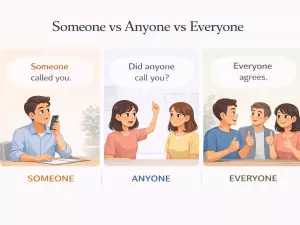
Someone vs Anyone vs Everyone: Meaning and Tone
Here we the core meaning differences between someone, anyone, and everyone. It explains their use in statements, questions, and requests, discusses tone, formality, common learner errors, and offers context-based practice.
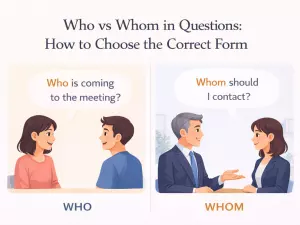
Who vs Whom in Questions: How to Choose the Correct Form
Here we why who and whom can be confusing in questions, explains their subject and object roles, preposition use, formal versus informal patterns, when who is acceptable, common mistakes, tests for correctness, and offers practice questions.
Previous
1
...
16
17
18
19
20
21
22
23
24
...
43
Next