Grammar ▾
▸ Articles ▸ Advanced Grammar ▸ Adjectives & Adverbs ▸ Conjunctions ▸ Conditionals ▸ Determiners ▸ Gerunds & Infinitives ▸ Grammar Practice ▸ Modal Verbs ▸ Nouns ▸ Parts of Speech ▸ Prepositions ▸ Pronouns ▸ Quantifiers ▸ Question Formation ▸ Reported Speech ▸ Verbs
Writing ▾
▸ Punctuation ▸ Sentence Structure ▸ Writing Mistakes
Vocabulary ▾
▸ Visual Vocabulary ▸ Food Vocabulary ▸ People Vocabulary ▸ Places Vocabulary ▸ Hobbies Vocabulary ▸ Home Vocabulary ▸ School Vocabulary ▸ Weather Vocabulary ▸ Basic Vocabulary ▸ General Vocabulary
Speaking ▾
▸ Conversational English
Calculators Contacts
Home » B1–B2 Intermediate

Second Conditional: Unreal or Hypothetical Present Situations

Second Conditional: Unreal or Hypothetical Present Situations
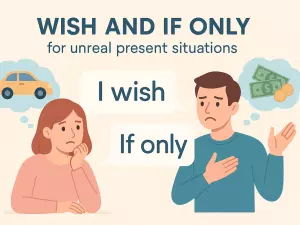
Here we how the second conditional describes unreal or hypothetical present situations, its structure with if and past simple plus would, differences from real future meaning, use of could and might, typical contexts, common tense mistakes, and practice…

Subordinating Conjunctions: Full List and Functions

Subordinating Conjunctions: Full List and Functions
The article compares main and subordinate clauses, defines subordinating conjunctions, and reviews common types like because, if, and although. It explains their uses, word order, punctuation rules, and offers practice matching each subordinator to its function.

Conjunctions of Reason: because, since, as (full comparison)

Conjunctions of Reason: because, since, as (full comparison)
This article explains how to use reason clauses in English, focusing on because, since, and as. It covers their differences in meaning, tone, and punctuation, and offers practice choosing the right conjunction for each situation.

Conjunctions of Contrast: although, though, whereas

Conjunctions of Contrast: although, though, whereas
The article explains how to express contrast using although, though, and whereas, including their specific uses, sentence placement, and comma rules. It also provides practice exercises for rewriting sentences with different contrast conjunctions.

Conjunctions of Condition: if, unless, provided that

Conjunctions of Condition: if, unless, provided that
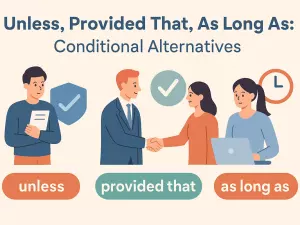
The article explains conditional meaning in grammar, details zero and first conditionals with if, shows how unless and provided that are used, compares if and unless, and highlights differences between spoken and written English. Practice exercises are included.

Conjunctions of Time (B1–B2): while, as soon as, once

Conjunctions of Time (B1–B2): while, as soon as, once
This article explains how time conjunctions like while, as soon as, and once order actions on a timeline. It covers their use in real examples, rules for tense, and tips for avoiding will in future sentences, plus practice exercises.

Conjunctions of Purpose: in order that, so that, lest

Conjunctions of Purpose: in order that, so that, lest
The article reviews purpose clauses, showing how and why we use so that, in order that, and lest. It explains their meanings, verb forms, frequency in modern English, and includes practice rewriting sentences with these conjunctions.

Conjunctions Showing Exception: except, except that

Conjunctions Showing Exception: except, except that
Here we the meaning of exceptions in grammar, explains how to use except and except that for different types of exclusions, highlights common mistakes with except and besides, and provides examples and practice sentences for clarity.

Conjunctions for Giving Alternatives: whether…or

Conjunctions for Giving Alternatives: whether…or
This article explains the difference between if and whether in reported and indirect questions, details the structure of whether…or with verbs and clauses, covers using whether…or not for outcomes, shows formal uses, common phrases, and practice…

Conjunctions for Showing Comparison: as…as, than

Conjunctions for Showing Comparison: as…as, than
This article reviews how to form comparative and equality structures in English, covers adjective and adverb comparisons with than, explains as…as usage, word order in long clauses, common mistakes, collocations, and provides practice sentences.
Previous 1 ... 28 29 30 31 32 33 34 35 36 ... 41 Next
English Learning Tools
  • CEFR Text Level Checker
  • Type-Token Ratio Calculator
  • Sentence Length & Clarity Analyzer
  • Reading Time Calculator
  • Dialogue vs Narrative Analyzer
  • Question Types Analyzer
  • Error Density Checker
  • English Learning Time Calculator
  • Syllable Counter
Popular Articles
Modal Verbs in Job Interview Questions and Answers
Using Modal Verbs for Regret and Criticism in English
Should Have vs Could Have vs Would Have Explained
Modal Verbs in Legal and Rule-Based Language
Modal Verbs Commonly Used in Professional Emails
Modal Verbs Used in Negotiation and Persuasion
About / Privacy Policy / Cookie Policy / Terms of Use

© 2025-2026 LingoHarvest — lingoharvest.com

Content on this website is provided for informational and educational purposes. You may share links to our pages; copying full texts is not permitted without permission.