Search the site
Search
Grammar ▾
▸ Articles
▸ Advanced Grammar
▸ Adjectives & Adverbs
▸ Conjunctions
▸ Conditionals
▸ Determiners
▸ Gerunds & Infinitives
▸ Grammar Practice
▸ Modal Verbs
▸ Nouns
▸ Parts of Speech
▸ Passive Voice
▸ Prepositions
▸ Pronouns
▸ Quantifiers
▸ Question Formation
▸ Reported Speech
▸ Verbs
Writing ▾
▸ Punctuation
▸ Sentence Structure
▸ Writing Mistakes
Vocabulary ▾
▸ Visual Vocabulary
▸ Food Vocabulary
▸ People Vocabulary
▸ Places Vocabulary
▸ Hobbies Vocabulary
▸ Home Vocabulary
▸ School Vocabulary
▸ Weather Vocabulary
▸ Basic Vocabulary
▸ General Vocabulary
Speaking ▾
▸ Conversational English
Calculators
Contacts
Home
» B1–B2 Intermediate
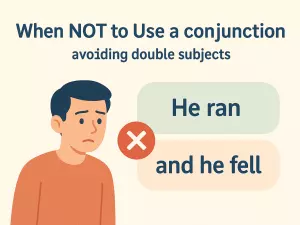
When NOT to Use a Conjunction: avoiding double subjects
This article explains why learners often add too many conjunctions, how to spot double subjects and double conjunctions, and when conjunctions are unnecessary. It covers compound predicates versus clauses, tips for fixing run-ons, and practice exercises.
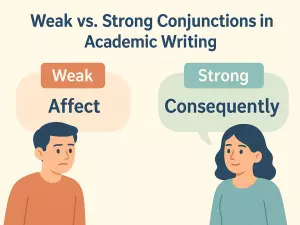
Weak vs Strong Conjunctions in Academic Writing
Here we why some conjunctions are weak in formal writing, gives examples of vague choices, and suggests stronger alternatives like however and moreover. It also covers how precise conjunctions improve cohesion and offers practice with sample paragraphs.
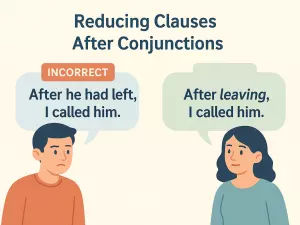
Reducing Clauses After Conjunctions (B2 level)
Here we clause reduction, showing how to shorten time, reason, and contrast clauses with conjunctions using -ing forms or past participles. It also discusses differences in spoken and written English and provides practice with rewriting clauses.
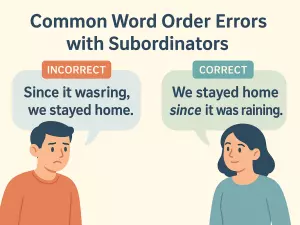
Common Word Order Errors with Subordinators
Here we sentence structure with subordinating conjunctions, common word order errors with subjects, verbs, and adverbs, differences when subordinate clauses lead, examples of confusing sentences, and provides word order practice with subordinators.
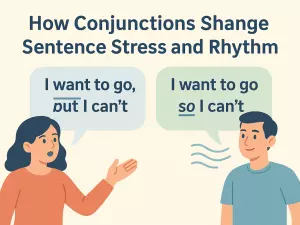
How Conjunctions Change Sentence Stress and Rhythm
Here we sentence stress and rhythm for B1–B2 learners, explains how conjunctions change word grouping and stress patterns, highlights contrastive stress with but, yet, although, and guides on placing pauses. It includes practice with reading aloud.
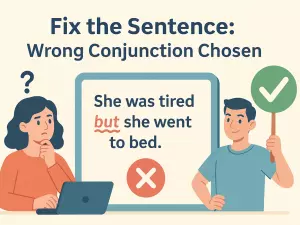
Fix the Sentence: Wrong Conjunction Chosen (B1–B2)
Here we common errors in choosing conjunctions, provides mismatched examples, and offers steps to identify relationships like time, reason, contrast, or condition.
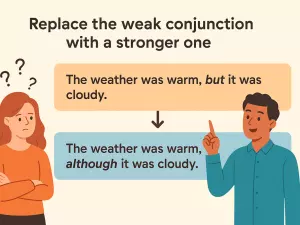
Replace the Weak Conjunction with a Stronger One
The article reviews weak versus strong conjunctions for intermediate learners, highlights vague and effective linking words by function, offers practice exercises at sentence and paragraph levels, and includes an answer key with expert suggestions for improvement.
Paragraph Practice: Choose the Best Conjunction (B1–B2)
This article explains how choosing the right conjunctions shapes paragraph flow and logic. It includes a gap-fill exercise, a conjunction selection task, a writing activity, and an answer key with model and alternative solutions.
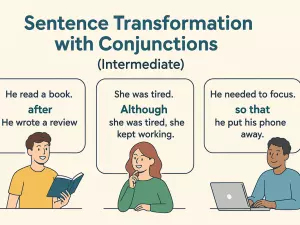
Sentence Transformation with Conjunctions (Intermediate)
This article explains sentence transformation tasks as found in exams and textbooks. It covers patterns like because to so, although to but, and if to unless, offers practice exercises, challenge tasks, and detailed step-by-step answer keys.
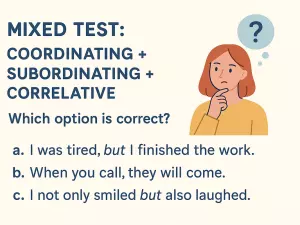
Mixed Test: Coordinating + Subordinating + Correlative
This article reviews coordinating, subordinating, and correlative conjunctions. It includes exercises to identify conjunction types, select suitable options, rewrite sentences with different conjunctions, and provides an answer key with explanations.
Previous
1
...
31
32
33
34
35
36
37
38
39
...
43
Next