Grammar ▾
▸ Articles ▸ Advanced Grammar ▸ Adjectives & Adverbs ▸ Conjunctions ▸ Conditionals ▸ Determiners ▸ Gerunds & Infinitives ▸ Grammar Practice ▸ Modal Verbs ▸ Nouns ▸ Parts of Speech ▸ Prepositions ▸ Pronouns ▸ Quantifiers ▸ Question Formation ▸ Reported Speech ▸ Verbs
Writing ▾
▸ Punctuation ▸ Sentence Structure ▸ Writing Mistakes
Vocabulary ▾
▸ Visual Vocabulary ▸ Food Vocabulary ▸ People Vocabulary ▸ Places Vocabulary ▸ Hobbies Vocabulary ▸ Home Vocabulary ▸ School Vocabulary ▸ Weather Vocabulary ▸ Basic Vocabulary ▸ General Vocabulary
Speaking ▾
▸ Conversational English
Calculators Contacts
Home » C1 Advanced

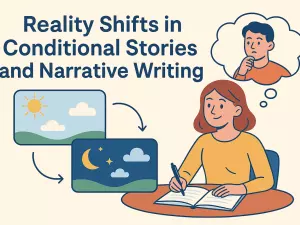
Reality Shifts in Conditional Stories and Narrative Writing

Reality Shifts in Conditional Stories and Narrative Writing
Here we how authors use conditionals to shift timelines and perspectives, differentiate imagined from real events, and create parallel realities. It includes examples from fiction and nonfiction, plus practice writing narrative reality shifts.

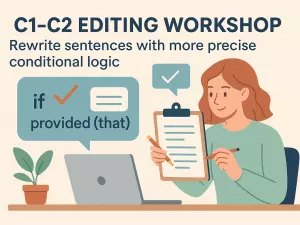
C1–C2 Editing Workshop: Rewrite Sentences with More Precise Conditional Logic

C1–C2 Editing Workshop: Rewrite Sentences with More Precise Conditional Logic
Here we advanced sentence rewriting, including how to identify and correct vague conditionals, improve logic with proper modals and tenses, clarify complex sentences, and practice transforming weak sentences using detailed examples.

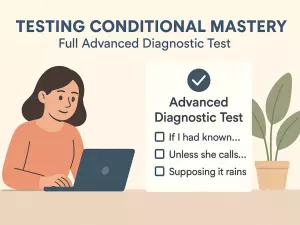
Testing Conditional Mastery: Full Advanced Diagnostic Test

Testing Conditional Mastery: Full Advanced Diagnostic Test
This article reviews advanced English conditional structures, including mixed conditionals, past modals, inversion, and elliptical forms. It details task types, multi-step logic, scoring methods, and provides a full answer key for self-evaluation.

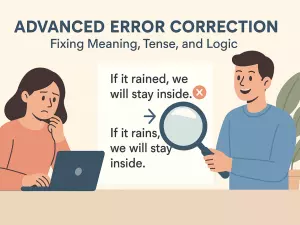
Advanced Error Correction: Fixing Meaning, Tense, and Logic in Conditionals

Advanced Error Correction: Fixing Meaning, Tense, and Logic in Conditionals
The article explains frequent C1–C2 conditional errors, including tense, modality, and meaning misalignment, mistakes in mixed and inverted conditionals, and strategies for spotting flawed logic. It also provides corrected examples and editing practice.

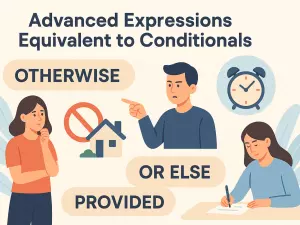
Advanced Expressions Equivalent to Conditionals: Otherwise, Or Else, Provided

Advanced Expressions Equivalent to Conditionals: Otherwise, Or Else, Provided
Here we how expressions such as otherwise, or else, and provided that function as conditionals, compares their tone and usage in different contexts, and gives examples and practice for replacing if-clauses with these alternatives.

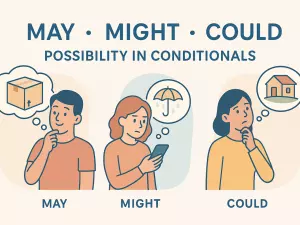
Using May, Might, and Could for Degrees of Possibility in Conditionals

Using May, Might, and Could for Degrees of Possibility in Conditionals
Here we how may, might, and could indicate different levels of possibility, compares their probability and tone, explains their use in second, third, and mixed conditionals with examples, highlights common errors, and offers practice in choosing the right…
Implied Conditional Meaning Without If (Elliptical Conditionals)

Implied Conditional Meaning Without If (Elliptical Conditionals)
The article defines elliptical conditionals, explores how dropping if alters style and emphasis in speech, distinguishes them from reduced clauses, and provides examples from journalism, fiction, and academic writing, along with practice exercises for creating them.

Conjunctions of Concession: even though, even if, much as

Conjunctions of Concession: even though, even if, much as
Here we the meaning of concession in complex grammar, explains how even though, even if, and much as differ in use and emphasis, and provides examples from essays and debates. It also offers practice rewriting sentences with concessive conjunctions.

Formal Conjunctions for Academic Writing: moreover, furthermore, nevertheless

Formal Conjunctions for Academic Writing: moreover, furthermore, nevertheless
Here we why precise logical connectors are vital in academic writing, examines how words like moreover and nevertheless clarify arguments, reviews placement and formality rules, and provides examples plus editing practice for stronger conjunction use.

Complex Conditional Conjunctions: provided that, assuming that, in case

Complex Conditional Conjunctions: provided that, assuming that, in case
This article explains how advanced conditional conjunctions like provided that, assuming that, and in case expand meaning. It covers their use in formal writing, with examples from policies and essays, and offers practice with complex conditionals.
Previous 1 ... 17 18 19 20 21 22 23 24 25 ... 31 Next
English Learning Tools
  • CEFR Text Level Checker
  • Type-Token Ratio Calculator
  • Sentence Length & Clarity Analyzer
  • Reading Time Calculator
  • Dialogue vs Narrative Analyzer
  • Question Types Analyzer
  • Error Density Checker
  • English Learning Time Calculator
  • Syllable Counter
Popular Articles
Modal Verbs in Job Interview Questions and Answers
Using Modal Verbs for Regret and Criticism in English
Should Have vs Could Have vs Would Have Explained
Modal Verbs in Legal and Rule-Based Language
Modal Verbs Commonly Used in Professional Emails
Modal Verbs Used in Negotiation and Persuasion
About / Privacy Policy / Cookie Policy / Terms of Use

© 2025-2026 LingoHarvest — lingoharvest.com

Content on this website is provided for informational and educational purposes. You may share links to our pages; copying full texts is not permitted without permission.