Grammar ▾
▸ Articles ▸ Advanced Grammar ▸ Adjectives & Adverbs ▸ Conjunctions ▸ Conditionals ▸ Determiners ▸ Gerunds & Infinitives ▸ Grammar Practice ▸ Modal Verbs ▸ Nouns ▸ Parts of Speech ▸ Prepositions ▸ Pronouns ▸ Quantifiers ▸ Question Formation ▸ Reported Speech ▸ Verbs
Writing ▾
▸ Punctuation ▸ Sentence Structure ▸ Writing Mistakes
Vocabulary ▾
▸ Visual Vocabulary ▸ Food Vocabulary ▸ People Vocabulary ▸ Places Vocabulary ▸ Hobbies Vocabulary ▸ Home Vocabulary ▸ School Vocabulary ▸ Weather Vocabulary ▸ Basic Vocabulary ▸ General Vocabulary
Speaking ▾
▸ Conversational English
Calculators Contacts
Home » C1 Advanced

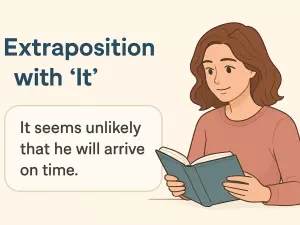
Extraposition with “It”: Moving Information for Better Flow

Extraposition with “It”: Moving Information for Better Flow
Here we the basic pattern of extraposition with it, shows how to move long clauses to the end for clarity, presents common academic structures, discusses formal tone, explains when extraposition is unsuitable, and includes practice exercises.

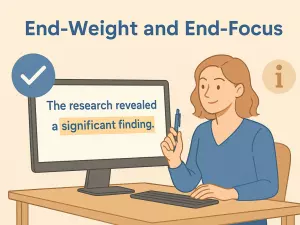
End-Weight and End-Focus: Structuring Sentences for Clarity

End-Weight and End-Focus: Structuring Sentences for Clarity
Here we end-weight and end-focus principles, reasons for placing heavy information at sentence ends, balancing subject and predicate length, managing focus in long sentences, using pronouns and given information, and practicing sentence order adjustment.

Fronted Adverbials for Tone and Structure in Academic Sentences

Fronted Adverbials for Tone and Structure in Academic Sentences
The article defines fronted adverbials and details their types, including time, place, manner, viewpoint, and linking. It also discusses their effects on emphasis and rhythm, punctuation rules, combining them with complex clauses, and practical exercises.
Stance Markers: Showing Certainty, Doubt, and Attitude in Text

Stance Markers: Showing Certainty, Doubt, and Attitude in Text
The article defines stance in writing, outlines lexical and grammatical stance markers, explains how to convey confidence, doubt, and evaluation, discusses clause positioning, compares spoken and written stance, and provides editing practice to clarify stance.

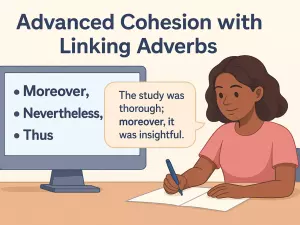
Advanced Cohesion with Linking Adverbs: Moreover, Nevertheless, Thus

Advanced Cohesion with Linking Adverbs: Moreover, Nevertheless, Thus
Here we how linking adverbs aid cohesion, explains their categories like addition and contrast, describes their sentence and clause positions, addresses punctuation and register, highlights common confusions, and provides practice with examples.

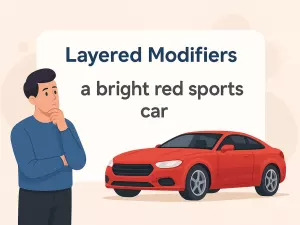
Layered Modifiers in Noun Phrases: Pre- and Postmodification

Layered Modifiers in Noun Phrases: Pre- and Postmodification
This article explains types of premodifiers and postmodifiers, the standard order of adjectives and modifiers, and how to combine multiple layers of information in noun phrases. It also covers balancing clarity, common errors, and provides practice exercises.

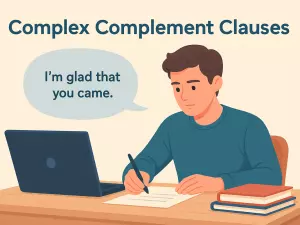
Complex Complement Clauses After Verbs, Nouns, and Adjectives

Complex Complement Clauses After Verbs, Nouns, and Adjectives
The article defines complement clauses and shows how they work with verbs, nouns, and adjectives. It explains that-, wh-, and if/whether-clauses as complements, addresses ambiguity issues, and includes practice with correct clause patterns.

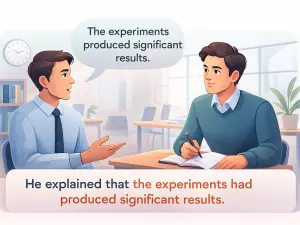
Advanced Reported Speech: Multi-Clause Backshifting Techniques

Advanced Reported Speech: Multi-Clause Backshifting Techniques
The article reviews basic backshifting rules, explains how to report complex sentences with several clauses, and discusses shifts in time, modality, and aspect. It also covers pronoun tracking and when backshifting is optional, with practice exercises included.

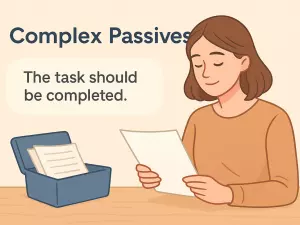
Complex Passives: Modals, Perfect Forms, and Multi-Layered Passives

Complex Passives: Modals, Perfect Forms, and Multi-Layered Passives
Here we advanced passive voice forms in English, such as passive with modals, perfect and continuous passive combinations, and layered passives in reporting. It also guides on choosing between active and complex passive forms and provides practice exercises.

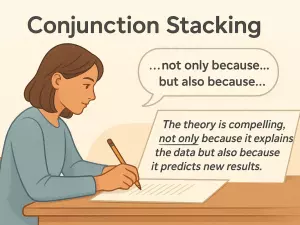
Conjunction Stacking in Advanced Writing: When Two Isn’t Too Many

Conjunction Stacking in Advanced Writing: When Two Isn’t Too Many
Here we what conjunction stacking is, gives examples of double and triple linkers, explains when stacking is helpful or redundant, outlines punctuation and parallelism rules, warns about conflicts, and includes practice editing such sentences.
Previous 1 ... 21 22 23 24 25 26 27 28 29 ... 31 Next
English Learning Tools
  • CEFR Text Level Checker
  • Type-Token Ratio Calculator
  • Sentence Length & Clarity Analyzer
  • Reading Time Calculator
  • Dialogue vs Narrative Analyzer
  • Question Types Analyzer
  • Error Density Checker
  • English Learning Time Calculator
  • Syllable Counter
Popular Articles
Modal Verbs in Job Interview Questions and Answers
Modal Verbs in Legal and Rule-Based Language
Using Modal Verbs in Instructions and Written Rules
Modal Verbs in Safety Instructions and Warnings
Modal Verbs Commonly Used in Professional Emails
Modal Verbs Used in Negotiation and Persuasion
About / Privacy Policy / Cookie Policy / Terms of Use

© 2025-2026 LingoHarvest — lingoharvest.com

Content on this website is provided for informational and educational purposes. You may share links to our pages; copying full texts is not permitted without permission.