Search the site
Search
Grammar ▾
▸ Articles
▸ Advanced Grammar
▸ Adjectives & Adverbs
▸ Conjunctions
▸ Conditionals
▸ Determiners
▸ Gerunds & Infinitives
▸ Grammar Practice
▸ Modal Verbs
▸ Nouns
▸ Parts of Speech
▸ Passive Voice
▸ Prepositions
▸ Pronouns
▸ Quantifiers
▸ Question Formation
▸ Reported Speech
▸ Verbs
Writing ▾
▸ Punctuation
▸ Sentence Structure
▸ Writing Mistakes
Vocabulary ▾
▸ Visual Vocabulary
▸ Food Vocabulary
▸ People Vocabulary
▸ Places Vocabulary
▸ Hobbies Vocabulary
▸ Home Vocabulary
▸ School Vocabulary
▸ Weather Vocabulary
▸ Basic Vocabulary
▸ General Vocabulary
Speaking ▾
▸ Conversational English
Calculators
Contacts
Home
» C1 Advanced
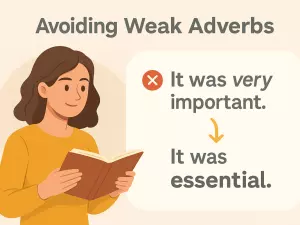
Avoiding Weak Adverbs in Writing (very, really - strong alternatives)
Weak adverbs like very and really weaken clarity in writing. This article explains their impact, suggests stronger adjective alternatives, shows improved sentence examples, discusses when intensifiers work, and offers practice replacing weak adverbs.
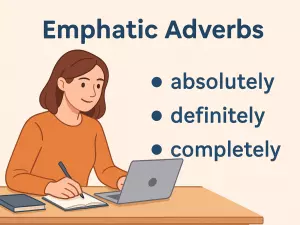
Emphatic Adverbs: absolutely, definitely, completely (advanced list)
Here we how emphatic adverbs show intensity and certainty, describes their main categories, and gives examples of common collocations. It also explains how they change tone, advises on avoiding overuse, and includes practice choosing suitable adverbs.
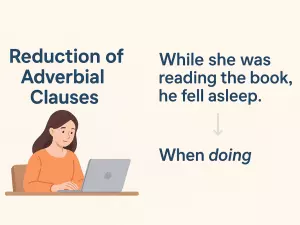
Reduction of Adverbial Clauses (while - when doing)
Here we when and how to reduce adverbial clauses, highlighting which clause types suit reduction, patterns with -ing and past participles, clarity concerns, formal versus informal contexts, and provides practice with participial reductions.
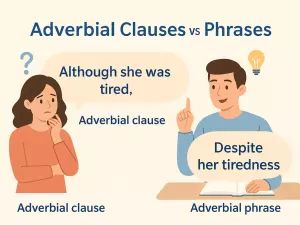
Adverbial Clauses vs Adverbial Phrases
Here we definitions and structural differences between adverbial clauses and phrases, how to reduce clauses, their functions in academic writing, punctuation rules, common mistakes, and provides practice converting clauses into phrases.
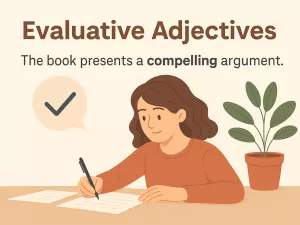
Evaluative Adjectives for Critical Analysis
Here we what evaluative adjectives express, common evaluative categories, and how these adjectives influence argument strength and balance precision with bias.
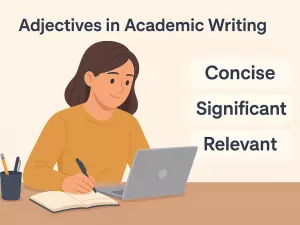
Using Adjectives in Academic Writing (concise, significant, relevant)
Here we how adjectives influence academic tone, highlights typical academic descriptors, and offers guidance on avoiding vague or subjective adjectives.
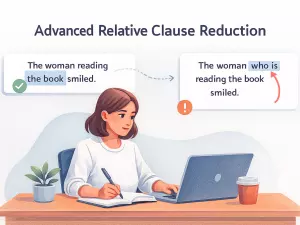
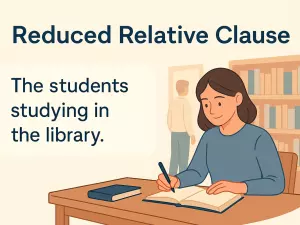
Advanced Relative Clause Reduction: How to Compress Complex Sentences
Here we what relative clause reduction is, the types that can be reduced, and how to reduce active, passive, and continuous forms. It also explains when reduction is inappropriate, its effects on writing, and offers practice with reduced clauses.
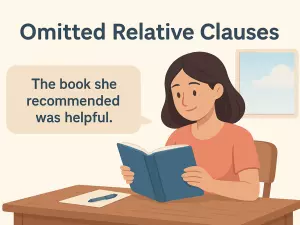
Fully Omitted Relative Clauses: When You Can Drop “Who / Which / That”
Here we the difference between reduced and omitted clauses, when you can omit relative pronouns, and how this differs for subject and object clauses.
Advanced Whiz-Deletion Patterns: Reducing Relative Clauses Naturally
The article explains whiz-deletion in grammar, covering patterns with -ing and -ed forms, its use after pronouns and nouns, register and style issues, common learner mistakes, and provides practice to improve sentence flow.
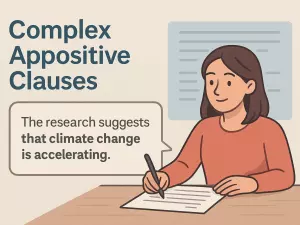
Complex Appositive Clauses for Academic Precision in Writing
This article explains what appositive clauses are, how they differ from relative clauses, and when to use that-clauses in apposition. It covers punctuation rules, their role in academic writing, and provides practice exercises.
Previous
1
...
20
21
22
23
24
25
26
27
28
...
31
Next