Grammar ▾
▸ Articles ▸ Advanced Grammar ▸ Adjectives & Adverbs ▸ Conjunctions ▸ Conditionals ▸ Determiners ▸ Gerunds & Infinitives ▸ Grammar Practice ▸ Modal Verbs ▸ Nouns ▸ Parts of Speech ▸ Prepositions ▸ Pronouns ▸ Quantifiers ▸ Question Formation ▸ Reported Speech ▸ Verbs
Writing ▾
▸ Punctuation ▸ Sentence Structure ▸ Writing Mistakes
Vocabulary ▾
▸ Visual Vocabulary ▸ Food Vocabulary ▸ People Vocabulary ▸ Places Vocabulary ▸ Hobbies Vocabulary ▸ Home Vocabulary ▸ School Vocabulary ▸ Weather Vocabulary ▸ Basic Vocabulary ▸ General Vocabulary
Speaking ▾
▸ Conversational English
Calculators Contacts
Home » C1 Advanced

Past Modal Verbs: Could Have, Should Have, Might Have

Past Modal Verbs: Could Have, Should Have, Might Have
This article explains how modal perfect forms talk about alternative past outcomes. It breaks down could have for missed chances, should have for criticism or regret, and might have for uncertain past events, with everyday comparisons and practice exercises.

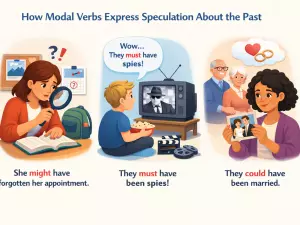
How Modal Verbs Express Speculation About the Past

How Modal Verbs Express Speculation About the Past
Learn how English speakers guess about past events using modal perfect forms like may have, might have, could have, and must have. See examples of inferring what probably happened, how certainty levels differ, how context shapes meaning, and practice with exercises.

How Modal Verbs Show Present-Time Speculation

How Modal Verbs Show Present-Time Speculation
Learn how English speakers guess about what’s happening now using modal verbs. It covers which modals show strong vs weak present speculation, how they pair with progressive forms, real examples, how context shifts certainty, cautious assumptions, plus exercises to practice.

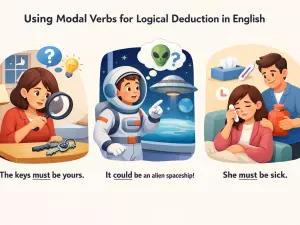
Using Modal Verbs for Logical Deduction in English

Using Modal Verbs for Logical Deduction in English
The article explains how English speakers use modal verbs to make logical deductions, comparing strong vs weak deduction. It shows how must, might, may, and could express different certainty levels, with evidence-based examples, context tips, and practice exercises.

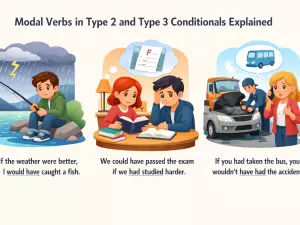
Modal Verbs in Type 2 and Type 3 Conditionals Explained

Modal Verbs in Type 2 and Type 3 Conditionals Explained
This article shows how modal verbs work in unreal conditionals, focusing on would, could, and might in Type 2 and Type 3 forms. It explains how they change the meaning of the result clause and express regret, possibility, or uncertainty, with comparisons and practice exercises.

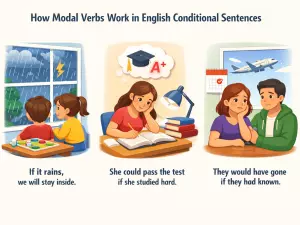
How Modal Verbs Work in English Conditional Sentences

How Modal Verbs Work in English Conditional Sentences
Covers how modal verbs work in if-clauses and result clauses, why speakers swap them for standard conditional forms, and how they shift certainty. Reviews can, could, may, might, with examples for permission, possibility, advice, plus softening results and practice exercises.

Gerunds and Infinitives Practice Exercises with Answers

Gerunds and Infinitives Practice Exercises with Answers
This article helps you test your understanding of gerunds and infinitives with exercises on verbs that take gerunds, verbs that take infinitives, and verbs that allow both. It also includes meaning-change drills, mixed grammar tasks, and an answer key with explanations.

Common Gerund and Infinitive Mistakes in English

Common Gerund and Infinitive Mistakes in English
Learn why gerunds and infinitives get confused, especially with stop, remember, and try, and which wrong verb patterns show up in speech and writing. See how meaning changes with the wrong form, plus quick choosing tips, correct vs incorrect examples, and practice exercises to fix typical errors.

Using Gerunds and Infinitives in Questions

Using Gerunds and Infinitives in Questions
This article explains how gerunds work in question structures, how indirect questions use patterns like what to do, and how question word + infinitive sentences are built. It compares direct vs embedded questions, gives everyday examples, flags common mistakes, and includes practice exercises.

Gerunds and Infinitives in Formal English Writing

Gerunds and Infinitives in Formal English Writing
Covers how gerunds and infinitives work in formal written English, when academic writing prefers infinitives, and when gerunds make sentences clearer. Includes examples from essays, reports, and professional communication, common informal-sounding mistakes, tips, and practice exercises.
Previous 1 2 3 4 5 6 7 8 9 10 ... 31 Next
English Learning Tools
  • CEFR Text Level Checker
  • Type-Token Ratio Calculator
  • Sentence Length & Clarity Analyzer
  • Reading Time Calculator
  • Dialogue vs Narrative Analyzer
  • Question Types Analyzer
  • Error Density Checker
  • English Learning Time Calculator
  • Syllable Counter
Popular Articles
Modal Verbs in Job Interview Questions and Answers
Modal Verbs in Legal and Rule-Based Language
Using Modal Verbs in Instructions and Written Rules
Modal Verbs in Safety Instructions and Warnings
Modal Verbs Commonly Used in Professional Emails
Modal Verbs Used in Negotiation and Persuasion
About / Privacy Policy / Cookie Policy / Terms of Use

© 2025-2026 LingoHarvest — lingoharvest.com

Content on this website is provided for informational and educational purposes. You may share links to our pages; copying full texts is not permitted without permission.