Grammar ▾
▸ Articles ▸ Advanced Grammar ▸ Adjectives & Adverbs ▸ Conjunctions ▸ Conditionals ▸ Determiners ▸ Gerunds & Infinitives ▸ Grammar Practice ▸ Modal Verbs ▸ Nouns ▸ Parts of Speech ▸ Prepositions ▸ Pronouns ▸ Quantifiers ▸ Question Formation ▸ Reported Speech ▸ Verbs
Writing ▾
▸ Punctuation ▸ Sentence Structure ▸ Writing Mistakes
Vocabulary ▾
▸ Visual Vocabulary ▸ Food Vocabulary ▸ People Vocabulary ▸ Places Vocabulary ▸ Hobbies Vocabulary ▸ Home Vocabulary ▸ School Vocabulary ▸ Weather Vocabulary ▸ Basic Vocabulary ▸ General Vocabulary
Speaking ▾
▸ Conversational English
Calculators Contacts
Home » C1 Advanced

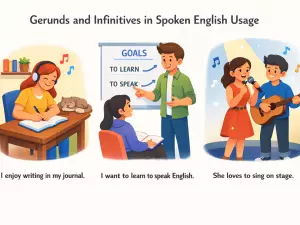
Gerunds and Infinitives in Spoken English Usage

Gerunds and Infinitives in Spoken English Usage
This article shows how gerunds and infinitives show up in everyday talk, using common patterns like like doing and want to do. It explains why some verb choices sound more natural than textbook rules, gives real conversation examples, flags learner mistakes, and includes rewrite exercises.

Gerund or Infinitive After Common English Verbs

Gerund or Infinitive After Common English Verbs
This article explains why some verbs take a gerund while others take an infinitive. It breaks down verb groups that require only gerunds or only infinitives, shows verbs that allow both, and highlights cases where meaning changes. Includes examples and practice exercises.

Gerunds in English Idioms and Fixed Expressions

Gerunds in English Idioms and Fixed Expressions
The article explains why many English idioms use gerunds, which fixed expressions require -ing, and how they show up in everyday speech. It covers cases where swapping the gerund breaks meaning, gives common spoken examples, shows how to spot fixed phrases, and includes fill-in practice.

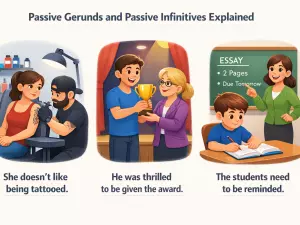
Passive Gerunds and Passive Infinitives Explained

Passive Gerunds and Passive Infinitives Explained
This article explains what passive gerunds and passive infinitives mean, how to form being done and to be done, and when English prefers passive over active. It shows patterns after verbs and prepositions, plus after nouns and adjectives, clears up common mix-ups, and ends with practice converting active sentences into passive forms.

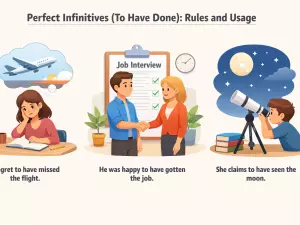
Perfect Infinitives (To Have Done): Rules and Usage

Perfect Infinitives (To Have Done): Rules and Usage
Learn what a perfect infinitive is and how to have plus a past participle points to an earlier action. See it after modals like should, could, and might for regret, criticism, or speculation, plus adjective and reporting-verb patterns. Includes common mistakes and practice exercises.

Perfect Gerunds (Having Done): Rules and Examples

Perfect Gerunds (Having Done): Rules and Examples
This article explains perfect gerunds and how having plus a past participle works to show one action happened before another. It covers common verb and preposition patterns, meaning changes vs regular gerunds, real examples, typical mistakes, and rewrite practice exercises.

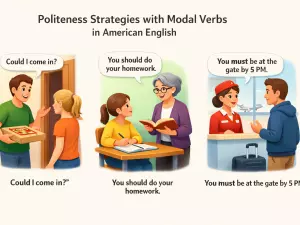
Politeness Strategies with Modal Verbs in American English

Politeness Strategies with Modal Verbs in American English
This article explains why modal verbs matter for polite communication, which ones soften requests or suggestions, and examples with could, would, and might. It also covers how tone, context, and American conversation affect modal choice, plus exercises rewriting direct statements politely.
Verb Simplification in Modern English Usage

Verb Simplification in Modern English Usage
Here we how verbs are simplified in modern English, highlighting common patterns, tense and aspect changes, and simpler alternatives to complex forms. It also covers spoken English’s influence on writing, acceptability, and practical tips for learners.

How Native Speakers Choose Verb Forms in Real Speech

How Native Speakers Choose Verb Forms in Real Speech
This article explains how verb choices in real conversations are shaped by context, time words, and storytelling. It covers shortcuts in speech, the impact of modality and register, common learner issues, and offers listening-based practice tasks.

Unreal Past Forms: If I Were, I Wish, It’s Time

Unreal Past Forms: If I Were, I Wish, It’s Time
The article explains what unreal past means in English and how it’s used in if-clauses, wish and if only structures, and it’s time patterns. It also discusses was vs were, common mistakes, differences from past simple, and provides practice exercises.
Previous 1 2 3 4 5 6 7 8 9 10 ... 31 Next
English Learning Tools
  • CEFR Text Level Checker
  • Type-Token Ratio Calculator
  • Sentence Length & Clarity Analyzer
  • Reading Time Calculator
  • Dialogue vs Narrative Analyzer
  • Question Types Analyzer
  • Error Density Checker
  • English Learning Time Calculator
  • Syllable Counter
Popular Articles
Modal Verbs in Job Interview Questions and Answers
Modal Verbs in Legal and Rule-Based Language
Using Modal Verbs in Instructions and Written Rules
Modal Verbs in Safety Instructions and Warnings
Modal Verbs Commonly Used in Professional Emails
Modal Verbs Used in Negotiation and Persuasion
About / Privacy Policy / Cookie Policy / Terms of Use

© 2025-2026 LingoHarvest — lingoharvest.com

Content on this website is provided for informational and educational purposes. You may share links to our pages; copying full texts is not permitted without permission.