Adjective or Adverb? 30 Real Examples

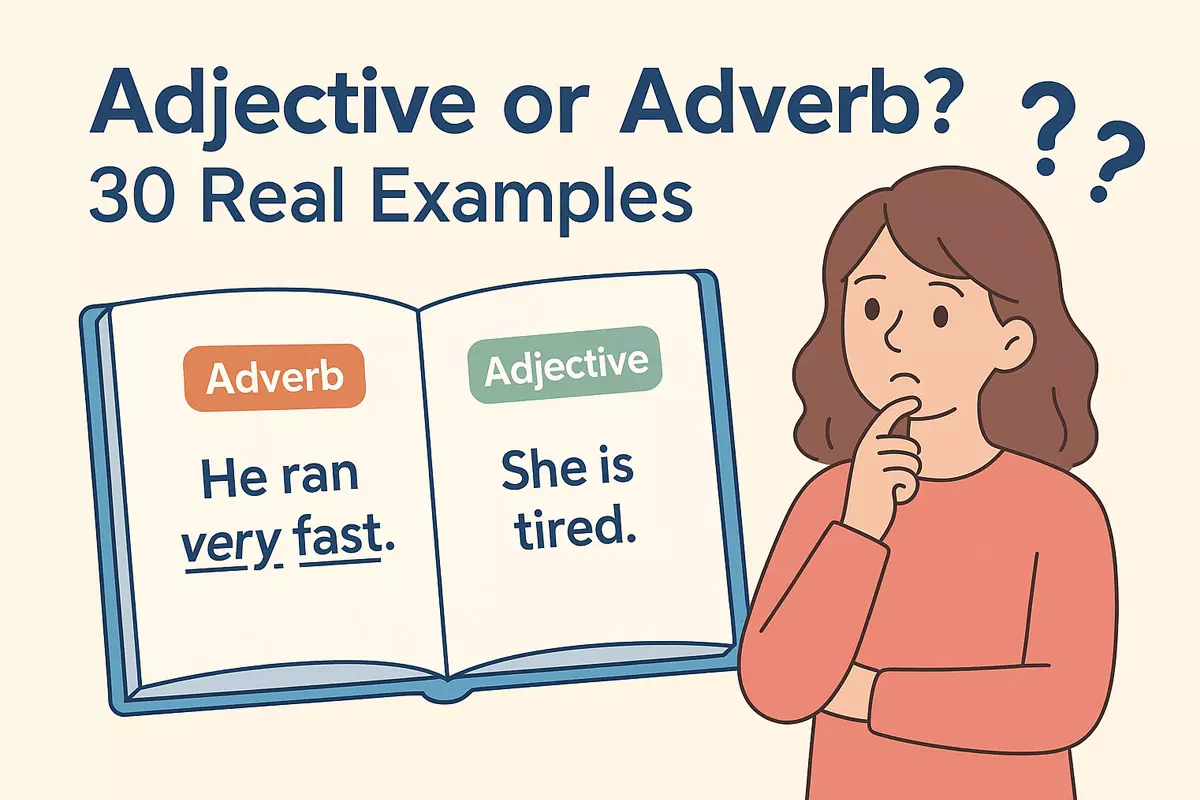 Learn how to use adjectives and adverbs correctly, including confusing pairs like good and well. This guide includes 30 real-life examples, signal words, practical tips, and exercises for changing adjectives to adverbs and back.
Adjectives and adverbs both add detail, but they do different jobs. Takeaway: use an adjective when you describe a noun or pronoun, and use an adverb when you describe a verb, adjective, another adverb, or the whole sentence. If you ask “What is this word describing?”, you can usually choose the correct form.
Review: what adjectives and adverbs do
An adjective describes a noun or pronoun. It tells us what kind of person, place, thing, or idea we mean. An adverb gives extra information about an action, quality, degree, time, frequency, place, or whole sentence. If you need the basic adjective lesson first, review this adjectives guide. For the adverb side, see the adverbs guide.
What adjectives describe
Adjectives usually describe nouns or pronouns. They answer questions such as What kind?, Which one?, How many?, or What is it like?
- a quiet room
- a quick answer
- a beautiful song
- a careful driver
- a hard problem
- a friendly teacher
- a late dinner
- a fast car
- a good idea
- a safe place
Adjectives can also come after linking verbs such as be, seem, look, feel, sound, smell, taste, and become.
- She is happy.
- The room looks clean.
- The soup tastes salty.
- The problem seems difficult.
How adverbs work
Adverbs can describe verbs, adjectives, other adverbs, or whole sentences. Many adverbs answer the question How?, but adverbs can also answer When?, Where?, How often?, or To what degree?
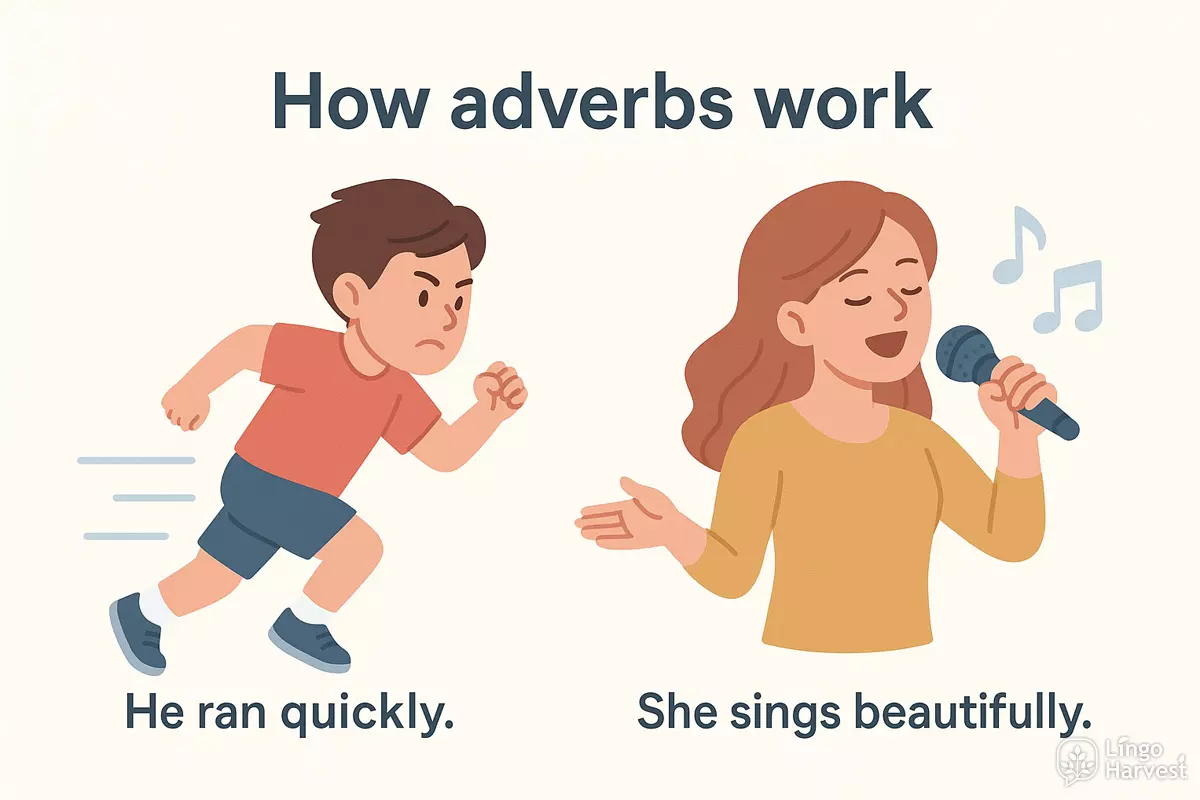
- She sings beautifully. (describes the verb sings)
- He answered quickly. (describes the verb answered)
- The test was really hard. (describes the adjective hard)
- He speaks very softly. (describes the adverb softly)
- Unfortunately, we missed the train. (describes the whole sentence)
- They arrived late. (adverb without -ly)
- The train moves fast. (same form adjective/adverb)
Adjective vs adverb: quick comparison
| Adjective | Adverb | What changes? |
|---|---|---|
| She is a careful driver. | She drives carefully. | Careful describes a noun; carefully describes a verb. |
| It was a beautiful song. | She sang beautifully. | Beautiful describes a song; beautifully describes singing. |
| This is a hard problem. | She works hard. | Hard can be both adjective and adverb. |
| He is a good speaker. | He speaks well. | Good describes a noun; well describes an action. |
| That is a fast car. | The car goes fast. | Fast keeps the same form. |
Quick summary
- Adjectives describe nouns and pronouns: a slow car, she is tired.
- Adverbs describe verbs, adjectives, other adverbs, or whole sentences: drive slowly, very tired, unfortunately.
- Many adverbs end in -ly, but not all: quickly, carefully, but fast, hard, and late.
- Some -ly words are adjectives, not adverbs: friendly, lovely, lonely, elderly.
Classic confusion pairs: good/well, quick/quickly
Some adjective/adverb pairs cause more mistakes than others. The most common ones are good/well, quick/quickly, hard/hardly, fast/fast, and late/lately. These pairs are important because the wrong choice can sound unnatural or even change the meaning.
Good vs well
Good is usually an adjective. It describes nouns. Well is usually an adverb. It describes how an action is done. However, well can also be an adjective when it means “healthy.”
- You did a good job. (Good describes the noun job.)
- You did the job well. (Well describes the verb did.)
- She is a good dancer. (Good describes dancer.)
- She dances well. (Well describes dances.)
- I feel good. (Natural for mood or general feeling.)
- I feel well. (Often means physically healthy.)
Quick vs quickly
Quick is an adjective. It describes a noun. Quickly is an adverb. It describes an action.
- He is a quick runner. (Quick describes runner.)
- He runs quickly. (Quickly describes runs.)
- Give me a quick answer. (Quick describes answer.)
- Please answer quickly. (Quickly describes the action.)
- She made a quick decision. (Quick describes decision.)
- She decided quickly. (Quickly describes decided.)
Hard vs hardly
Hard can be an adjective or an adverb. Hardly does not mean “in a hard way.” It means “almost not.” This is a common trap.
- This is a hard question. (adjective)
- She works hard. (adverb)
- I hardly know him. (almost do not know him)
- Incorrect: She works hardly. (This usually means she almost does not work.)
- Correct: She works hard.
Fast, late, and early keep the same form
Some adverbs have the same form as adjectives. These are often called flat adverbs.
- a fast car / The car moves fast.
- a late dinner / They arrived late.
- an early meeting / She arrived early.
- a high wall / The bird flew high.
Classic pairs table
| Pair | Adjective use | Adverb use |
|---|---|---|
| good / well | He gave a good answer. | He answered well. |
| quick / quickly | It was a quick reply. | She replied quickly. |
| hard / hard | This is a hard task. | They worked hard. |
| fast / fast | That is a fast train. | The train goes fast. |
| late / late | We had a late dinner. | They arrived late. |
For more spelling and form patterns, review the guide to -ly adverbs.
30 short real-life examples to analyse
The table below gives exactly 30 real-life examples. Each example shows whether the highlighted word works as an adjective or an adverb, and why.
30 examples with explanations
| # | Example | Type | Why |
|---|---|---|---|
| 1 | She gave a good answer. | Adjective | Good describes the noun answer. |
| 2 | She answered well. | Adverb | Well describes the verb answered. |
| 3 | He sent a quick reply. | Adjective | Quick describes the noun reply. |
| 4 | He replied quickly. | Adverb | Quickly describes how he replied. |
| 5 | She is a careful driver. | Adjective | Careful describes the noun driver. |
| 6 | She drives carefully. | Adverb | Carefully describes the verb drives. |
| 7 | This is a hard problem. | Adjective | Hard describes the noun problem. |
| 8 | They worked hard all day. | Adverb | Hard describes the verb worked. |
| 9 | I hardly know him. | Adverb | Hardly means “almost not.” |
| 10 | That is a fast car. | Adjective | Fast describes the noun car. |
| 11 | The car goes fast. | Adverb | Fast describes the verb goes. |
| 12 | We had a late dinner. | Adjective | Late describes the noun dinner. |
| 13 | They arrived late. | Adverb | Late describes the verb arrived. |
| 14 | I haven’t seen her lately. | Adverb | Lately means “recently.” |
| 15 | I feel bad about the mistake. | Adjective | After feel, bad describes the subject. |
| 16 | He sang badly at the audition. | Adverb | Badly describes the verb sang. |
| 17 | The room looks beautiful. | Adjective | After looks, the adjective describes the noun room. |
| 18 | She sings beautifully. | Adverb | Beautifully describes how she sings. |
| 19 | He is a friendly teacher. | Adjective | Friendly ends in -ly, but it describes the noun teacher. |
| 20 | She spoke politely to the customer. | Adverb | Politely describes the verb spoke. |
| 21 | We have an early meeting. | Adjective | Early describes the noun meeting. |
| 22 | She arrived early. | Adverb | Early describes the verb arrived. |
| 23 | That is a high wall. | Adjective | High describes the noun wall. |
| 24 | The bird flew high. | Adverb | High describes the verb flew. |
| 25 | He is a close friend. | Adjective | Close describes the noun friend. |
| 26 | Please listen closely. | Adverb | Closely means “carefully” or “with attention.” |
| 27 | This is a real problem. | Adjective | Real describes the noun problem. |
| 28 | I am really tired. | Adverb | Really describes the adjective tired. |
| 29 | The traffic was slow. | Adjective | Slow describes the noun traffic. |
| 30 | The line moved slowly. | Adverb | Slowly describes the verb moved. |
Tips for choosing the correct form
To choose between an adjective and an adverb, do not start by asking whether the word ends in -ly. Start by asking what the word describes.
Tip 1: Find the word being described
- If the word describes a noun, choose an adjective: a quick reply.
- If the word describes a verb, choose an adverb: reply quickly.
- If the word describes an adjective, choose an adverb: really tired.
- If the word describes another adverb, choose an adverb: very carefully.
Tip 2: Be careful after linking verbs
After linking verbs, English often uses adjectives, not adverbs. Common linking verbs include be, seem, look, feel, sound, smell, taste, and become. You can review more examples in the lesson on linking verbs.
- Correct: She looks tired.
- Incorrect: She looks tiredly.
- Correct: The soup tastes good.
- Incorrect: The soup tastes well. (unless you mean the soup can taste things, which is not the intended meaning)
- Correct: I feel bad about it.
- Incorrect: I feel badly about it. in the intended meaning “I feel bad.”
Tip 3: Remember words that keep the same form
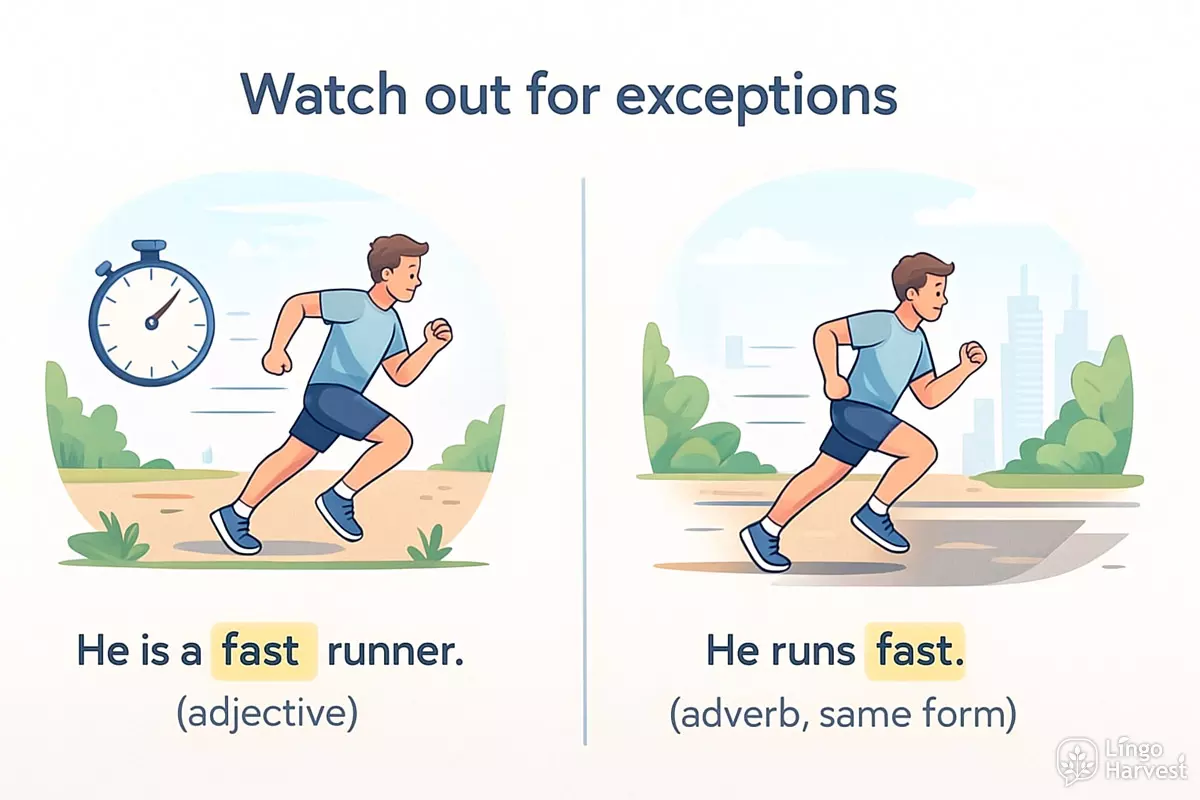
Some words can work as both adjectives and adverbs without changing form.
| Word | Adjective example | Adverb example |
|---|---|---|
| fast | a fast car | The car goes fast. |
| hard | a hard test | She works hard. |
| late | a late train | The train arrived late. |
| early | an early meeting | We arrived early. |
| high | a high shelf | The plane flew high. |
Tip 4: Do not trust -ly too quickly
Many adverbs end in -ly, but some -ly words are adjectives. This is why sentence function matters more than spelling.
- quickly — adverb: She answered quickly.
- carefully — adverb: He checked it carefully.
- friendly — adjective: She is friendly.
- lonely — adjective: He feels lonely.
- lovely — adjective: It was a lovely day.
Signal words that help you decide
Signal words are clues that help you decide whether you need an adjective or an adverb. They are not perfect rules, but they are useful when you are editing your writing or checking a sentence.
Common signals for adjectives
- Before a noun: a quick answer, a quiet room, a beautiful view
- After be: The answer is clear.
- After seem: The task seems easy.
- After look: You look tired.
- After feel: I feel nervous.
- After taste/smell/sound: It tastes sweet. That sounds strange.
- After become/get when describing a state: The room became quiet. He got angry.
Common signals for adverbs
- After action verbs: She answered quickly.
- Before adjectives: The room was very cold.
- Before other adverbs: He worked extremely carefully.
- At the start of a sentence: Unfortunately, we were late.
- With frequency: She often studies at night.
- With degree: I almost finished the task.
Signal table
| Signal | Usually choose | Example |
|---|---|---|
| Before a noun | Adjective | a safe road |
| After a linking verb | Adjective | She looks happy. |
| After an action verb | Adverb | She smiled happily. |
| Before an adjective | Adverb | It is really cold. |
| Before another adverb | Adverb | He ran very fast. |
| Whole sentence comment | Adverb | Luckily, nobody was hurt. |
Quick checklist
- Ask: Is the word describing a noun? Use an adjective.
- Ask: Is the word describing an action? Use an adverb.
- Ask: Is there a linking verb? You may need an adjective.
- Ask: Does the word end in -ly? Check carefully; it might still be an adjective.
- Ask: Is the word fast, hard, late, early, or high? It may keep the same form.
Practice: change adjectives to adverbs and back
Now practice identifying forms, converting adjectives to adverbs, correcting mistakes, and writing your own examples. You can also continue with adjective practice after this page.
Exercise 1: Identify the word type
Decide whether the highlighted word is an adjective or an adverb.
- She danced gracefully.
- It was a cold morning.
- He speaks loudly in class.
- This is a hard question.
- The train moved fast.
- She moved quickly through the crowd.
- They had a happy moment together.
- He answered correctly.
- The movie was boring.
- She whispered softly.
Show answers
- Adverb
- Adjective
- Adverb
- Adjective
- Adverb
- Adverb
- Adjective
- Adverb
- Adjective
- Adverb
Exercise 2: Convert the form
Write the common adverb form for each adjective. Watch the exceptions.
- quick → ______
- careful → ______
- easy → ______
- happy → ______
- beautiful → ______
- fast → ______
- good → ______
- hard → ______
- late → ______
- safe → ______
- polite → ______
- angry → ______
- simple → ______
- clear → ______
- lucky → ______
Show answers
- quick → quickly
- careful → carefully
- easy → easily
- happy → happily
- beautiful → beautifully
- fast → fast
- good → well
- hard → hard
- late → late
- safe → safely
- polite → politely
- angry → angrily
- simple → simply
- clear → clearly
- lucky → luckily
Exercise 3: Correct the mistakes
Each sentence has one adjective/adverb mistake. Rewrite it correctly.
- She sings beautiful.
- He is a well student.
- Please drive safe.
- The soup tastes well.
- They worked hardly all day.
- He answered quick.
- She looked sadly after the news.
- This is an easily question.
- The baby slept quiet.
- I feel badly about my mistake.
Show answers
- She sings beautifully.
- He is a good student.
- Please drive safely. (Drive safe is common informally, but safely is the standard adverb.)
- The soup tastes good.
- They worked hard all day.
- He answered quickly.
- She looked sad after the news.
- This is an easy question.
- The baby slept quietly.
- I feel bad about my mistake.
Exercise 4: Rewrite the sentence
Change the adjective sentence into an adverb sentence, or the adverb sentence into an adjective sentence.
- She is a careful driver. → She drives ______.
- He gave a good answer. → He answered ______.
- The dog is loud. → The dog barks ______.
- It was an easy test. → She passed the test ______.
- He is a quick runner. → He runs ______.
- The teacher was angry. → The teacher spoke ______.
- She is a quiet person. → She speaks ______.
- It was a beautiful performance. → She performed ______.
- The report is clear. → The report explains the issue ______.
- He is a hard worker. → He works ______.
Show answers
- She drives carefully.
- He answered well.
- The dog barks loudly.
- She passed the test easily.
- He runs quickly.
- The teacher spoke angrily.
- She speaks quietly.
- She performed beautifully.
- The report explains the issue clearly.
- He works hard.
Exercise 5: Homework — write your own examples
Write your own sentences for each prompt. Then compare with the sample answers.
- Write one sentence with an adjective before a noun.
- Write one sentence with an adjective after be.
- Write one sentence with an adverb after an action verb.
- Write one sentence with good.
- Write one sentence with well.
- Write one sentence with fast as an adjective.
- Write one sentence with fast as an adverb.
- Write one sentence with an adverb before an adjective.
- Write one sentence with a linking verb and an adjective.
- Write one sentence with a sentence adverb such as luckily or unfortunately.
Show sample answers
- She bought a beautiful coat.
- The answer is clear.
- He spoke quietly.
- That was a good idea.
- She explains grammar well.
- He drives a fast car.
- The car moves fast.
- The room was extremely cold.
- The soup tastes salty.
- Luckily, we found the keys.
FAQ
1. What is the main difference between an adjective and an adverb?
An adjective describes a noun or pronoun. An adverb describes a verb, adjective, another adverb, or sometimes the whole sentence. For example, a quick answer uses an adjective, while answer quickly uses an adverb.
2. Is good an adjective or an adverb?
Good is usually an adjective. It describes nouns: a good student, a good answer, a good idea. The common adverb form is well: She writes well.
3. Is well always an adverb?
No. Well is often an adverb, as in He speaks well. But well can also be an adjective when it means healthy: I feel well today.
4. Why do we say feel bad, not feel badly?
In I feel bad, the word bad describes the subject’s feeling, so it works as an adjective after the linking verb feel. Feel badly can sound like your sense of touch is poor, so it does not usually express the intended meaning.
5. Are all -ly words adverbs?
No. Many adverbs end in -ly, such as quickly, carefully, and quietly. But some -ly words are adjectives, such as friendly, lovely, lonely, and elderly.
6. Can the same word be both an adjective and an adverb?
Yes. Words such as fast, hard, late, early, and high can work as adjectives or adverbs. For example: a fast car and The car goes fast.
7. What is the difference between hard and hardly?
Hard can mean difficult as an adjective or with effort as an adverb: a hard test, work hard. Hardly means almost not: I hardly know him.
8. Do I use an adjective or adverb after look, feel, sound, taste, and smell?
When these verbs describe the subject’s state or quality, use an adjective: You look tired, That sounds strange, The soup tastes good. These are linking verb patterns.
9. What is the easiest way to choose the correct form?
Ask what the word describes. If it describes a noun or pronoun, use an adjective. If it describes an action, adjective, adverb, or whole sentence, use an adverb.