Search the site
Search
Grammar ▾
▸ Articles
▸ Advanced Grammar
▸ Adjectives & Adverbs
▸ Conjunctions
▸ Conditionals
▸ Determiners
▸ Gerunds & Infinitives
▸ Grammar Practice
▸ Modal Verbs
▸ Nouns
▸ Parts of Speech
▸ Prepositions
▸ Pronouns
▸ Quantifiers
▸ Question Formation
▸ Reported Speech
▸ Verbs
Writing ▾
▸ Punctuation
▸ Sentence Structure
▸ Writing Mistakes
Vocabulary ▾
▸ Visual Vocabulary
▸ Food Vocabulary
▸ People Vocabulary
▸ Places Vocabulary
▸ Hobbies Vocabulary
▸ Home Vocabulary
▸ School Vocabulary
▸ Weather Vocabulary
▸ Basic Vocabulary
▸ General Vocabulary
Speaking ▾
▸ Conversational English
Calculators
Contacts
Home
»
English
»
Grammar
Grammar
This section focuses on English grammar explained in a simple and practical way. You will find clear rules, step-by-step examples, and common mistakes to avoid, helping you build a strong foundation for speaking and writing confidently.
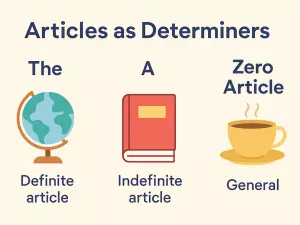
Articles as Determiners: The, A, and Zero Article Explained
The article explains what determiners are and how articles fit in, clarifies the use of definite, indefinite, and zero articles, provides rules for a, an, and the, shows when to use zero article, reviews common patterns, and addresses frequent mistakes.
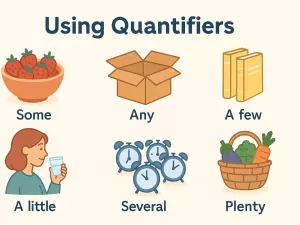
Using Quantifiers: some, any, a few, a little, several, plenty
Here we the use of quantifiers in English, explains the difference between some and any, how to use a few, few, a little, and little, when to use several and plenty, rules for countable and uncountable nouns, common beginner mistakes, and includes practice.
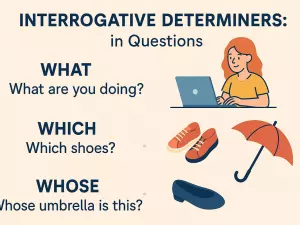
Interrogative Determiners: what, which, whose in Questions
Here we what interrogative determiners are, how to use what, which, and whose in questions, their correct order, and common mistakes. It also provides practical exercises for forming questions about people, objects, and choices.
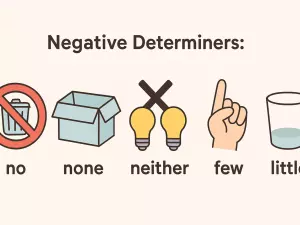
Negative Determiners: no, none, neither, few, little
Here we what negative determiners are, explains the differences between no, none, neither, few, and little, shows how they affect sentence meaning, and gives tips on avoiding double negatives. It also provides practice choosing the correct determiner.
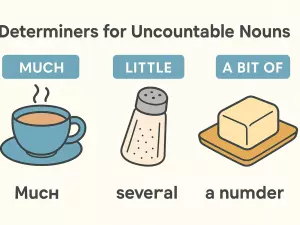
Determiners for Uncountable Nouns: much, little, a bit of
Here we how to recognize uncountable nouns, gives examples for food, materials, and ideas, explains using much, little, and a bit of, highlights mistakes with many, offers useful phrases, and provides practice with determiners.
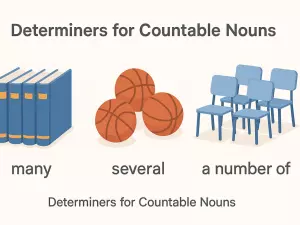
Determiners for Countable Nouns: many, several, a number of
The article explains countable nouns and their role with determiners, covers the use of many, several, a number of, a lot of, and clarifies few vs a few. It also addresses mixing noun types, typical learner errors, and provides practice exercises.
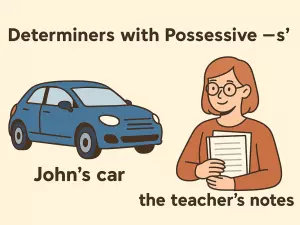
Determiners with Possessive ’s: John’s car, the teacher’s notes
Here we how possessive ’s functions as a determiner in English, forming it with singular and plural nouns, word order differences, special cases like children’s and names ending in s, common mistakes with its and it’s, and practice rewriting phrases.
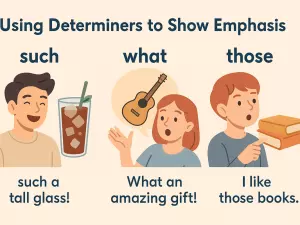
Using Determiners to Show Emphasis: such, what, those
Here we how to express emphasis in English using such, what, and those, explains the difference between neutral and emphatic determiners, discusses intonation and punctuation in emphatic structures, and includes practice transforming sentences.
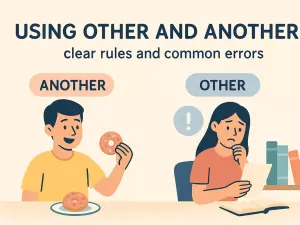
Using other and another: clear rules and common errors
The article explains the difference between other and another, details their correct use with singular, plural, and uncountable nouns, covers phrases like the other and each other, gives common mistakes, real-life examples, and practice exercises.
Determiners of Amount and Degree: enough, too much, too many
Here we amount and degree determiners, shows how to use enough, too much, and too many with nouns, explains the difference between too and very, addresses common mistakes, and includes practice sentences for rewriting.
Previous
1
...
63
64
65
66
67
68
69
70
71
...
124
Next