WH Questions: Who, What, Where, When, Why, How

 This guide explains the meanings of WH words and how to structure WH questions. It gives real-life examples, common mistakes, and practice exercises for writing your own WH questions.
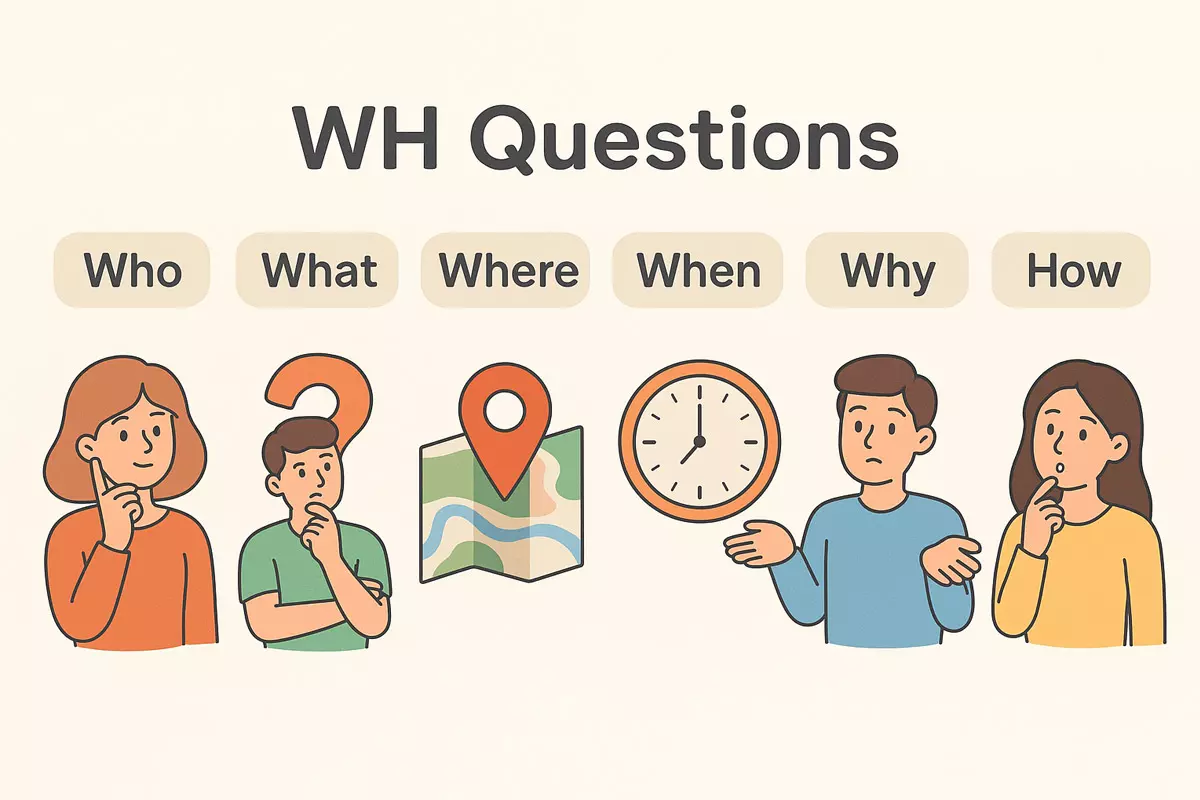
WH questions help you ask for specific information in English. Takeaway: choose the WH word by the type of answer you need, then use the correct question word order. Use who for people, what for things or actions, where for places, when for time, why for reasons, and how for manner, condition, process, amount, or degree.
Meaning of WH Words
WH words are question words used to ask for missing information. The name “WH questions” comes from words like who, what, where, when, and why. The word how does not start with WH, but it belongs to the same question group because it works in the same way.
Overview of common WH words
- Who asks about a person or people: Who is calling?
- What asks about a thing, idea, action, or general information: What is this?
- Where asks about a place or location: Where do you live?
- When asks about time, date, or period: When did it happen?
- Why asks about a reason or cause: Why are you late?
- How asks about manner, process, condition, amount, or degree: How did you do that?
WH words and their typical uses
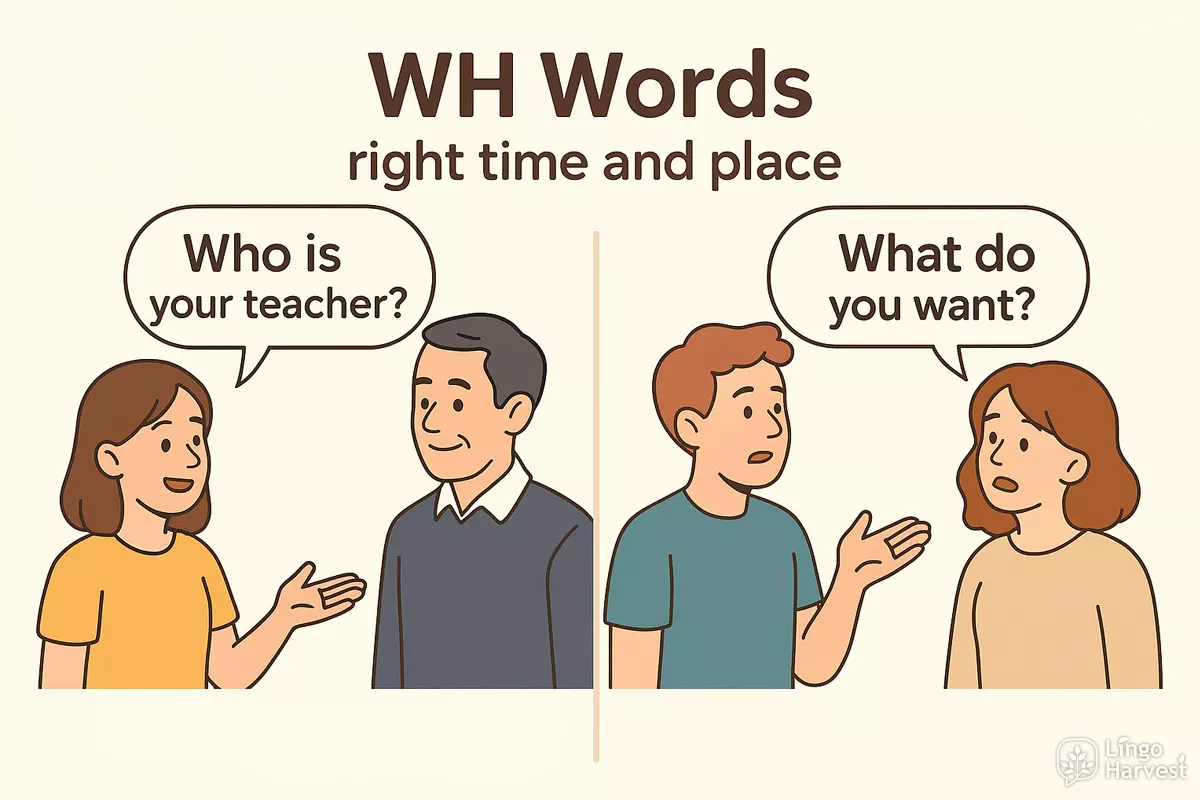
| WH Word | Typical Use | Example Question | Expected Answer |
|---|---|---|---|
| Who | Person or people | Who is your teacher? | Mr. Lewis / My English teacher |
| What | Thing, action, idea, or information | What do you need? | A pen / More time / Help |
| Where | Place or location | Where did you go? | To the supermarket / Home / London |
| When | Time, date, or period | When will you arrive? | At 6 p.m. / Tomorrow / Next week |
| Why | Reason or cause | Why are you upset? | Because I lost my phone |
| How | Manner, process, condition, amount, or degree | How did you solve it? | By checking the instructions |
Which and whose also work like WH words
In real English, you will also see which and whose. They are not always included in a short beginner list, but they are very useful.
- Which asks about a choice from a limited group: Which jacket do you prefer?
- Whose asks about possession: Whose phone is this?
How questions can be longer
How often combines with another word to ask for more specific information. These forms are common in daily conversation and in quantity questions.
- How much asks about price or uncountable quantity: How much does it cost?
- How many asks about countable quantity: How many people came?
- How long asks about duration or length: How long will it take?
- How often asks about frequency: How often do you exercise?
- How far asks about distance: How far is the station?
- How old asks about age: How old is your brother?
- How big asks about size: How big is your apartment?
Expanded examples of WH question starters
- Who are your closest friends?
- Who made this cake?
- What is your favorite color?
- What happened here?
- Where is my phone?
- Where did they meet?
- When does the movie start?
- When is your birthday?
- Why did you leave early?
- Why is the sky blue?
- How do you get to the station?
- How much does it cost?
- How long will it take?
- How often do you exercise?
- Which answer is correct?
- Whose bag is on the chair?
Word Order in WH Questions
Correct word order is the main grammar challenge in WH questions. In many English questions, the WH word comes first, then an auxiliary verb, then the subject, then the main verb. This is different from normal statement order. You can review the broader pattern in this guide to English question word order.
The basic WH question structure
Most WH questions follow this pattern:
- WH word + auxiliary verb + subject + main verb + rest of sentence?
Examples:
- Where are you going?
- Why did she leave early?
- How can we help?
- What do you want?
- When will they arrive?
Common auxiliaries in WH questions
| Auxiliary | Use | Example WH Question |
|---|---|---|
| do / does | Present simple questions | Where do you live? |
| did | Past simple questions | When did she call? |
| am / is / are | Be verb and present continuous questions | Why are you waiting? |
| was / were | Past be verb and past continuous questions | Where were they going? |
| can / could / will / would / should | Modal questions | How can I improve? |
| have / has | Present perfect questions | Where have you been? |
Statements vs WH questions
Notice how the subject and auxiliary move when a statement becomes a WH question.
| Statement | WH Question | What changes? |
|---|---|---|
| You are going to the store. | Where are you going? | Where comes first; are moves before the subject. |
| She left early. | Why did she leave early? | Did appears; main verb returns to base form. |
| They can help us. | How can they help us? | The modal can moves before the subject. |
| The meeting starts at 10. | When does the meeting start? | Does appears because the subject is singular. |
| You bought this bag yesterday. | When did you buy this bag? | Did shows past; bought becomes buy. |
Special case: subject questions
Sometimes the WH word is the subject of the question. In this case, English usually does not use do, does, or did. The word order looks more like a statement.
- Who called you? (Who = the person who called.)
- What happened? (What = the thing that happened.)
- Which team won? (Which team = the subject.)
- Who knows the answer? (Who = the person who knows.)
Compare this with object questions:
| Subject question | Object question |
|---|---|
| Who called you? | Who did you call? |
| What happened? | What did you see? |
| Which team won? | Which team did you support? |
This difference is important, so it is worth studying subject and object questions separately if this part feels confusing.
WH questions with be
When the main verb is be, the structure is often shorter:
- Where is the station?
- Who are those people?
- Why is he angry?
- How are you today?
- What is your name?
WH questions vs yes/no questions
WH questions ask for specific information. Yes/no questions ask for confirmation.
| Yes/no question | WH question |
|---|---|
| Do you live here? | Where do you live? |
| Did she call? | When did she call? |
| Are they waiting? | Why are they waiting? |
| Can you help? | How can you help? |
Examples in Everyday Speech
WH questions appear constantly in normal conversation. People use them to ask for directions, check times, clarify problems, start small talk, make plans, and understand what someone means.
Sample questions using each WH word
- Who is coming to dinner tonight?
- Who called me earlier?
- Who needs help with the project?
- What time does the movie start?
- What is your favorite book?
- What happened at the event?
- Where did you park the car?
- Where should we meet?
- Where does she work now?
- When are you leaving for your trip?
- When can I expect your reply?
- When is the deadline?
- Why is the meeting postponed?
- Why did you choose this option?
- Why are you upset?
- How do you make this recipe?
- How was your weekend?
- How did you solve the problem?
Comparing WH question uses
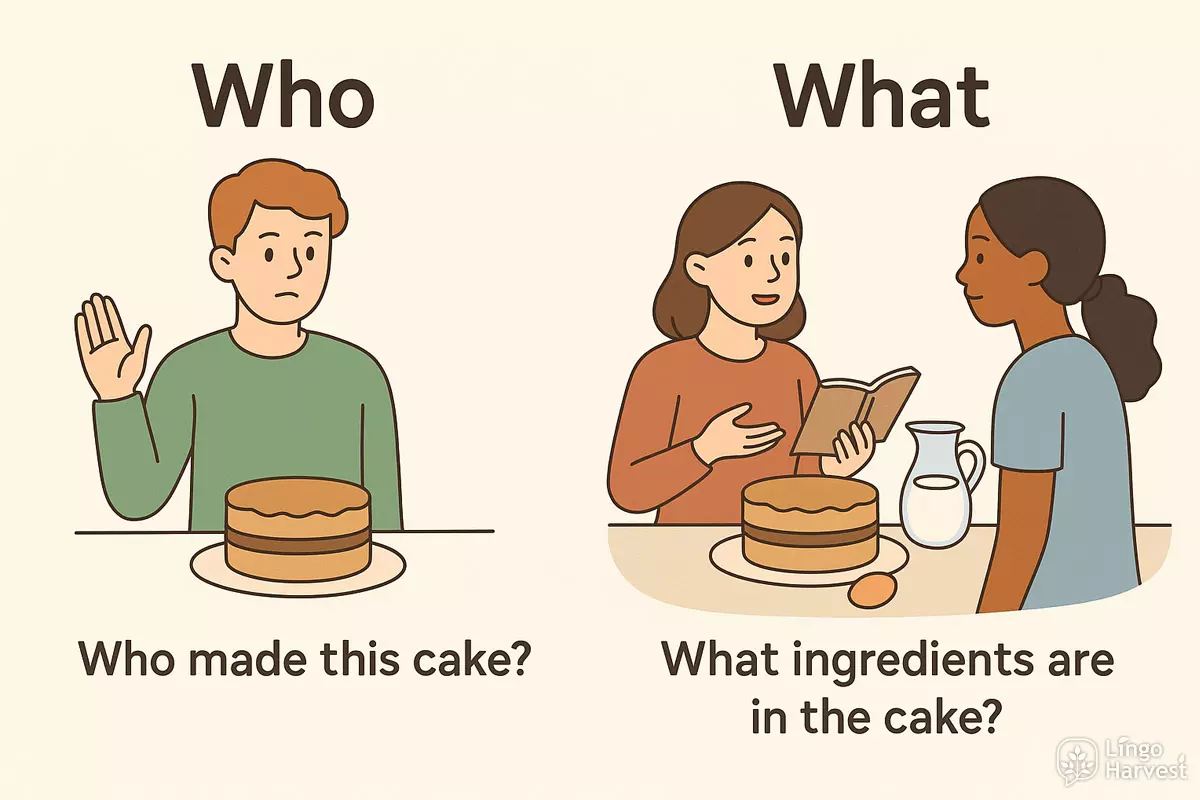
The same situation can produce different questions. Each WH word focuses on a different detail.
| Question Word | Example in Context | Focus |
|---|---|---|
| Who | Who made this cake? | The person |
| What | What ingredients are in the cake? | The things inside it |
| Where | Where did you buy the cake? | The place |
| When | When did you bake it? | The time |
| Why | Why did you choose this recipe? | The reason |
| How | How did you decorate the cake? | The method |
| Which | Which cake do you want? | A choice from a set |
| Whose | Whose cake is this? | The owner |
WH questions in common situations
| Situation | Natural WH Questions |
|---|---|
| Travel | Where is the nearest station? When does the train leave? How much is a ticket? |
| School or class | What page are we on? Who is working with me? When is the test? |
| Work | Who sent this file? Why was the meeting moved? How should I reply? |
| Shopping | How much does this cost? Where can I pay? Which size do you have? |
| Daily conversation | How was your day? What did you do yesterday? Why are you smiling? |
Short conversation examples
- A: Where are you going?
B: I’m going to the library. - A: Why did you call me?
B: I need your advice. - A: How did you get here?
B: I came by bus. - A: Who is that man?
B: He’s my new neighbor. - A: When does your flight leave?
B: It leaves at 9:40.
Common Mistakes
WH question mistakes usually come from three problems: choosing the wrong WH word, using statement word order, or forgetting a preposition. These mistakes are common, but they are easy to fix when you know what to check.
Mistake 1: mixing up WH words
Choose the WH word by the type of information you need. Do not use what for every question.
| Incorrect | Correct | Why |
|---|---|---|
| Who is your favorite book? | What is your favorite book? | A book is a thing, not a person. |
| What is your teacher? | Who is your teacher? | The answer is a person. |
| Where is your birthday? | When is your birthday? | A birthday is a date or time. |
| When do you live? | Where do you live? | The answer is a place. |
| Why did you fix it? | How did you fix it? | Use how for method. Use why for reason. |
Mistake 2: using statement word order
In most WH questions, the auxiliary verb comes before the subject. This is the same general inversion pattern that appears in many English questions.
- Incorrect: Where you are going?
- Correct: Where are you going?
- Incorrect: When you will leave?
- Correct: When will you leave?
- Incorrect: Why you did that?
- Correct: Why did you do that?
- Incorrect: What she wants?
- Correct: What does she want?
Mistake 3: using did but keeping the past verb
When you use did in a past simple question, the main verb returns to its base form.
- Incorrect: Where did you went?
- Correct: Where did you go?
- Incorrect: What did she bought?
- Correct: What did she buy?
- Incorrect: Why did they left?
- Correct: Why did they leave?
Mistake 4: forgetting prepositions
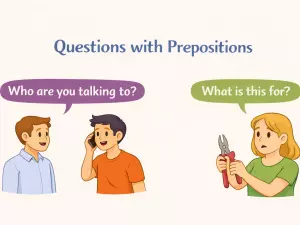
Some WH questions need a preposition, especially with verbs such as talk to, look at, wait for, listen to, and depend on. In everyday English, the preposition often comes at the end of the question. You can study this pattern in more detail in questions with prepositions.
- Incorrect: Who did you talk?
- Correct: Who did you talk to?
- Incorrect: What are you looking?
- Correct: What are you looking at?
- Incorrect: Who are you waiting?
- Correct: Who are you waiting for?
- Incorrect: What does it depend?
- Correct: What does it depend on?
Mistake 5: confusing direct and indirect questions
Direct WH questions use question word order. Indirect questions often use statement word order after the opening phrase.
| Direct question | Indirect question |
|---|---|
| Where is the station? | Do you know where the station is? |
| What time does it start? | Can you tell me what time it starts? |
| Why did she leave? | I wonder why she left. |
For polite and formal question patterns, continue with indirect questions.
Quick correction table
| Problem | Incorrect | Correct |
|---|---|---|
| Wrong WH word | Where is your birthday? | When is your birthday? |
| Statement order | Why you are late? | Why are you late? |
| Missing do/does | What she wants? | What does she want? |
| Past verb after did | Where did you went? | Where did you go? |
| Missing preposition | Who did you speak? | Who did you speak to? |
Practice: Write WH Questions
Now practice building WH questions from answers, correcting mistakes, and writing your own questions. Try to think about the answer type before you choose the question word.
Task 1: Make questions for the answers
For each answer, write a complete WH question.
- My favorite color is blue.
- I met her at the library.
- He travels by train.
- They left because it was raining.
- The concert starts at 7 PM.
- We are going to Paris for vacation.
- She called me yesterday.
- The book belongs to Anna.
- He eats breakfast at 8 o’clock.
- This tool is used to fix bikes.
Show answers
- What is your favorite color?
- Where did you meet her?
- How does he travel?
- Why did they leave?
- When does the concert start?
- Where are you going for vacation?
- When did she call you?
- Whose book is this?
- When does he eat breakfast?
- What is this tool used for?
Task 2: Complete the questions
Fill in the blank with the best WH word or WH phrase.
- ______ is your birthday?
- ______ did you go last weekend?
- ______ is sitting next to you?
- ______ do you want to eat for lunch?
- ______ did you finish your homework?
- ______ are you feeling today?
- ______ is the capital of France?
- ______ did he leave so early?
- ______ will you arrive?
- ______ much does this cost?
Show answers
- When is your birthday?
- Where did you go last weekend?
- Who is sitting next to you?
- What do you want to eat for lunch?
- When did you finish your homework?
- How are you feeling today?
- What is the capital of France?
- Why did he leave so early?
- When will you arrive?
- How much does this cost?
Task 3: Correct the mistakes
Each sentence has one WH question mistake. Rewrite it correctly.
- Where you are going?
- When you will call me?
- What did she bought?
- Who did you talk?
- Why you did leave early?
- Where is your birthday?
- What is your teacher?
- How many money do you need?
- What are you looking?
- Why did you fixed it?
Show answers
- Where are you going?
- When will you call me?
- What did she buy?
- Who did you talk to?
- Why did you leave early?
- When is your birthday?
- Who is your teacher?
- How much money do you need?
- What are you looking at?
- Why did you fix it?
Task 4: Homework — write your own WH questions
Write one question for each prompt. Then compare your questions with the sample answers.
- Write one question asking about a person.
- Write one question asking about a thing.
- Write one question asking about a place.
- Write one question asking about time.
- Write one question asking about a reason.
- Write one question asking about a method.
- Write one question with how much.
- Write one question with how many.
- Write one question with whose.
- Write one question that ends with a preposition.
Show sample answers
- Who is your best friend?
- What did you buy yesterday?
- Where do you usually study?
- When does your English class start?
- Why are you learning English?
- How do you remember new words?
- How much time do you spend reading each day?
- How many messages did you send today?
- Whose jacket is on the chair?
- Who are you waiting for?
For more mixed question work after this lesson, you can continue with questions with quantifiers or review question word order.
FAQ
1. What are WH questions in English?
WH questions are questions that ask for specific information. They usually begin with words such as who, what, where, when, why, or how. For example: Where do you live? and Why are you studying English?
2. Why is how included in WH questions?
How does not start with WH, but it works like the other question words. It asks for information about manner, condition, process, amount, or degree. For example: How do you feel?, How did you do it?, and How much does it cost?
3. What is the basic word order in WH questions?
The common pattern is WH word + auxiliary verb + subject + main verb. For example: Where do you live?, Why did she leave?, and How can I help?
4. When do WH questions not need do, does, or did?
When the WH word is the subject of the question, you usually do not need do, does, or did. For example: Who called?, What happened?, and Which team won?
5. What is the difference between who and what?
Use who for people and what for things, ideas, actions, or general information. Say Who is your teacher? but What is your favorite book?
6. What is the difference between what and which?
Use what when the possible answers are open or not limited. Use which when you choose from a known group. For example: What do you want to drink? is open, but Which drink do you want, tea or coffee? gives limited choices.
7. Can WH questions end with a preposition?
Yes. In everyday English, WH questions often end with a preposition. For example: Who are you waiting for?, What are you looking at?, and Who did you speak to?
8. What is the difference between direct and indirect WH questions?
A direct WH question uses question word order: Where is the station? An indirect question often uses statement word order after an opening phrase: Do you know where the station is?
9. How can I practice WH questions?
Start with answers and build questions for them. For example, if the answer is at 7 PM, ask When does it start? If the answer is Anna, ask Who called? This helps you connect each WH word with the type of answer it needs.