Search the site
Search
Grammar ▾
▸ Articles
▸ Advanced Grammar
▸ Adjectives & Adverbs
▸ Conjunctions
▸ Conditionals
▸ Determiners
▸ Gerunds & Infinitives
▸ Grammar Practice
▸ Modal Verbs
▸ Nouns
▸ Parts of Speech
▸ Prepositions
▸ Pronouns
▸ Quantifiers
▸ Question Formation
▸ Reported Speech
▸ Verbs
Writing ▾
▸ Punctuation
▸ Sentence Structure
▸ Writing Mistakes
Vocabulary ▾
▸ Visual Vocabulary
▸ Food Vocabulary
▸ People Vocabulary
▸ Places Vocabulary
▸ Hobbies Vocabulary
▸ Home Vocabulary
▸ School Vocabulary
▸ Weather Vocabulary
▸ Basic Vocabulary
▸ General Vocabulary
Speaking ▾
▸ Conversational English
Calculators
Contacts
Home
»
English
»
Grammar
Grammar
This section focuses on English grammar explained in a simple and practical way. You will find clear rules, step-by-step examples, and common mistakes to avoid, helping you build a strong foundation for speaking and writing confidently.
Using Gerunds and Infinitives in Questions
This article explains how gerunds work in question structures, how indirect questions use patterns like what to do, and how question word + infinitive sentences are built. It compares direct vs embedded questions, gives everyday examples, flags common mistakes, and includes practice exercises.
Verb Choice and Precision in English Writing
Covers why precise verb choice matters, how to swap vague verbs for specific ones, match verbs to tone and register, cut wordy verb phrases, and use strong verbs in descriptions. Also flags common learner mistakes, gives editing strategies, and ends with homework rewriting tasks.
Gerunds and Infinitives in Formal English Writing
Covers how gerunds and infinitives work in formal written English, when academic writing prefers infinitives, and when gerunds make sentences clearer. Includes examples from essays, reports, and professional communication, common informal-sounding mistakes, tips, and practice exercises.
Conditionals and Verb Forms Explained
This article explains what conditionals express in English, covers zero and first verb forms, second and unreal present, third and unreal past, and mixed conditionals. It also flags common if and would mistakes, shows how to choose by meaning, and ends with homework practice tasks.
Gerunds and Infinitives in Spoken English Usage
This article shows how gerunds and infinitives show up in everyday talk, using common patterns like like doing and want to do. It explains why some verb choices sound more natural than textbook rules, gives real conversation examples, flags learner mistakes, and includes rewrite exercises.
Perfect Aspect: Result, Experience, and Duration
This article explains what the perfect aspect means and how it links past actions to the present through results, life experience, and duration with since and for. It also covers already, yet, just, ever, never, contrasts it with past simple, flags common mistakes, and ends with practice homework.
Gerund or Infinitive After Common English Verbs
This article explains why some verbs take a gerund while others take an infinitive. It breaks down verb groups that require only gerunds or only infinitives, shows verbs that allow both, and highlights cases where meaning changes. Includes examples and practice exercises.
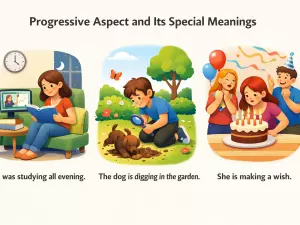
Progressive Aspect and Its Special Meanings
The article explains what the progressive aspect really expresses: temporary actions and situations, changes and trends, repeated annoyance, and future arrangements. It also covers stative verbs and exceptions, typical learner mistakes with fixes, and homework practice tasks.
Gerunds in English Idioms and Fixed Expressions
The article explains why many English idioms use gerunds, which fixed expressions require -ing, and how they show up in everyday speech. It covers cases where swapping the gerund breaks meaning, gives common spoken examples, shows how to spot fixed phrases, and includes fill-in practice.
Aspect in English Verbs: Simple, Continuous, Perfect
The article explains what aspect means in English grammar, focusing on simple, continuous, and perfect forms and what each one expresses. It shows how to choose aspect by meaning rather than time words, how stative vs dynamic verbs affect aspect, common mistakes, and homework practice tasks.
Previous
1
...
6
7
8
9
10
11
12
13
14
...
124
Next