Search the site
Search
Grammar ▾
▸ Articles
▸ Advanced Grammar
▸ Adjectives & Adverbs
▸ Conjunctions
▸ Conditionals
▸ Determiners
▸ Gerunds & Infinitives
▸ Grammar Practice
▸ Modal Verbs
▸ Nouns
▸ Parts of Speech
▸ Prepositions
▸ Pronouns
▸ Quantifiers
▸ Question Formation
▸ Reported Speech
▸ Verbs
Writing ▾
▸ Punctuation
▸ Sentence Structure
▸ Writing Mistakes
Vocabulary ▾
▸ Visual Vocabulary
▸ Food Vocabulary
▸ People Vocabulary
▸ Places Vocabulary
▸ Hobbies Vocabulary
▸ Home Vocabulary
▸ School Vocabulary
▸ Weather Vocabulary
▸ Basic Vocabulary
▸ General Vocabulary
Speaking ▾
▸ Conversational English
Calculators
Contacts
Home
»
English
»
Grammar
Grammar
This section focuses on English grammar explained in a simple and practical way. You will find clear rules, step-by-step examples, and common mistakes to avoid, helping you build a strong foundation for speaking and writing confidently.
Gerund vs Infinitive: Key Differences and Rules
Learn why some English verbs take a gerund and others an infinitive, and how switching forms can change the meaning of a sentence. Get lists of common verbs for each pattern, plus verbs that allow both with different meanings. Finish with practical tips and exercises to choose correctly in context.
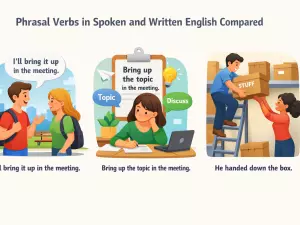
Phrasal Verbs in Spoken and Written English Compared
Learn why phrasal verbs are so common in spoken English, why formal writing often avoids them, and how to replace them in academic style. It also covers register and tone, spoken-only phrasal verbs, learner mistakes, choosing verbs by context, and rewrite homework.
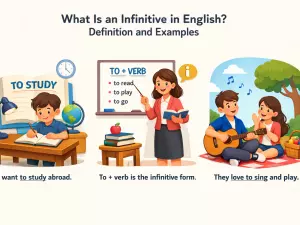
What Is an Infinitive in English? Definition and Examples
Learn what an infinitive is, how the to + verb form works, and how it differs from the bare infinitive. See how infinitives act as nouns, adjectives, or adverbs, which verbs commonly take them, and how they show purpose, intention, or result. Spot common mistakes and try practice sentences.
Phrasal Verbs with Get, Take, Put, Come, and Go
The article explains why get, take, put, come, and go form so many phrasal verbs, then lists common examples with meanings and shows how they’re used in everyday English. It also compares literal vs idiomatic uses, highlights typical learner confusion, and ends with homework practice.
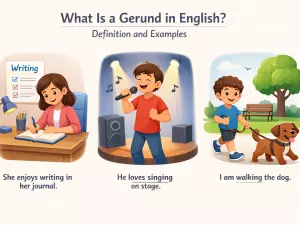
What Is a Gerund in English? Definition and Examples
This article explains what a gerund is and why an -ing form can act as a noun, how to spot gerunds in real sentences, and the roles they play as subject, object, or complement. It also covers verbs and prepositions that trigger gerunds, common learner mistakes, and practice exercises.
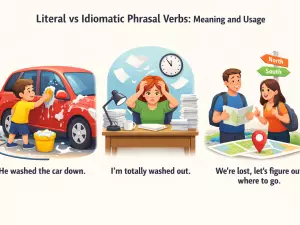
Literal vs Idiomatic Phrasal Verbs: Meaning and Usage
This article explains literal vs idiomatic meanings, how idioms shift meaning, and how to spot literal phrasal verbs. It lists common idiomatic phrasal verbs, shows context clues, flags typical learner mistakes, shares learning strategies, and ends with homework practice.
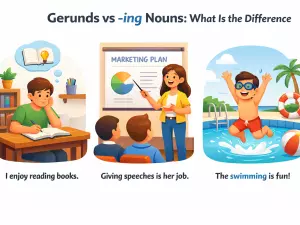
Gerunds vs -ing Nouns: What Is the Difference
This article explains why -ing words can act differently in English, how to spot true gerunds, and how -ing nouns behave like regular nouns. It gives side-by-side sentence examples, practical clues, common learner confusions, and exercises to identify each in context.
Separable and Inseparable Phrasal Verbs Explained
This article explains what separable and inseparable phrasal verbs mean, how to place objects, and why pronouns must go in the middle. It lists common inseparable verbs, shows meaning changes when you split, flags typical mistakes, gives word order tips, and ends with homework practice.
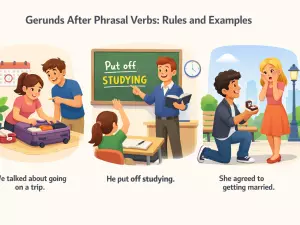
Gerunds After Phrasal Verbs: Rules and Examples
Explains why many phrasal verbs are followed by gerunds, lists common ones that require -ing, and shows the sentence structure. It also explains how meaning stays consistent, flags mistakes with give up, keep on, end up, and gives tips plus fill-in practice exercises.
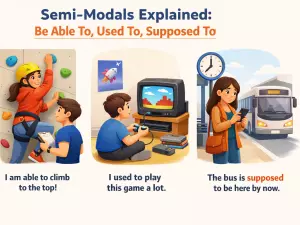
Semi-Modals Explained: Be Able To, Used To, Supposed To
This article explains what semi-modals are in English, then shows how be able to expresses ability, used to describes past habits and states, and supposed to covers obligation and expectation. It also reviews tense forms, negatives, questions, common confusion, and homework practice tasks.
Previous
1
...
9
10
11
12
13
14
15
16
17
...
124
Next