Search the site
Search
Grammar ▾
▸ Articles
▸ Advanced Grammar
▸ Adjectives & Adverbs
▸ Conjunctions
▸ Conditionals
▸ Determiners
▸ Gerunds & Infinitives
▸ Grammar Practice
▸ Modal Verbs
▸ Nouns
▸ Parts of Speech
▸ Prepositions
▸ Pronouns
▸ Quantifiers
▸ Question Formation
▸ Reported Speech
▸ Verbs
Writing ▾
▸ Punctuation
▸ Sentence Structure
▸ Writing Mistakes
Vocabulary ▾
▸ Visual Vocabulary
▸ Food Vocabulary
▸ People Vocabulary
▸ Places Vocabulary
▸ Hobbies Vocabulary
▸ Home Vocabulary
▸ School Vocabulary
▸ Weather Vocabulary
▸ Basic Vocabulary
▸ General Vocabulary
Speaking ▾
▸ Conversational English
Calculators
Contacts
Home
»
English
»
Grammar
Grammar
This section focuses on English grammar explained in a simple and practical way. You will find clear rules, step-by-step examples, and common mistakes to avoid, helping you build a strong foundation for speaking and writing confidently.
Using Conjunctions to Control Paragraph Cohesion
The article explains cohesion in advanced writing, focusing on how conjunctions link sentences and ideas. It covers choosing connectors based on paragraph goals, avoiding repetition, and includes academic examples and practice exercises.
Build Long Sentences Using 3–4 Conjunctions (Advanced)
Here we how to join multiple ideas in one sentence, select the right conjunctions for complex logic, organize subordinate clauses, and balance clarity with length. It also provides examples and practice for building longer sentences.
Advanced Editing Test: Improve Logic with Better Conjunctions
The article explains how to identify and replace weak conjunctions, select stronger alternatives for clarity, edit paragraphs for an academic tone, review before-and-after examples, and practice editing an advanced-level passage.
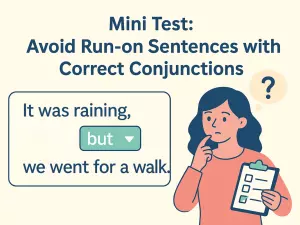
Mini Test: Avoid Run-on Sentences with Correct Conjunctions
This article explains common causes of run-on and comma-splice errors, how to use conjunctions to link clauses, and when to use punctuation or separate sentences. It includes a test, a paragraph rewrite task, and answer explanations.
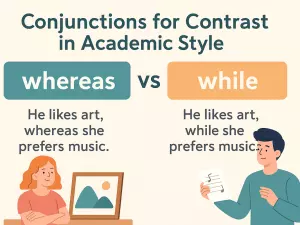
Conjunctions for Contrast in Academic Style: whereas vs while
Here we the difference between contrastive and temporal uses of while, explains why whereas is preferred for formal comparisons, and offers tips to avoid ambiguity. It also provides examples and practice revising unclear while-clauses.
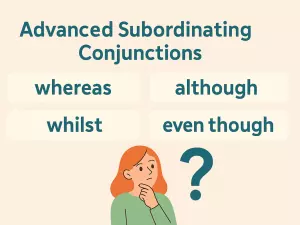
Advanced Subordinating Conjunctions: whereas, whilst, although, even though
Here we how advanced subordinating conjunctions such as whereas, whilst, although, and even though affect sentence meaning, their distinct functions and regional uses, their role in argument structure, and practical ways to use them in formal writing.
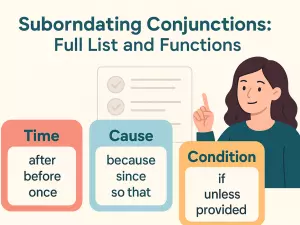
Subordinating Conjunctions: Full List and Functions
The article compares main and subordinate clauses, defines subordinating conjunctions, and reviews common types like because, if, and although. It explains their uses, word order, punctuation rules, and offers practice matching each subordinator to its function.
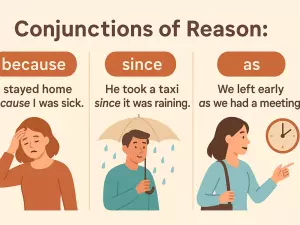
Conjunctions of Reason: because, since, as (full comparison)
This article explains how to use reason clauses in English, focusing on because, since, and as. It covers their differences in meaning, tone, and punctuation, and offers practice choosing the right conjunction for each situation.
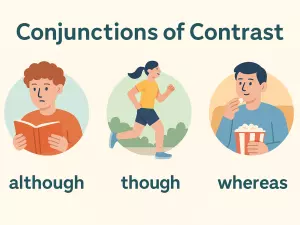
Conjunctions of Contrast: although, though, whereas
The article explains how to express contrast using although, though, and whereas, including their specific uses, sentence placement, and comma rules. It also provides practice exercises for rewriting sentences with different contrast conjunctions.
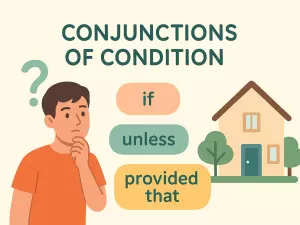
Conjunctions of Condition: if, unless, provided that
The article explains conditional meaning in grammar, details zero and first conditionals with if, shows how unless and provided that are used, compares if and unless, and highlights differences between spoken and written English. Practice exercises are included.
Previous
1
...
70
71
72
73
74
75
76
77
78
...
124
Next