Search the site
Search
Grammar ▾
▸ Articles
▸ Advanced Grammar
▸ Adjectives & Adverbs
▸ Conjunctions
▸ Conditionals
▸ Determiners
▸ Gerunds & Infinitives
▸ Grammar Practice
▸ Modal Verbs
▸ Nouns
▸ Parts of Speech
▸ Prepositions
▸ Pronouns
▸ Quantifiers
▸ Question Formation
▸ Reported Speech
▸ Verbs
Writing ▾
▸ Punctuation
▸ Sentence Structure
▸ Writing Mistakes
Vocabulary ▾
▸ Visual Vocabulary
▸ Food Vocabulary
▸ People Vocabulary
▸ Places Vocabulary
▸ Hobbies Vocabulary
▸ Home Vocabulary
▸ School Vocabulary
▸ Weather Vocabulary
▸ Basic Vocabulary
▸ General Vocabulary
Speaking ▾
▸ Conversational English
Calculators
Contacts
Home
»
English
»
Grammar
Grammar
This section focuses on English grammar explained in a simple and practical way. You will find clear rules, step-by-step examples, and common mistakes to avoid, helping you build a strong foundation for speaking and writing confidently.
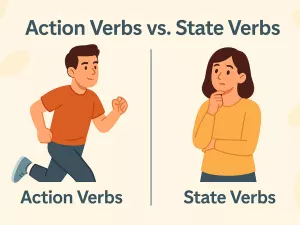
Action Verbs vs State Verbs: Easy Guide
This article explains action verbs and state verbs, how their meanings can change, and when state verbs can be used in the continuous tense. It also lists verbs used both ways, gives real-life examples, and includes practice exercises.
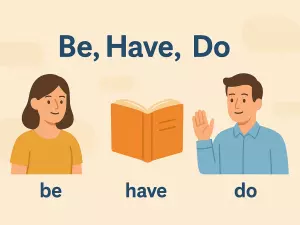
Be, Have, Do: The Three Essential Verbs for A1 Learners
This article explains why be, have, and do are vital for A1 English learners. It covers how to use am, is, are, have, have got, do, and does in sentences, questions, and negatives, plus tips on word order, agreement, and common mistakes.
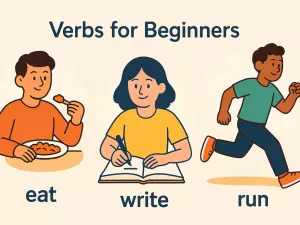
Verbs for Beginners: What They Are and How They Work
This article explains what verbs are, how to use their base and -s forms, and when to use be, have, and do as main or helper verbs. It also covers negatives, questions, simple present word order, and common mistakes.
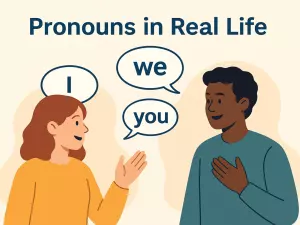
Pronouns in Real Life: The Quick Trick to Sound Natural
This article explains how to use pronouns in everyday situations, choose the right pronoun for clarity, use contractions and singular they, avoid ambiguous references, fix common mistakes, and practice with mini dialogues.
Common Pronoun Mistakes and How to Fix Them
This article tackles common pronoun mistakes, including subject vs object confusion, its vs it's, their vs they're vs there, and unclear references. It explains when to use he, she, or they, and offers quick fixes and practice exercises.
Avoiding Repetition: How Pronouns Make Sentences Clear
Here we the importance of avoiding repetition, shows how to use pronouns instead of nouns, explains how to keep pronoun references clear, and offers examples and practice to help avoid ambiguous pronouns in writing.
Pronouns for Things and People: Which Word to Choose?
This article explains how to choose the right pronouns for people, things, and animals. It covers he, she, they, it, and singular they, with examples and practice exercises to help you use modern English pronouns correctly.
Indefinite Pronouns: Someone, Anyone, Everyone, No One
This article explains indefinite pronouns, comparing positive and negative forms like someone, anyone, everyone, no one, and nobody. It discusses formal and informal usage, common mistakes, and includes practice exercises for clarity.
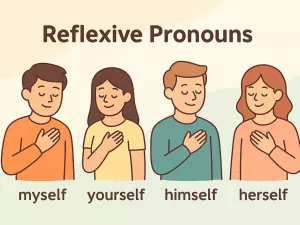
Reflexive Pronouns: Myself, Yourself, Himself...
This article explains reflexive pronouns, their different forms, and when to use them. It also covers the difference between emphasis and reflexive meaning, highlights common mistakes, and provides practice exercises.
Demonstrative Pronouns: This, That, These, Those
Explore demonstrative pronouns like this, that, these, and those to distinguish between singular and plural, near and far. Learn their usage in real-life situations involving objects, places, and time, and discover how to avoid common mistakes.
Previous
1
...
115
116
117
118
119
120
121
122
123
124
Next