Search the site
Search
Grammar ▾
▸ Articles
▸ Advanced Grammar
▸ Adjectives & Adverbs
▸ Conjunctions
▸ Conditionals
▸ Determiners
▸ Gerunds & Infinitives
▸ Grammar Practice
▸ Modal Verbs
▸ Nouns
▸ Parts of Speech
▸ Prepositions
▸ Pronouns
▸ Quantifiers
▸ Question Formation
▸ Reported Speech
▸ Verbs
Writing ▾
▸ Punctuation
▸ Sentence Structure
▸ Writing Mistakes
Vocabulary ▾
▸ Visual Vocabulary
▸ Food Vocabulary
▸ People Vocabulary
▸ Places Vocabulary
▸ Hobbies Vocabulary
▸ Home Vocabulary
▸ School Vocabulary
▸ Weather Vocabulary
▸ Basic Vocabulary
▸ General Vocabulary
Speaking ▾
▸ Conversational English
Calculators
Contacts
Home
»
English
»
Grammar
Grammar
This section focuses on English grammar explained in a simple and practical way. You will find clear rules, step-by-step examples, and common mistakes to avoid, helping you build a strong foundation for speaking and writing confidently.
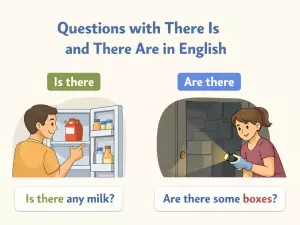
Questions with There Is and There Are in English
Here we how to use there is and there are in English, including yes/no and WH-questions, singular and plural forms, correct word order, short answers, common mistakes, and provides practice exercises to check your understanding.
How to Form Questions in English: Word Order Rules
This article explains English question word order, comparing statements and questions, showing where to place auxiliary and be verbs, and how to use WH-words. It also highlights common mistakes and provides exercises for practice.
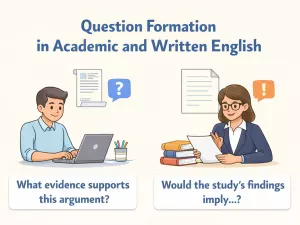
Question Formation in Academic and Written English
Here we how to use effective question styles in academic English, including formal and indirect structures. It discusses proper question use in essays, assignments, and exams, highlights common mistakes, and offers practice exercises for improvement.
Questions with Gerunds and Infinitives in English
Here we how to form questions with gerunds and infinitives, explains verbs that change meaning, and when to use each form. It also highlights common mistakes, differences in formal and informal usage, and includes practice exercises with self-checks.
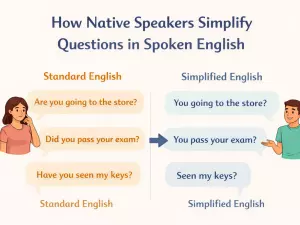
How Native Speakers Simplify Questions in Spoken English
This article explains why native English speakers simplify questions, often by shortening forms or dropping auxiliary verbs in speech. It covers intonation, common patterns, yes/no questions, context-based queries, and includes practice exercises.
Questions in Formal and Informal English Compared
The article compares formal and informal English questions, focusing on word order, auxiliaries, and modals. It also covers politeness techniques, common style errors, and offers practice exercises for both spoken and written questions.
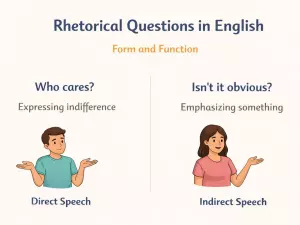
Rhetorical Questions in English: Form and Function
This article explains what rhetorical questions are, their purpose, common structures, and how they differ from real questions. It covers their use in speech and writing, tone and emphasis, common learner mistakes, and includes practice exercises.
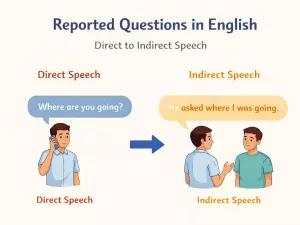
Reported Questions in English: Direct to Indirect Speech
This article explains reported questions, the difference between direct and indirect questions, and how to change word order, tense, pronouns, and time expressions. It also covers reported yes/no and WH-questions, common mistakes, and includes practice exercises.
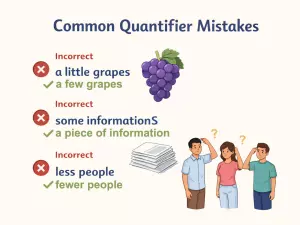
Common Quantifier Mistakes English Learners Often Make
This article explains why quantifiers often cause errors, such as confusion with countable and uncountable nouns, overgeneralizing rules, register mistakes, and translation errors. It includes examples and practice with error correction.
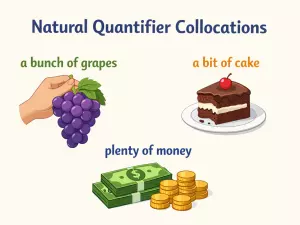
Natural Quantifier Collocations in Modern English Usage
This article explains what collocations are, why they’re important, and highlights common quantifier–noun pairings. It covers usage patterns, fixed versus flexible collocations, typical learner mistakes, and gives practical examples and tips.
Previous
1
...
25
26
27
28
29
30
31
32
33
...
124
Next