Search the site
Search
Grammar ▾
▸ Articles
▸ Advanced Grammar
▸ Adjectives & Adverbs
▸ Conjunctions
▸ Conditionals
▸ Determiners
▸ Gerunds & Infinitives
▸ Grammar Practice
▸ Modal Verbs
▸ Nouns
▸ Parts of Speech
▸ Prepositions
▸ Pronouns
▸ Quantifiers
▸ Question Formation
▸ Reported Speech
▸ Verbs
Writing ▾
▸ Punctuation
▸ Sentence Structure
▸ Writing Mistakes
Vocabulary ▾
▸ Visual Vocabulary
▸ Food Vocabulary
▸ People Vocabulary
▸ Places Vocabulary
▸ Hobbies Vocabulary
▸ Home Vocabulary
▸ School Vocabulary
▸ Weather Vocabulary
▸ Basic Vocabulary
▸ General Vocabulary
Speaking ▾
▸ Conversational English
Calculators
Contacts
Home
»
English
»
Grammar
Grammar
This section focuses on English grammar explained in a simple and practical way. You will find clear rules, step-by-step examples, and common mistakes to avoid, helping you build a strong foundation for speaking and writing confidently.
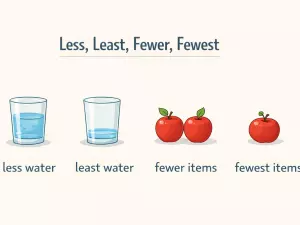
Less vs Least vs Fewer vs Fewest: Forms and Usage Explained
Here we comparative and superlative quantity forms, explains the difference between amount and number, and shows how to use them with countable and uncountable nouns. It also discusses sentence patterns, common mistakes, and provides practice examples.
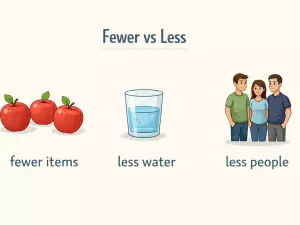
Fewer vs Less: The Rule, the Exceptions, and Real Usage
Here we the traditional rule for fewer and less with countable and uncountable nouns, modern exceptions such as time and money, differences between formal and spoken English, common mistakes, real-life examples, and practice exercises.
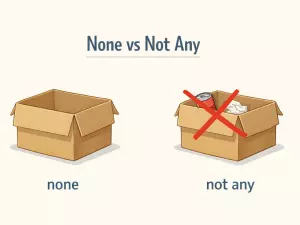
None vs Not Any: Formal and Informal Usage Compared
The article clarifies the meanings of none and not any, compares their use as pronoun or determiner, addresses tone and formality, explains sentence patterns and verb agreement, points out common mistakes, and gives practice choosing the right form in context.
Quantifiers in Questions: Polite Forms vs Direct Forms
Here we how polite and direct questions differ, the role of quantifiers in softening or sharpening tone, and common question patterns. It also covers context, typical learner errors, and provides examples and practice in rewriting questions for tone.
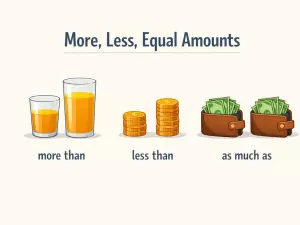
Quantifiers in Comparisons: More Than, Less Than, As Much As
Here we basic comparison structures with quantities, explains how to compare amounts and numbers with countable and uncountable nouns, discusses word order and common errors, and provides examples and practice for building clear comparative sentences.
Using Quantifiers with Time and Money Expressions
Here we when time and money are countable or uncountable, which quantifiers to use with each, how to distinguish between duration and frequency, common learner mistakes, and includes real-life examples and practice exercises.
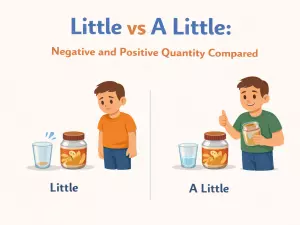
Little vs A Little: Negative and Positive Quantity Compared
Here we the main difference between little and a little, their positive or negative meanings, correct use with uncountable nouns, sentence patterns, how speaker attitude affects meaning, frequent learner mistakes, real-life examples, and practice exercises.
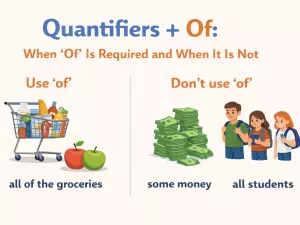
Quantifiers + Of: When “Of” Is Required and When It Is Not
Here we how to use of with quantifiers, including when it is needed before nouns or pronouns, common patterns with words like some and most, typical learner mistakes, and provides examples and practice distinguishing correct usage.
Too Much vs Too Many vs Too: Expressing Excess in English
Here we the core meaning of excess in English, explains how to use too, too much, and too many with countable and uncountable nouns, highlights common mistakes, discusses word order, and gives practical examples and exercises.
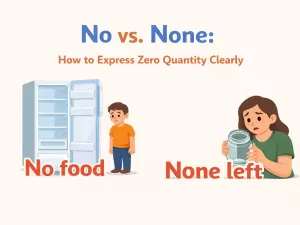
No vs None: How to Express Zero Quantity Clearly
The article explains how to use no and none, showing their roles as determiner and pronoun. It covers agreement rules, double negatives, common errors, and gives clear examples and practice for choosing the correct word in everyday situations.
Previous
1
...
29
30
31
32
33
34
35
36
37
...
124
Next